
For most of her twenties, Kavya believed speed was success. Fast promotions, fast investments, fast decisions. She lived in Bengaluru, worked in tech, and tracked markets the way some people track their steps.
Every alert felt important. Every dip felt personal. She was doing well. Anyone looking at her would say she was financially savvy. Equity-heavy portfolio, SIPs running like clockwork, a few short-term wins she was proud of.
But by the time she turned thirty, something shifted, not in her income, but in her nervous system. She realized that most of her financial decisions were reactive. Based on headlines. Based on trends. Based on what everyone else seemed to be doing. Her money was always moving, but she did not feel settled.
That was the year she asked herself a quieter question. What kind of asset would still make sense if she stopped checking her phone every hour? That question led her away from screens and into soil. At first, farmland felt unrealistic. She had no agricultural background. She did not have time to manage the land. And like most urban professionals, she assumed farmland investment in India was either too risky or too complicated. But managed farmland changed the conversation. Managed farmland allows investors to own agricultural land while professionals handle operations such as planting, irrigation, maintenance, and long-term planning. The land works quietly in the background, without demanding daily attention for someone like Kavya, which matters.
She started reading about farmland as an asset class. About how land appreciates differently from stocks. About how agricultural land has utility beyond price. About how food demand is not a trend; it is a constant.
That is when she came across Mogg’s Estates. What stood out was not flashy returns or aggressive timelines. It was the calm confidence of the approach. Focus on sustainability, transparent ownership, and thoughtfully planned, managed farmland projects. No urgency, no fear-based selling. Just long-term thinking.
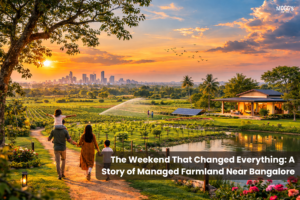
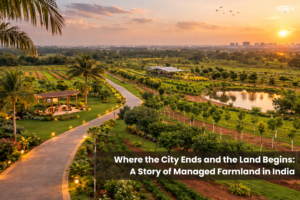
Kavya visited one of their managed farmland developments. It was quiet. Green. Nothing about it screamed investment opportunities. And that is precisely why it worked. She walked the trails, watched irrigation systems run, and spoke to the team about how the land would be managed over the years.
For the first time in a long while, money did not feel abstract. It felt physical. She invested. Not a massive amount. Not everything she had. Just enough to know that a part of her wealth was no longer living on a screen.
What surprised her most was not the returns. It was the mental shift. She stopped obsessing over daily market movements. She stopped comparing her portfolio to others. She knew that while markets would rise and fall, her land would still be there, growing, resting, compounding in its own way. This is something many investors underestimate: the emotional stability that comes with owning tangible assets.
In India, land has always carried meaning. Not just as property, but as security, as something tangible you can pass on. Modern investors often forget this in the rush to optimize returns. Managed farmland bridges that gap. It allows urban professionals to participate in land ownership without giving up their lifestyles.
You do not need to quit your job. You do not need farming knowledge. You do not need to spend weekends managing land. That is the value Mogg’s Estates focuses on. Their managed farmland projects in Bangalore are designed for people who want diversification, stability, and a long-term horizon. People who understand that not all wealth needs to be fast.
Over time, Kavya noticed another change. Her relationship with money softened. She started planning in decades instead of quarters. She became more selective about where she put her money. She stopped chasing what was popular and began building what felt right. Farmland did not replace her other investments. It balanced them.
That balance is the real advantage. In a portfolio filled with volatile assets, farmland behaves differently. It does not correlate directly with stock markets. It does not rely on speculation. It derives value from land scarcity, agricultural productivity, and long-term demand.
This is why farmland investment in India is increasingly viewed as a strategic asset rather than an emotional one, especially when professionally managed.
Kavya also realized that farmland investment had lifestyle benefits. She started visiting her plots occasionally. Walking the trails, feeling the soil, watching the trees grow. It gave her a sense of connection she had never felt with apartments or digital portfolios.
Owning land felt like owning time itself. This was particularly meaningful for young professionals in cities like Bengaluru. Surrounded by concrete and constant notifications, finding a piece of nature that also functioned as an asset was rare.
Managed farmland is different from traditional real estate investment. Apartments depreciate, require constant maintenance, and often sit idle. Farmland, when professionally managed, quietly appreciates, yields agricultural products, and provides long-term security.
Kavya understood that she was not chasing the next trend. She was building a foundation. That foundation could support her goals, her lifestyle, and eventually, her legacy.
Mogg’s Estates understands this modern investor mindset. Their projects integrate sustainability, transparency, and professional operations. Investors own farmland without worrying about daily management.
The land is irrigated, maintained, and cultivated in accordance with long-term agricultural planning. This removes the traditional barriers that urban investors face when entering the farm sector.
Kavya started to notice subtle changes in her life. She spent more weekends offline, walking through the land, observing seasonal changes. She became more aware of the environment and the food she consumed. Her sense of achievement no longer depended on market trends or social media comparisons.
The farmland investment gave her a tangible anchor in an unpredictable financial world. This is one of the overlooked benefits of managed farmland: it provides emotional returns as well as economic stability.
Farmland investment also opens doors to intergenerational wealth creation. Unlike volatile equities, farmland can be passed down, preserved, and appreciated over the course of decades. Kavya realized that she was not just thinking about herself. She was thinking about the family she might have one day, and the values she wanted to pass on.
Investing in managed farmland was more than a financial decision; it was a lifestyle choice, a conscious step toward grounded wealth.
By the time Kavya reached her mid-thirties, she had diversified her portfolio across stocks, mutual funds, and digital assets. But the corner of her wealth invested in managed farmland through Mogg’s Estates remained steady. She could check her phone less often, sleep better, and focus on her work without the constant anxiety of market fluctuations.
Farmland had become her personal anchor, a quiet reminder that patience pays.
The story of Kavya reflects a broader trend among urban professionals in India. Managed farmland is gaining attention because it aligns with lifestyle aspirations, long-term financial goals, and the need for emotional security. Professionals are beginning to understand that true wealth is not just numbers on a screen; it is tangible, productive, and enduring. Farmlands near Bangalore meets all three criteria.
Her journey also highlights an important lesson: high income does not automatically lead to financial freedom. Without careful allocation, even a substantial salary can feel fragile. Investing in managed farmland allows urban professionals to convert part of their active income into passive, resilient assets.
The land grows independently, generates agricultural yield, and appreciates steadily, creating a foundation that supports other investments. This is a cornerstone of modern retirement planning and wealth creation in India.
Kavya often reflects on the choice she made. The mental calm, the connection to nature, and the steady growth of her managed farmland investment remind her that wealth is most potent when it is grounded. Land ownership is not about speculation or hype. It is about building security, creating a legacy, and experiencing the satisfaction of tangible, long-term growth.
At Mogg’s Estates, this philosophy guides every project. They focus on creating farmland investment opportunities that are professionally managed, sustainable, and accessible to urban investors. The goal is not short-term returns, but lasting value. Investors like Kavya can enjoy the benefits of farmland ownership without becoming farmers themselves.
As Kavya’s story shows, the most intelligent financial decisions are often quiet. They are patient. They allow your wealth to grow in the background while your life continues. Managed farmland offers this rare combination of stability, growth, and peace of mind. It is no wonder that urban professionals are increasingly turning to cropland as a strategic investment.
Her journey from chasing fast returns to building roots demonstrates a broader lesson: financial growth is significant, but emotional and lifestyle stability are equally valuable. With managed farmland, investors can balance both. They can diversify their portfolios, secure their future, and reconnect with the environment.
Kavya’s choice to invest in farmland through Mogg’s Estates is more than a financial decision; it is a statement. A commitment to patience, sustainability, and real value. It is a reminder that sometimes, the most meaningful investments are the ones that do not require constant attention, the ones that grow quietly, steadily, and reliably.
For anyone wondering how to start their own journey in wealth creation, Kavya’s story offers a blueprint. Choose assets that provide long-term value, professional management, and emotional satisfaction. Consider managed farmland as a core part of your portfolio. Think beyond short-term returns, and invest in something that grows with time.
Kavya’s journey is ongoing. Every visit to her land reinforces the wisdom of her choice. Every season of growth reminds her that patience and foresight pay off. In a world that rewards speed, she has discovered the value of slow, steady, and grounded investment.
Managed farmland with Mogg’s Estates has not only given her financial security but also a lifestyle she cherishes, a connection to nature, and a sense of legacy.