Water has always been the lifeline of agriculture. Yet today, farmers across the world face an undeniable reality: water is no longer an unlimited resource. Changing climate patterns, unpredictable rainfall, and increasing demand have made efficient water management not just an option, but a necessity. This is where water-wise farming steps in, transforming traditional agricultural practices into intelligent, sustainable systems built for the future.
Smart irrigation is at the heart of this transformation. It is not merely about watering crops; it is about delivering the right amount of water, at the right time, in the right way. The result? Healthier soil, stronger yields, reduced waste, and long-term sustainability.
As modern investors and landowners explore opportunities such as managed and premium farmland near Bangalore, understanding how smart irrigation reshapes agriculture is more important than ever.
The Growing Need for Water-Wise Agriculture
Agriculture consumes nearly 70% of global freshwater resources. Traditional irrigation methods, such as flood irrigation, often lead to excessive runoff, evaporation, and soil degradation. In many regions, more than half of the water used never actually benefits the crops.
Water-wise farming challenges this inefficiency.
Instead of relying on outdated techniques, sustainable farms are adopting systems that treat water as a strategic asset. Every drop is measured, monitored, and optimized.
This shift is especially critical in fast-growing regions where urban expansion and agricultural demand compete for the same resources. For buyers searching for the best farmland near Bangalore, water security has become one of the most important indicators of long-term land value.
After all, fertile soil means little without reliable water management.
What Is Smart Irrigation?
Smart irrigation combines technology, data, and ecological awareness to create precision-driven farming environments. Unlike conventional methods, these systems respond dynamically to real-time conditions such as:
- Soil moisture levels
- Weather forecasts
- Crop type
- Growth stage
- Temperature and humidity
Sensors placed in the soil communicate with automated irrigation networks, ensuring crops receive exactly what they need, nothing more, nothing less.
Think of it as moving from guesswork to intelligence.
The benefits extend far beyond water conservation. Farmers experience lower operational costs, improved crop quality, and reduced dependence on unpredictable rainfall.
For managed farmland projects, this technological backbone enhances both productivity and investor confidence.
Key Smart Irrigation Techniques Transforming Farms
1. Drip Irrigation: Precision at the Root
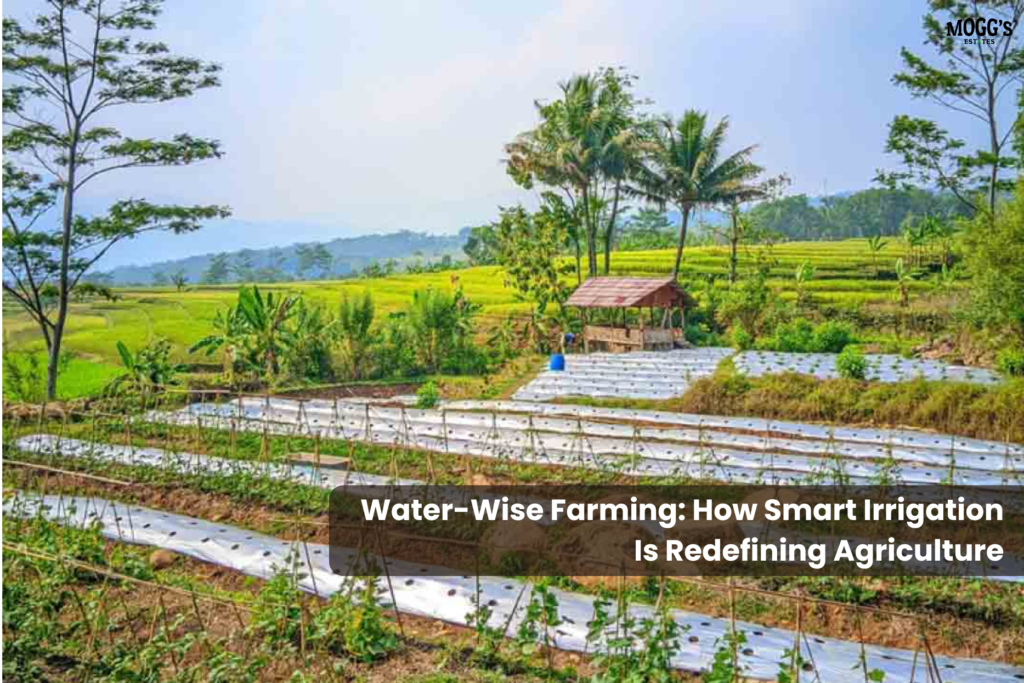
Drip irrigation delivers water directly to the plant’s root zone through a network of tubes and emitters. This minimizes evaporation and prevents water from nourishing weeds.
Why it matters:
- Uses up to 60% less water
- Improves nutrient absorption
- Reduces soil erosion
- Supports consistent crop growth
On premium managed farmland, drip systems are quickly becoming the gold standard for sustainable cultivation.
2. Soil Moisture Sensors: Farming That Listens to the Land
Overwatering can be just as damaging as drought. Soil moisture sensors eliminate the uncertainty by providing real-time data.
When the soil has sufficient moisture, irrigation pauses automatically. When levels drop, watering resumes.
This creates a balanced ecosystem where plants thrive without stressing natural resources.
For farmland near Bangalore, where seasonal variations can be significant, this technology provides a powerful safeguard against the unpredictability of the climate.
3. Weather-Based Controllers: Predict Before You Pour
Why irrigate before a rainstorm?
Weather-integrated irrigation systems analyze forecasts and adjust watering schedules accordingly. If rainfall is expected, the system delays irrigation to prevent waste.
Over time, this predictive approach saves enormous volumes of water while maintaining optimal soil conditions.
It is sustainability powered by foresight.
4. Rainwater Harvesting: Turning Nature Into Infrastructure
Water-wise farms do not rely solely on external sources. They capture and store rainwater, building self-sufficient ecosystems capable of supporting crops even during dry spells.
Harvested water can replenish groundwater, stabilize irrigation supply, and reduce dependency on municipal or tanker sources.
For investors evaluating the best farmland near Bangalore, properties with integrated rainwater harvesting often signal stronger long-term resilience.
Sustainability Meets Profitability
A common misconception is that sustainable farming sacrifices profitability. In reality, the opposite is often true.
Smart irrigation reduces input costs while increasing yield stability, a rare combination in agriculture.
Here’s how water-wise farming strengthens financial performance:
- Lower electricity usage due to optimized pumping
- Reduced fertilizer loss from runoff
- Fewer crop failures
- Higher-quality produce
- Greater land appreciation
This is why environmentally responsible farmland is increasingly viewed as a future-ready asset rather than a niche investment.
Managed farmland projects that priorities water intelligence are not just protecting the environment; they are protecting returns.
The Rise of Premium Managed Farmland
Today’s farmland buyers are not only looking for scenic plots; they are searching for infrastructure, expertise, and sustainability.
Premium managed farmland delivers exactly that by integrating:
- Scientific irrigation planning
- Crop strategy
- Soil health management
- Professional farm operations
- Long-term ecological vision
Projects developed by experienced providers such as Mogg’s Estates focus on creating agricultural environments where productivity and sustainability coexist.
Instead of leaving landowners to navigate farming complexities on their own, managed models ensure advanced irrigation systems and responsible water practices are implemented from day one.
For urban professionals seeking farmland near Bangalore, this approach removes uncertainty while enhancing long-term value.
Why Water Security Is the New Farmland Currency
Historically, location determined farmland’s worth. Today, water security is emerging as an equally powerful metric.
Land supported by intelligent irrigation is better equipped to handle:
- Erratic monsoons
- Rising temperatures
- Groundwater fluctuations
- Regulatory changes
In contrast, farms dependent on outdated watering methods face increasing operational risks.
This is one reason the best farmland near Bangalore is often associated with projects that prioritise sustainable infrastructure rather than short-term yield.
Because in agriculture, resilience is wealth.
Environmental Impact That Extends Beyond the Farm
Water-wise farming does more than support crops; it protects entire ecosystems.
Efficient irrigation helps:
- Prevent groundwater depletion
- Reduce chemical runoff into nearby water bodies
- Maintain soil biodiversity
- Lower carbon footprint
- Encourage regenerative land practices
Over time, sustainable farms can transform landscapes, turning previously stressed land into thriving green zones.
For many landowners, this creates something deeply meaningful: the opportunity to become stewards of the earth while building a tangible legacy.
Technology + Nature: The Future of Agriculture
The farms of tomorrow will not look like those of the past.
They will be data-driven yet deeply connected to natural cycles and automated yet environmentally conscious. Highly productive yet resource-efficient.
Smart irrigation is just the beginning.
Emerging innovations include AI-driven crop modelling, satellite-based moisture tracking, and fully automated fertigation systems that combine watering with nutrient delivery.
Managed farmland providers are increasingly integrating these technologies to ensure farms remain viable for decades, not just seasons.
In regions experiencing rapid growth, such as the areas surrounding Bangalore, this fusion of technology and sustainability is shaping a new agricultural narrative.
Choosing Farmland That Is Ready for Tomorrow
If you are considering premium managed farmland, water infrastructure should be one of your top evaluation criteria.
Ask questions like:
- Does the land have modern irrigation systems?
- Are water sources renewable?
- Is rainwater harvesting integrated?
- How is usage monitored and optimized?
- Is the farm designed for long-term sustainability?
Forward-thinking developers like Mogg’s Estates recognize that future-ready farmland must go beyond fertile soil; it must be engineered for resilience.
Because the farms that will thrive tomorrow are being designed today.
A Smarter Way Forward
Water-wise farming represents a powerful shift in how we view agriculture. It replaces excess with efficiency, uncertainty with intelligence, and short-term thinking with generational vision.
For buyers exploring farmland near Bangalore, this evolution offers a compelling opportunity to invest not just in land, but in a sustainable future.
Managed farmland rooted in smart irrigation is more than an agricultural trend. It is a response to one of the greatest challenges of our time: preserving resources while feeding a growing world.
And perhaps the most inspiring part?
Every intelligently irrigated field proves that progress and preservation can grow side by side.
The future of farming will belong to those who respect water, because where water is valued, life flourishes.