
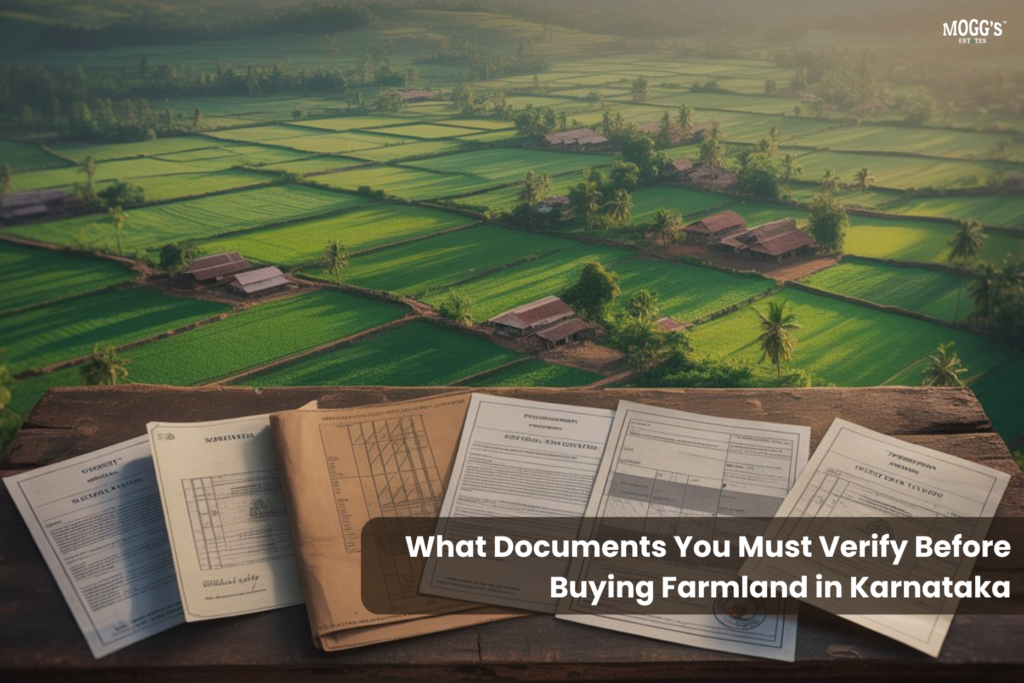
Buying farmland in Karnataka can be a rewarding long-term investment, but it also requires careful legal verification. Unlike apartments or plots in gated layouts, agricultural land has its own set of records, restrictions, and historical details that must be checked thoroughly. Many issues in farmland transactions arise not because the land is bad, but because documents were not appropriately verified.
For anyone exploring farmland ownership, especially urban investors, understanding the documents related to farmland in India is essential. This blog explains the most important documents you must verify before buying farmland in Karnataka, why each one matters, and how they protect your investment.
Why Document Verification Is Crucial in Farmland Purchases
Farmland in Karnataka is governed by state specific land laws, revenue records, and agricultural regulations. Unlike residential property, farmland ownership depends heavily on revenue documents rather than just sale deeds.
Improper verification can lead to disputes related to ownership, land classification, cultivation rights, or even future resale issues. That is why checking RTC land records in Karnataka and other supporting documents is non negotiable.
RTC (Record of Rights, Tenancy and Crops)
What Is RTC
RTC is the most critical land record document in Karnataka. It is officially known as the Record of Rights, Tenancy and Crops and is maintained by the state revenue department.
Why RTC Matters
RTC confirms:
- Name of the current landholder
- Survey number of the land
- Land extent and boundaries
- Type of land, whether agricultural or otherwise
- Crops grown on the land
- Nature of possession
When buying farmland, the seller’s name must be reflected clearly in the RTC. Any mismatch between the RTC and the sale deed is a major red flag.
How to Verify RTC
RTC can be verified online through Karnataka’s Bhoomi portal or physically at the local revenue office. Ensure the RTC is up to date.
Mutation Extract (MR)
What Is Mutation
Mutation records show the transfer of ownership from one party to another after a sale, inheritance, or gift.
Why Mutation Is Important
A registered sale deed alone does not complete ownership. Mutation ensures the buyer’s name is officially entered in revenue records.
Before buying farmland, verify that all prior mutations have been appropriately completed. Pending or disputed mutations indicate unresolved ownership issues.
Many buyers make the mistake of verifying documents only on paper without understanding what those records actually represent on the ground. Farmland documentation in Karnataka is deeply tied to local revenue administration, and even a single mismatch between records can create complications later. This is why experienced investors often treat document verification not as a formality, but as the foundation of the entire investment.
One of the most overlooked aspects of farmland verification is understanding land classification. Agricultural land, conversion status, and land use history must align clearly across RTC, mutation records, and sale deeds. If land is marked as agricultural but shows signs of conversion or non-agricultural use without approval, it can attract penalties or legal notices in the future. This is especially important for buyers planning long-term farmland ownership rather than short-term resale.
Another critical factor is access and right-of-way. Many farmland disputes arise not from ownership issues but from access-related conflicts. Buyers must ensure that approach roads are clearly documented and legally accessible. In Karnataka, traditional access paths sometimes exist informally but are not recorded in revenue documents. Verifying this beforehand avoids future dependency on neighboring landowners.
Water availability is another dimension that documents indirectly reveal. Borewell permissions, irrigation sources, and historical water usage can often be traced through local records and village-level information. While water rights may not always be explicitly mentioned in sale deeds, cross-checking borewell permissions and irrigation entries in revenue records helps assess the land’s long-term viability.
This is where structured farmland projects bring clarity. At Mogg’s Estates, document verification is treated as a multi-layer process rather than a checklist. Every parcel goes through title tracing, revenue record verification, encumbrance checks, and local authority validation before being offered to buyers. This approach reduces risk for investors who may not be familiar with Karnataka’s land record systems.
For first-time farmland buyers, another area of confusion is joint ownership and ancestral claims. Many lands pass through generations without proper partition deeds or updated mutation entries. Even if a seller appears legitimate, missing succession documentation can invite future claims from extended family members. Ensuring a clean title flow with properly recorded inheritance is essential for peaceful ownership.
Encumbrance certificates deserve special attention over longer durations. While many buyers check only the last 10 or 15 years, farmland investments are long-term assets. Extending the EC verification period provides more profound clarity on historical loans, litigations, or unresolved charges. This step is crucial when buying land that has changed hands multiple times.
In managed farmland models, buyers benefit from institutional diligence that individual investors often find challenging to undertake. Mogg’s Estates works closely with legal experts, revenue officials, and local authorities to ensure that every document aligns with regulatory requirements. This allows investors to focus on the value-creation aspect of farmland ownership rather than on legal complexity.
Document verification is not about mistrust. It is about foresight. Farmland is an asset meant to be held for decades, sometimes for generations. A single overlooked detail today can become a costly issue years later. Taking the time to verify every document is not cautionary; it is responsible investing.