If you are planning to buy farmland in Karnataka, one document will come up again and again during discussions, site visits, and legal checks. That document is the RTC.
Many first time land buyers hear the term but do not fully understand its importance. Some assume it is just another formality. Others rely on brokers or sellers without verifying it themselves.
In reality, the RTC is one of the most critical farmland documents in India, especially in Karnataka. It plays a central role in establishing ownership, land usage, and legal clarity.
This blog explains what RTC is, why it matters when buying farmland in Karnataka, and how it protects you as an investor.
What is RTC?
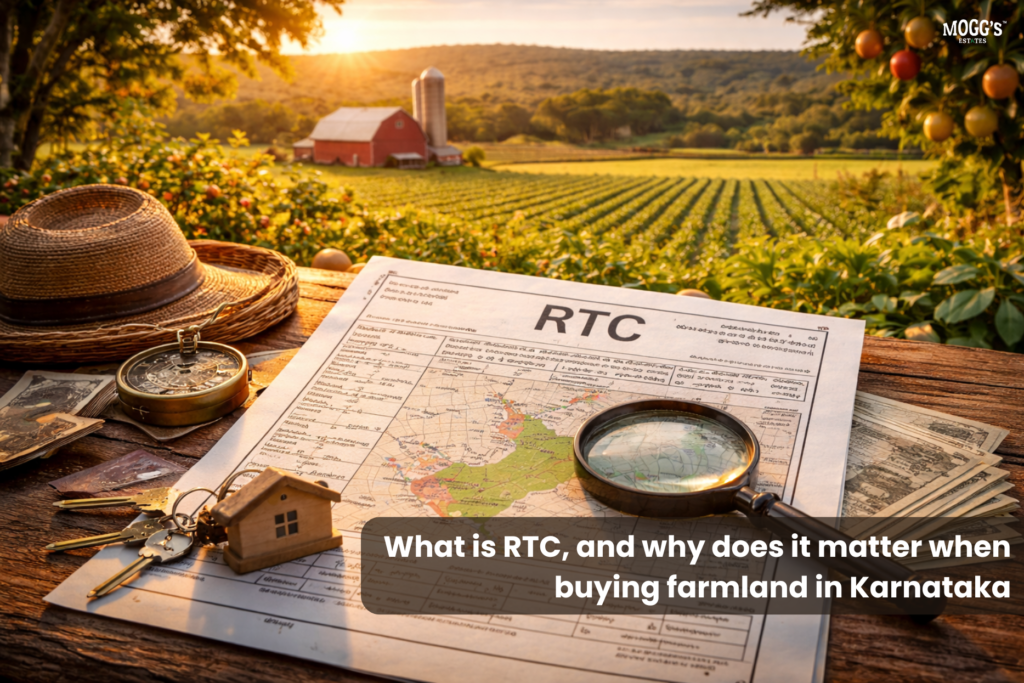
RTC stands for Record of Rights, Tenancy, and Crops. In Karnataka, it is also commonly called the pahani.
It is an official land record maintained by the state government and issued by the revenue department. The RTC contains key information about a specific piece of land.
Simply put, the RTC tells you who owns the land, how the land is classified, and what activity is legally permitted on it.
When people talk about RTC land records Karnataka, they are referring to this document.
Why RTC is crucial when buying farmland in Karnataka:
Farmland transactions are different from apartment or plotted development purchases. Agricultural land comes with specific legal rules, usage conditions, and ownership restrictions.
The RTC acts as the foundation document for all these aspects.
Without a clear and verified RTC, buying farmland becomes risky.
What information does an RTC contain
An RTC is not a single line document. It contains multiple layers of information that together establish the legal status of the land.
Owner details
The RTC lists the name of the landowner as per government records. This helps confirm whether the person selling the land has the legal right to do so.
If the seller’s name does not appear on the RTC, it is a major red flag.
Survey number and location
Each parcel of land in Karnataka has a unique survey number. The RTC maps the land to this survey number along with village, hobli, taluk, and district details.
This ensures there is no confusion about the exact land being purchased.
Land classification
The RTC clearly mentions whether the land is agricultural or non agricultural. This is extremely important.
Only agricultural land can be used for farming. Buying land assuming future conversion without clarity can lead to legal issues.
Extent of land
The total area of the land is specified in acres or guntas. This helps verify that the land being shown on ground matches official records.
Tenancy details
If the land is leased or cultivated by someone other than the owner, this information appears in the RTC.
Tenancy rights can complicate ownership transfer if not addressed properly.
Crop details:
The RTC also records the type of crops grown on the land. This indicates whether the land is actively farmed or left idle.
Active cultivation is generally a positive sign for farmland buyers.
How RTC protects farmland buyers
When buying farmland in Karnataka, the RTC serves as your first layer of legal protection.
Confirms ownership
The RTC verifies who legally owns the land as per government records. This reduces the risk of buying from unauthorised sellers.
Prevents title disputes
Clear RTC records reduce the chances of disputes arising from multiple claims on the same land.
Validates land use
The document confirms whether the land is agricultural and whether farming activities are legally permitted.
Ensures transparency
Because RTCs are maintained by the revenue department, they provide an official and transparent snapshot of the land.
This is why rtc land records Karnataka searches are so common among serious land buyers.
How to check RTC online in Karnataka:
Karnataka has made land records accessible through the Bhoomi portal.
Buyers can check RTC details online using:
District name
Taluk
Hobli
Village
Survey number
The online RTC provides the same core information as the physical document. However, for a transaction, a certified copy is always recommended.
Common mistakes buyers make regarding RTC:
Despite its importance, many buyers misunderstand or ignore RTC checks.
Relying only on verbal assurances.
Sellers may claim clear ownership, but without verifying the RTC, these claims hold no legal weight.
Checking outdated RTC copies.
Land records change with mutations, inheritance, and sales. Always ensure the RTC is updated.
Ignoring tenancy entries.
Tenancy rights can delay or block ownership transfer if not resolved legally.
Confusing RTC with other documents.
RTC is different from encumbrance certificate, sale deed, and khata. Each serves a different purpose.
RTC and managed farmland investments:
For urban investors, managed farmland has become an attractive option. However, legal clarity remains non-negotiable.
At Mogg’s Estates, every farmland project undergoes thorough legal due diligence. RTC verification is a foundational step in this process.
Clear RTC records ensure that:
Ownership is transparent.
Land usage is agricultural.
There are no unresolved tenancy issues.
This allows investors to focus on long term value rather than legal uncertainty.
RTC versus other farmland documents:
While the RTC is critical, it works alongside other farmland documents in India.
Sale deed establishes transfer of ownership. Encumbrance certificate shows financial liabilities. Mutation records update ownership after sale.
Among these, the RTC acts as the base document that validates the land’s legal identity.
Why RTC matters even after purchase:
Many buyers assume RTC is only relevant during purchase. This is not true.
Post purchase, the RTC must be updated through mutation to reflect the new owner’s name.
This ensures:
Legal recognition of ownership
Smooth resale or inheritance
Protection against future disputes
Farmland buying in Karnataka requires patience and verification. Unlike urban property, farmland transactions demand deeper legal understanding. The RTC is your entry point into that understanding. Taking the time to verify RTC details can save years of complications later.
How Mogg’s Estates simplifies farmland ownership:
Mogg’s Estates understands that legal documentation can feel overwhelming for first time farmland investors.
Their managed farmland projects are structured only after:
Verifying RTC and pahani records
Ensuring clear land titles
Eliminating tenancy risks.
Aligning land usage with long term agricultural goals: This approach ensures investors receive farmland that is legally sound and future ready.
Buying farmland in Karnataka is not just a financial decision. It is a legal commitment that demands clarity and caution. The RTC is not just a document. It is proof of ownership, usage, and legitimacy.
Understanding RTC land records Karnataka and their role in farmland documents India empowers buyers to make confident decisions.
Whether you are buying land independently or through a managed farmland platform like Mogg’s Estates, never underestimate the importance of the RTC. Because when it comes to land, clarity is the most valuable asset you can own.