For decades, investors relied on a familiar formula: stocks for growth, real estate for stability, and gold for security. But today, a quiet shift is happening. A growing number of investors are turning their attention to farmland, not just as an asset, but as a sustainable, future-ready investment.
The conversation is no longer only about returns. It is about resilience. It is about environmental responsibility. And most importantly, it is about long-term value creation.
Welcome to the era where farmland is viewed through a sustainability lens.
The Global Shift Toward Sustainable Investing
Sustainability is no longer a trend. It is becoming a core investment principle.
Across the world, investors are evaluating assets based on environmental impact, resource efficiency, and long-term viability. Climate change, water scarcity, soil degradation, and food security are no longer distant concerns. They are real, measurable risks.
Farmland sits at the center of all these issues.
Agriculture directly affects water use, soil health, biodiversity, and carbon cycles. When managed responsibly, farmland can regenerate ecosystems. When neglected, it can deplete them.
This dual power is exactly why farmland is attracting serious attention.
Farmland: A Tangible, Essential Asset
Unlike volatile markets, farmland produces something the world will always need: food.
No matter how technology evolves, people must eat. As the global population grows, the demand for agricultural output increases. This makes farmland a fundamentally essential asset.
But today’s investors are asking deeper questions:
- Is the land water-secure?
- Are farming practices sustainable?
- Is soil health being preserved?
- Is the project designed for long-term productivity?
This is where sustainably managed farmland stands out.
The Rise of Managed Farmland
Traditionally, farmland ownership required agricultural expertise. Investors had to understand crop cycles, irrigation systems, labor management, and market risks.
Now, managed farmland models have changed the game.
Professional operators oversee cultivation, infrastructure, and sustainability practices. Investors can participate in agricultural growth without handling day-to-day farming operations.
Premium managed farmland near Bangalore is gaining traction because it combines:
- Scientific irrigation systems
- Crop planning strategies
- Soil health management
- Water conservation methods
- Long-term land development vision
This structured approach reduces uncertainty and increases transparency, two factors investors value highly.
Sustainability Is Not Just Ethical, It Is Profitable
One of the biggest myths about sustainable agriculture is that it sacrifices profitability.
In reality, sustainable farming often improves financial performance.
Here’s how:
1. Water Efficiency Lowers Costs
Smart irrigation reduces water waste and electricity usage. Efficient systems mean lower operating expenses over time.
2. Healthy Soil Improves Yield Stability
Regenerative practices enhance soil fertility. Strong soil retains nutrients and moisture, which protects crops during dry spells.
3. Reduced Dependency on Chemicals
Balanced ecosystems require fewer chemical inputs, lowering long-term costs and environmental risk.
4. Higher Land Appreciation
Farmland designed with sustainability in mind tends to hold value better. Infrastructure, water security, and professional management increase demand.
When investors look at the best farmland near Bangalore, they are not only examining the location. They are assessing resilience.
Why Bangalore Is Emerging as a Farmland Hotspot
Bangalore’s rapid urban growth has increased interest in peripheral agricultural zones. Investors are exploring farmland near Bangalore for both lifestyle and wealth diversification.
However, proximity alone is not enough.
The real differentiator is infrastructure and sustainability.
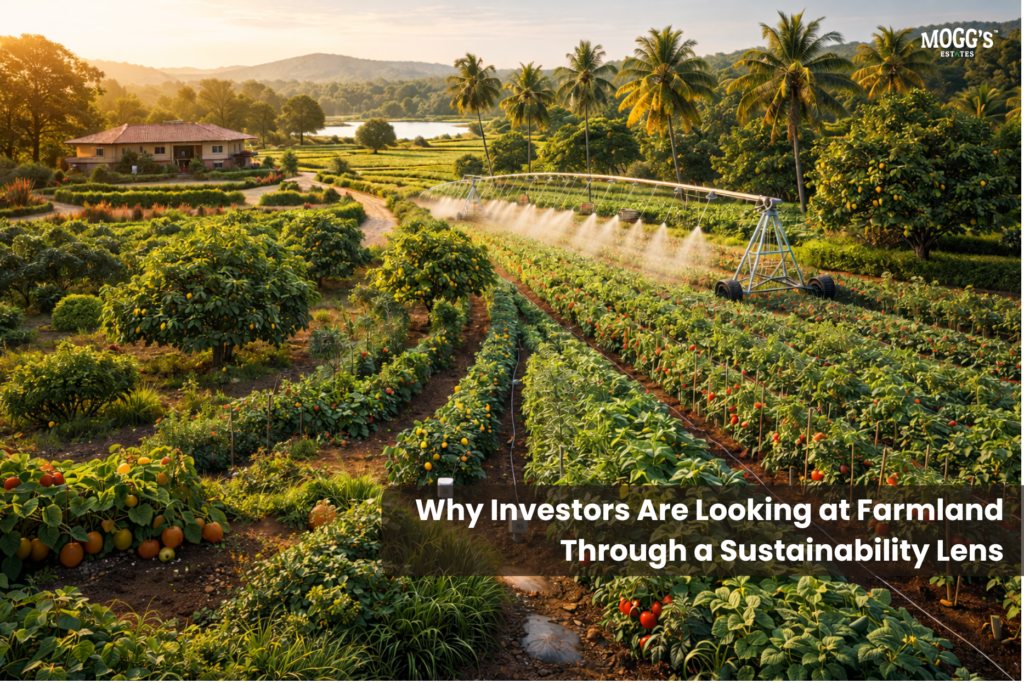
Premium managed farmland projects integrate:
- Drip irrigation
- Rainwater harvesting
- Solar-powered systems
- Crop diversification
- Professional maintenance
These features transform raw land into structured agricultural assets.
Developers such as Mogg’s Estates focus on building ecosystems rather than just selling plots. This approach aligns farmland investment with environmental stewardship.
Climate Risk Is Real, Sustainable Farms Are More Resilient
Climate volatility is reshaping investment strategies. Unpredictable rainfall, rising temperatures, and groundwater depletion can threaten traditional farming operations.
Sustainable farms, however, are built differently.
They rely on:
- Water-efficient irrigation
- Diversified crop selection
- Soil conservation methods
- Long-term land planning
These systems are designed to adapt.
For investors, this reduces operational risk. In uncertain times, resilience becomes a valuable asset.
ESG Investing and Agriculture
Environmental, Social, and Governance (ESG) principles are influencing global capital flows. Institutions and individual investors increasingly evaluate opportunities based on sustainability metrics.
Agriculture plays a key role in ESG alignment because:
- It affects carbon emissions
- It influences water consumption
- It impacts rural livelihoods
- It shapes biodiversity
Managed farmland projects that integrate sustainable practices, which naturally fit into ESG portfolios.
This is another reason farmland is moving from a niche alternative investment to a mainstream consideration.
Beyond Returns: Emotional and Lifestyle Value
Farmland investment offers something few other assets can, a tangible connection to nature.
Urban professionals investing in premium managed farmland near Bangalore often value:
- Weekend retreats
- Green open spaces
- Agricultural participation
- Legacy building
Owning farmland is not only about yield projections. It is about contributing to something productive and sustainable.
In many cases, it becomes a generational asset.
The Scarcity Factor
Land is finite.
As cities expand, agricultural land near major urban centers becomes increasingly scarce. Once converted, farmland rarely returns to agricultural use.
This scarcity creates natural appreciation potential, especially for well-planned projects.
The best farmland near Bangalore is not just fertile; it’s also fertile. It is strategically located, water-secure, and professionally managed.
Investors understand that quality land with sustainable infrastructure will likely outperform unmanaged plots in the long run.
The Role of Water Security
Water is emerging as one of the most critical evaluation factors in farmland investment.
Sustainable farms prioritize:
- Borewell management
- Rainwater harvesting
- Smart irrigation systems
- Soil moisture monitoring
These features ensure productivity even during dry seasons.
Without water security, farmland value can decline rapidly. With it, farmland becomes a stable and dependable asset.
Managed farmland projects led by experienced teams, such as Mogg’s Estates, often incorporate these safeguards from the beginning.
Long-Term Thinking Wins in Agriculture
Unlike short-term market trades, farmland is inherently a long-term asset.
Crops grow in cycles. Soil health improves over time. Trees mature slowly but create enduring value.
Sustainability aligns perfectly with this long-term perspective.
Investors who prioritize regenerative practices and structured management are positioning themselves for steady growth rather than speculative spikes.
In many ways, farmland represents a return to fundamentals, investing in something real, productive, and essential.
Technology Is Strengthening Sustainable Agriculture
Modern farms are not primitive operations. They are increasingly data-driven.
Technologies now include:
- Soil sensors
- Weather-based irrigation controls
- Satellite monitoring
- Automated fertigation systems
These innovations enhance efficiency and reduce waste.
Premium managed farmland projects integrate these systems to maintain consistent quality and productivity.
The combination of technology and sustainability creates a powerful investment model.
A New Definition of Wealth
Wealth is being redefined.
It is no longer measured only in financial returns. It is also measured in impact, stability, and future relevance.
Farmland checks all three boxes:
- It generates agricultural output.
- It offers capital appreciation potential.
- It supports environmental regeneration.
For investors evaluating farmland near Bangalore, the sustainability factor is becoming central to decision-making.
Final Thoughts: Investing in the Future of Food and Land
The shift toward sustainable farmland investing is not accidental. It reflects a deeper understanding of global challenges and opportunities.
Food security, climate resilience, water conservation, and land scarcity are interconnected realities. Farmland sits at the intersection of them all.
Managed farmland models have made agricultural investment more accessible and structured. Premium projects are integrating smart irrigation, ecological planning, and professional management to create stable, long-term assets.
For those exploring the best farmland near Bangalore, sustainability is no longer optional. It is a core investment filter.
Because in a world facing environmental uncertainty, the most powerful investments may be the ones rooted in the soil, nurtured responsibly, managed intelligently, and designed to last for generations.