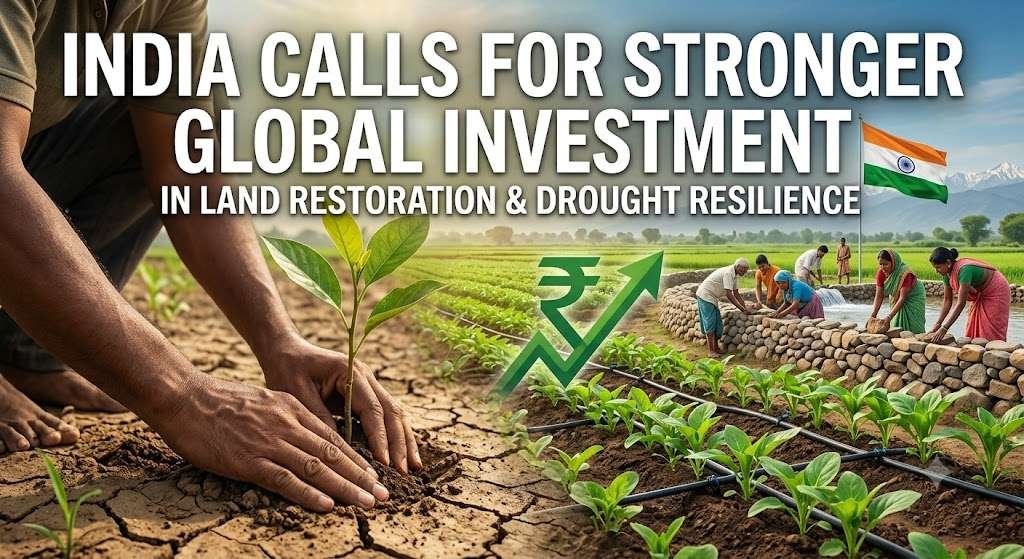
India has called for stronger and more predictable international financing for land restoration and drought resilience, highlighting the growing need to protect agricultural land, water resources and ecosystems from environmental stress.
Speaking at a ministerial dialogue on innovative financial mechanisms for healthy land and drought resilience during the 17th Conference of Parties (COP17) of the UN Convention to Combat Desertification in Ulaanbaatar, Mongolia, Union Environment Minister Bhupender Yadav said land restoration should be viewed as an investment rather than simply a cost.
India’s position comes at a time when land degradation and drought are becoming increasingly important concerns for agriculture and rural communities.
Healthy land supports food production, stores carbon, maintains biodiversity and helps regulate water resources. For farming communities, the condition of the soil can directly influence productivity and resilience during periods of water stress.
The Environment Minister emphasised that investment in land restoration can generate benefits across food security, water security, biodiversity, livelihoods and long-term resilience.
During the dialogue, India highlighted its blended green-finance framework, which is designed to support areas including climate-change adaptation, sustainable land use, forestry, agriculture, afforestation and biodiversity conservation.
The focus on finance is significant because restoring degraded land often requires long-term investment rather than short-term interventions.
For agricultural regions, such investment can support practices that improve soil quality, conserve water and strengthen the ability of farmland to withstand drought and other climate-related pressures.
The discussion also reflects a broader shift in the way agricultural development is being viewed.
Farming depends heavily on natural resources. Soil, water, vegetation and biodiversity form the foundation of productive agricultural landscapes.
India has been promoting several sustainable agriculture approaches, including efficient water use, conservation agriculture, agroforestry, natural farming and climate-resilient agricultural technologies. The government said in August that more than 26 crore Soil Health Cards had been generated, while the National Mission on Natural Farming had covered 11.81 lakh hectares across 24,031 clusters.
These initiatives underline the growing emphasis on maintaining the productivity of agricultural land while reducing pressure on natural resources.
Land restoration is increasingly being considered not only an environmental priority but also an economic one.
Degraded agricultural land can affect crop productivity and rural livelihoods, while healthy landscapes can provide benefits extending beyond farming. Better soil structure, improved water retention, vegetation cover and biodiversity can contribute to the long-term resilience of rural areas.
For investors and policymakers, this creates a broader perspective on agricultural land: its value is connected not only to its present productivity, but also to its ability to remain productive and environmentally sustainable over time.
India’s call for diversified, adequate and predictable international finance comes as countries work towards addressing land degradation, drought and desertification.
The discussions at COP17 highlight the need for governments, financial institutions and the private sector to work together on projects that can restore degraded landscapes while supporting communities that depend on them.
As pressure on land and water resources increases, investment in healthy agricultural ecosystems could become an increasingly important part of sustainable development strategies.
The message emerging from the discussions is straightforward: protecting land is also an investment in the future of food, water and rural economies.
For India, where agriculture remains closely connected with natural resources and rural livelihoods, stronger investment in land restoration could play an important role in building more resilient farmland and communities.
Source: News on AIR, August 24, 2026; Press Information Bureau, Government of India.