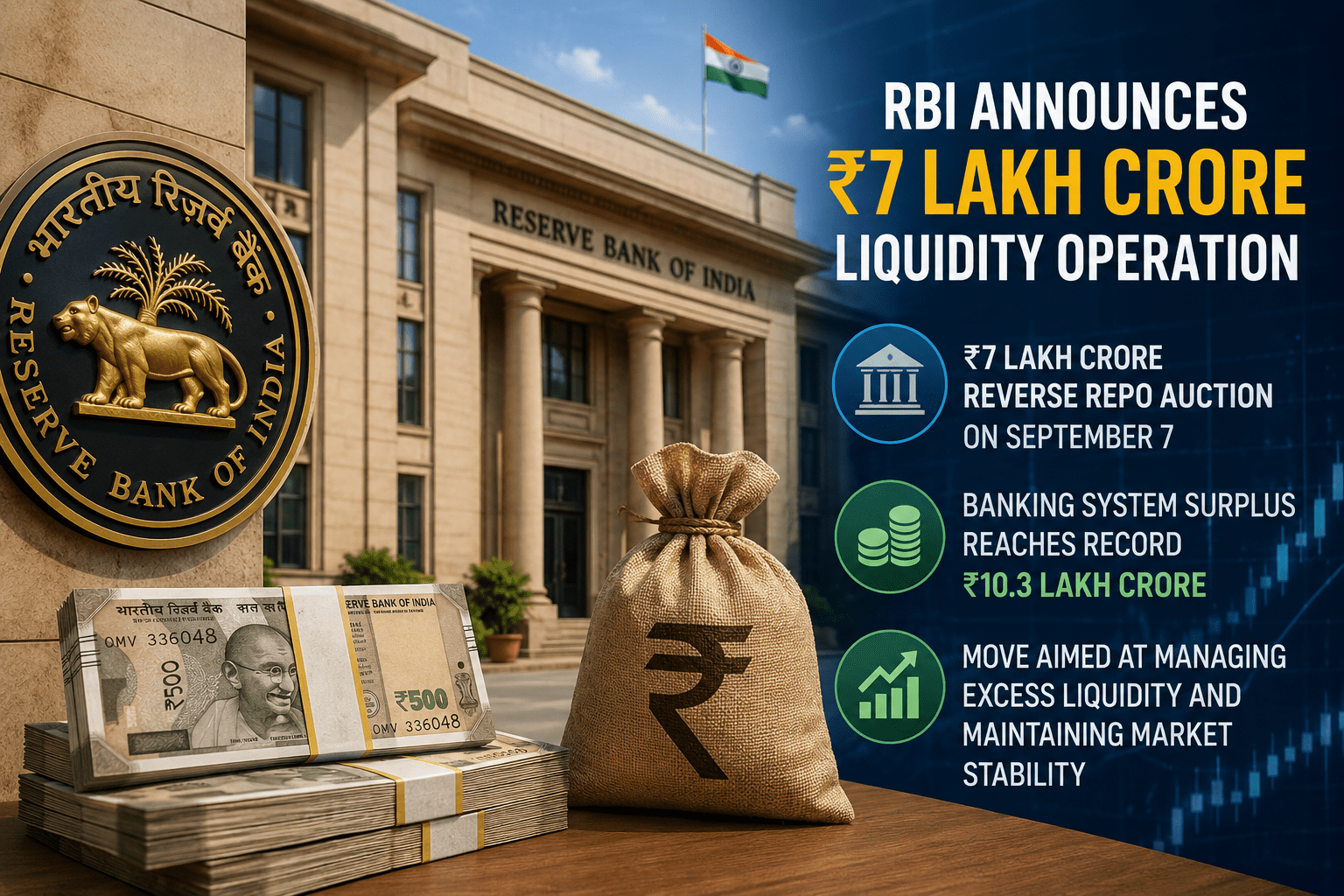
India’s banking system is holding a record amount of surplus cash.
To manage the excess liquidity, the Reserve Bank of India (RBI) has announced a ₹7 lakh crore variable rate reverse repo auction for September 7.
The 30-day operation will also give banks an option to withdraw their funds early. The RBI introduced this flexibility to encourage greater participation from banks.
The move comes as surplus liquidity in the banking system reached ₹10.3 lakh crore on September 3. A large part of the surplus came from foreign-currency deposits raised under a special RBI scheme.
The latest move puts liquidity management in focus across the Indian financial markets.
The RBI will conduct a 30-day variable rate reverse repo (VRRR) auction worth ₹7 lakh crore on September 7.
Under a reverse repo operation, banks can park surplus funds with the central bank. In return, they earn interest.
The latest auction is different because banks will have an early redemption option.
This means banks will not necessarily have to keep their funds with the RBI for the full 30-day period.
The RBI expects this flexibility to make the operation more attractive to banks.
The decision comes after a sharp rise in banking-system liquidity.
Surplus liquidity reached a record ₹10.3 lakh crore on September 3.
The increase was largely linked to foreign-currency deposits raised under a special RBI scheme. These funds were later swapped with the central bank, adding rupee liquidity to the banking system.
When banks have more funds than they immediately need, they can place that money in the market or with the RBI.
The central bank can use liquidity operations to manage these conditions.
A reverse repo is a monetary policy tool.
In simple terms, banks temporarily place money with the RBI. The central bank pays interest on these funds.
This allows the RBI to absorb excess money from the banking system.
The RBI has already been using shorter-duration VRRR auctions. These operations have ranged from overnight periods to seven days.
It also conducted a 15-day operation earlier this week.
However, longer-duration auctions have sometimes received a weaker response because banks may not want to lock their funds away for too long.
The new early-exit option is designed to address that concern.
The RBI manages liquidity to keep short-term money-market conditions orderly.
Too much surplus cash can affect market rates.
It can also influence how banks manage deposits and lending.
By absorbing some excess funds, the RBI can bring liquidity conditions closer to its preferred level.
The latest ₹7 lakh crore operation is therefore a significant step in managing the banking system’s unusually high surplus.
However, the success of the auction will depend on how much money banks actually place with the RBI.
The recent liquidity increase is closely connected to foreign-currency deposits.
Indian banks raised large amounts of foreign-currency funds under a special RBI scheme. These funds were then swapped with the central bank.
The process increased rupee liquidity within India’s banking system.
Reuters reported that this was a major reason why surplus liquidity reached the record ₹10.3 lakh crore level.
The RBI is now working to absorb part of that excess.
This shows how one financial policy can influence several parts of the market.
The early redemption feature is one of the most important parts of the latest operation.
Banks usually consider the opportunity cost of parking funds with the RBI.
If they lock money for a longer period, they may have less flexibility to use those funds elsewhere.
The new structure allows banks to exit early if they need the money.
A senior treasury official cited by Reuters said this flexibility could receive a better response from banks than a standard reverse repo auction.
That could make the September 7 operation more effective.
High liquidity can provide banks with more funds to manage their daily operations.
It can also affect short-term funding costs.
However, banks still need to decide where their surplus money can earn the best risk-adjusted return.
They may lend funds in the market. They may invest in securities. Or they may park funds with the RBI.
The choice depends on market rates, credit demand and liquidity conditions.
Therefore, the RBI’s operation could influence how banks manage their balance sheets in the coming weeks.
Liquidity is an important factor for financial markets.
When liquidity is high, money-market conditions can become easier.
However, the effect on the broader stock market is not always direct.
Equity prices also depend on company earnings, economic growth, interest rates, foreign investment and global markets.
The latest RBI move is therefore best understood as a liquidity-management measure, rather than a direct signal about the direction of Indian stocks.
Investors will still watch other economic and global factors.
The central bank needs to maintain a balance.
It must ensure that banks have enough liquidity to support the economy.
At the same time, it must prevent excess liquidity from creating unwanted pressure in financial markets.
The current situation makes that balance more important.
The banking system has a large surplus. The RBI now wants to absorb part of it without creating unnecessary pressure on banks.
The early-exit option is designed to provide that flexibility.
The new structure has received different views from market participants.
Some believe the early redemption option could encourage banks to participate.
The flexibility allows banks to access their funds if market conditions change.
However, there are also concerns.
ICICI Securities Primary Dealership questioned whether the early withdrawal option could reduce the RBI’s control over how long liquidity remains absorbed.
This highlights an important challenge.
The RBI needs to absorb liquidity while also maintaining control over financial conditions.
The September 7 auction will be closely watched by market participants.
Several factors will matter.
First, investors will look at how much money banks place with the RBI.
Second, they will watch short-term money-market rates.
Third, they will track whether banking liquidity remains high.
Finally, investors will look for further RBI action if the surplus remains elevated.
These developments can influence the banking sector and wider financial markets.
Banking liquidity is closely connected to economic activity.
Banks provide loans to businesses, households and other borrowers.
If liquidity conditions change, lending costs and credit availability can also change.
However, the impact is not immediate.
Banks consider many factors before increasing or reducing lending.
These include credit demand, risk, deposit costs and broader economic conditions.
The RBI’s latest operation is therefore one part of a larger monetary and financial framework.
The latest development also highlights how quickly financial conditions can change.
Bank liquidity can rise sharply because of foreign-currency flows. The RBI can then step in to absorb part of that surplus.
For investors, this is a reminder that different assets respond differently to changes in financial conditions.
Stocks, bonds, deposits and physical assets each have their own risk and return characteristics.
For people considering agricultural land or managed farmland as part of a long-term portfolio, market liquidity is only one factor to consider.
Location, land quality, water availability, management and the investment horizon also matter.
The RBI’s ₹7 lakh crore VRRR auction is now the key event for the banking market.
The operation comes at a time when India’s banking system is carrying a record ₹10.3 lakh crore liquidity surplus.
The early redemption option could help the RBI attract stronger participation from banks. However, the actual response will become clearer after the auction.
For investors, the development is worth watching because liquidity conditions can influence short-term money markets and banking activity.
The broader message is clear.
India’s financial system has entered a phase where managing surplus liquidity is becoming as important as providing liquidity.
The RBI’s next steps will determine how smoothly the banking system adjusts to these changing conditions.