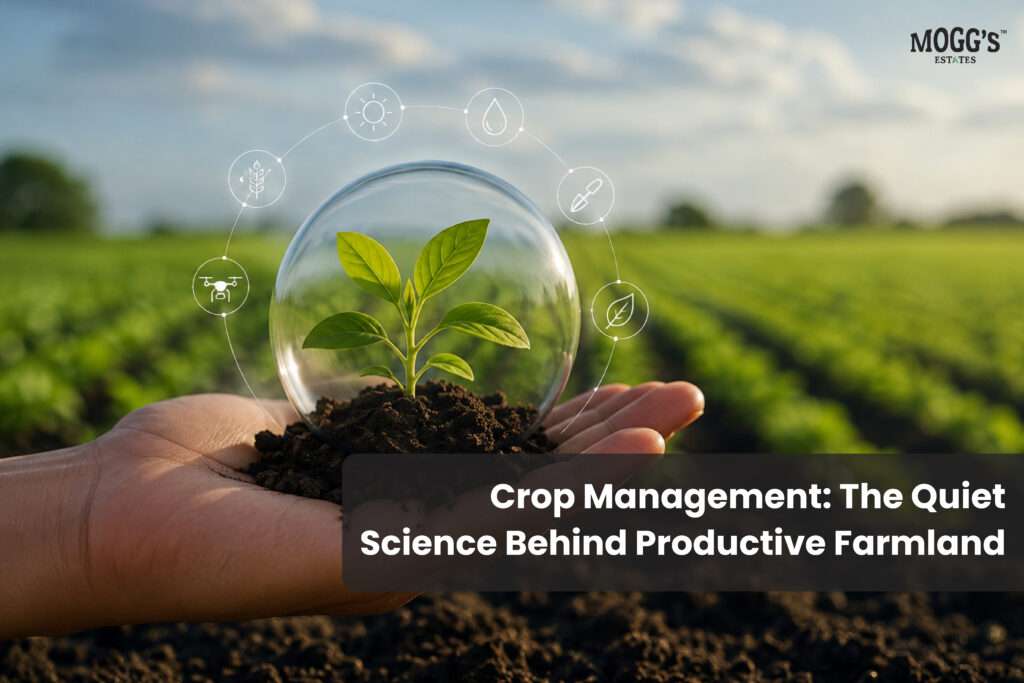
Crop Management Is More Than Growing a Crop
A productive farm does not happen by accident.
Behind every healthy crop is a series of decisions: which crop to grow, when to plant it, how much water it needs, what nutrients the soil requires, how pests should be managed and how the land should be cared for after harvest.
This is the foundation of crop management.
Crop management refers to the planning and practices used to maintain healthy crops while making efficient use of soil, water, nutrients, labour and other farm resources. Good management can support productivity while protecting the long-term health of the land.
For farmers, this is essential for maintaining consistent agricultural output. For people considering farmland investment, it offers another perspective: the value of agricultural land is not only about its location or size. The way the land is managed can also influence its productivity and long-term potential.
What Does Crop Management Actually Include?
Crop management covers almost the entire production cycle.
It begins before a seed goes into the soil and continues well after harvesting.
Some of the most important areas include:
- Soil preparation and soil health
- Selection of suitable crops
- Quality seeds and planting material
- Water and irrigation management
- Nutrient management
- Weed control
- Pest and disease management
- Crop rotation
- Harvest planning
- Post-harvest management
These practices work together.
For example, a crop with poor nutrition may become more vulnerable to pests and diseases. Similarly, excessive irrigation can create problems in the soil, while insufficient water during critical growth stages can affect yield. FAO notes that irrigation, soil fertility, crop selection and pest control need to be considered as interconnected parts of productive farming systems.
That is why modern agriculture increasingly looks at the farm as a complete system rather than treating each problem separately.
1. Healthy Soil Is the Starting Point
Before discussing crops, it is important to discuss the soil.
Soil is not simply a medium that holds plants in place. It provides nutrients, supports roots, stores water and contains a living community of organisms that influence plant growth.
According to the FAO, soil fertility depends on the soil’s ability to support plant growth through adequate nutrients and favourable physical, chemical and biological conditions.
Good crop management therefore begins with understanding the soil.
Farmers may use soil testing to understand nutrient levels and pH. Organic matter, crop residues, compost and appropriate nutrient applications can also form part of a broader soil-management strategy.
The objective is simple:
Do not only take from the soil. Maintain the soil that makes future harvests possible.
This becomes particularly important when thinking about farmland as a long-term asset.
2. Choosing the Right Crop for the Land
Not every crop performs equally well in every location.
Crop selection should consider factors such as:
- Soil characteristics
- Water availability
- Local climate
- Seasonal conditions
- Crop duration
- Market demand
- Farm infrastructure
- Labour availability
Choosing crops according to local conditions can reduce unnecessary pressure on farm resources.
It can also make farming more predictable.
This is one reason crop management should be location-specific rather than based on a single formula that works everywhere.
3. Water Management: Every Drop Matters
Water is one of the most important resources in agriculture.
But effective crop management is not simply about providing more water. It is about providing the right amount at the right time.
Over-irrigation can waste water and create soil-related problems. Under-irrigation can stress crops and reduce productivity.
Efficient irrigation therefore becomes an important part of sustainable farming.
FAO highlights that irrigation method, frequency and duration can significantly influence crop yield and farm productivity.
For modern managed farmland, water planning can therefore become an important component of overall farm management.
Rainfall patterns, water sources, soil moisture and crop requirements can all be considered when planning irrigation.
4. Nutrient Management Is About Balance
Plants need nutrients to grow, but more fertilizer does not automatically mean better crops.
Good nutrient management focuses on balance.
Nitrogen, phosphorus, potassium and several micronutrients play different roles in plant development. The right requirement depends on the crop, soil and growing conditions.
FAO recommends assessing crop and soil nutrient requirements and using fertilizers judiciously to reduce nutrient losses and maintain soil health.
This is where scientific crop management can make a meaningful difference.
Instead of applying inputs according to habit, farmers can use soil information and crop requirements to make more informed decisions.
The result can be better resource efficiency and healthier soil over time.
5. Managing Pests Without Depending Only on Chemicals
Pests and diseases are among the biggest challenges faced by agriculture.
But crop protection does not necessarily begin with pesticides.
Integrated Pest Management, or IPM, focuses on monitoring crops, understanding pest populations and combining different control methods. FAO describes IPM as an ecosystem-based approach designed to maintain healthy crops while reducing unnecessary pesticide use.
This may include:
- Regular field monitoring
- Biological control
- Crop diversification
- Natural pest predators
- Trap crops
- Good field hygiene
- Appropriate pesticide use when necessary
The principle is straightforward: prevent problems where possible instead of reacting only after serious damage occurs.
6. Crop Rotation Can Protect the Land
Growing the same crop repeatedly can place continuous pressure on specific nutrients and may contribute to recurring pest, disease and weed problems.
Crop rotation introduces variety into the farming system.
For example, rotating crops with legumes can support nutrient cycling, while changing crop types can interrupt some pest and disease cycles.
FAO identifies crop rotation, intercropping and cover crops among practices that can contribute to soil fertility and resource management.
For farmland owners, this highlights an important idea:
Good agricultural land management is measured over years, not just one harvest.
7. Technology Is Changing Crop Management
Crop management is also becoming more data-driven.
Today, farms can use tools such as:
- Weather information
- Soil testing
- Irrigation monitoring
- Satellite imagery
- Farm management software
- Digital records
- Remote monitoring
These tools can help farmers identify changes earlier and make more informed decisions.
Technology does not replace agricultural knowledge. Instead, it can make that knowledge more precise.
This is particularly relevant to professionally operated managed farmland, where systematic monitoring and planned maintenance can help create greater consistency across agricultural operations.
What Crop Management Means for Farmland Investors
For someone looking at farmland investment, the conversation often starts with location.
Is the land close to a major city?
How accessible is it?
What is the surrounding infrastructure?
What is the size of the property?
These are important questions.
But another question deserves attention:
How is the land being managed?
A parcel of agricultural land is a long-term asset. Its productive potential depends partly on how its soil, water resources, crops and surrounding ecosystem are maintained.
This is where professionally managed agricultural properties can offer a different ownership experience.
With managed farmland near Bengaluru, for example, the focus can extend beyond simply owning a piece of land. Planned crop management, irrigation, maintenance and agricultural operations can help connect land ownership with an active farming ecosystem.
That does not mean crop management guarantees financial returns. Farmland, like any investment, involves risks and should be evaluated based on location, legal status, infrastructure, water availability, agricultural potential and the investor’s objectives.
But it does reinforce an important principle:
The quality of land management matters to the quality of the asset.
Managed Farmland: Connecting Ownership With Agriculture
Traditional farmland ownership can require considerable involvement.
There may be questions about who will cultivate the land, how irrigation will be handled, how crops will be maintained and how the property will be looked after when the owner is away.
A managed farmland model can address some of these operational challenges by placing agricultural activities under structured farm management.
For busy professionals, entrepreneurs and families interested in owning agricultural land, this can make farmland ownership more accessible.
Instead of viewing farmland only as real estate, owners can see it as a living agricultural asset.
The distinction is important.
An apartment is built and maintained as a structure.
A farm is constantly changing.
Crops grow. Seasons change. Soil needs attention. Water availability changes. Agricultural decisions need to be made continuously.
That makes farm management an important part of the ownership experience.
The Future of Crop Management Is About Doing More With Less
Agriculture faces a simple but difficult challenge: produce efficiently while protecting the resources needed for future production.
That means using water carefully.
Maintaining healthy soil.
Choosing crops thoughtfully.
Managing nutrients efficiently.
Monitoring pests early.
Protecting biodiversity.
And planning the farm beyond a single season.
Conservation agriculture, for example, promotes minimum soil disturbance, permanent soil cover and crop diversification as ways to support soil health and resource efficiency.
The future of agriculture will therefore not be defined only by how much a farm produces.
It will also be defined by how intelligently the farm is managed.
Conclusion: Good Land Deserves Good Management
Crop management may sound like a technical agricultural term, but its underlying idea is simple.
Healthy land supports healthy crops. Healthy crops support productive farms. And productive farms depend on thoughtful management.
For farmers, this means making better decisions throughout the growing cycle.
For landowners, it means understanding that farmland is not a passive asset.
And for people exploring farmland investment, it means looking beyond the boundaries of the property itself.
Location matters. Infrastructure matters. Water matters.
But so does what happens on the land.
Whether you are exploring farmland near Bengaluru, considering managed farmland, or simply interested in sustainable agriculture, understanding crop management offers a better way to appreciate the real work behind productive farmland.
Because ultimately, farmland creates value not simply by being owned but by being understood, maintained and managed well.