India’s startup investment landscape is seeing another major vote of confidence.
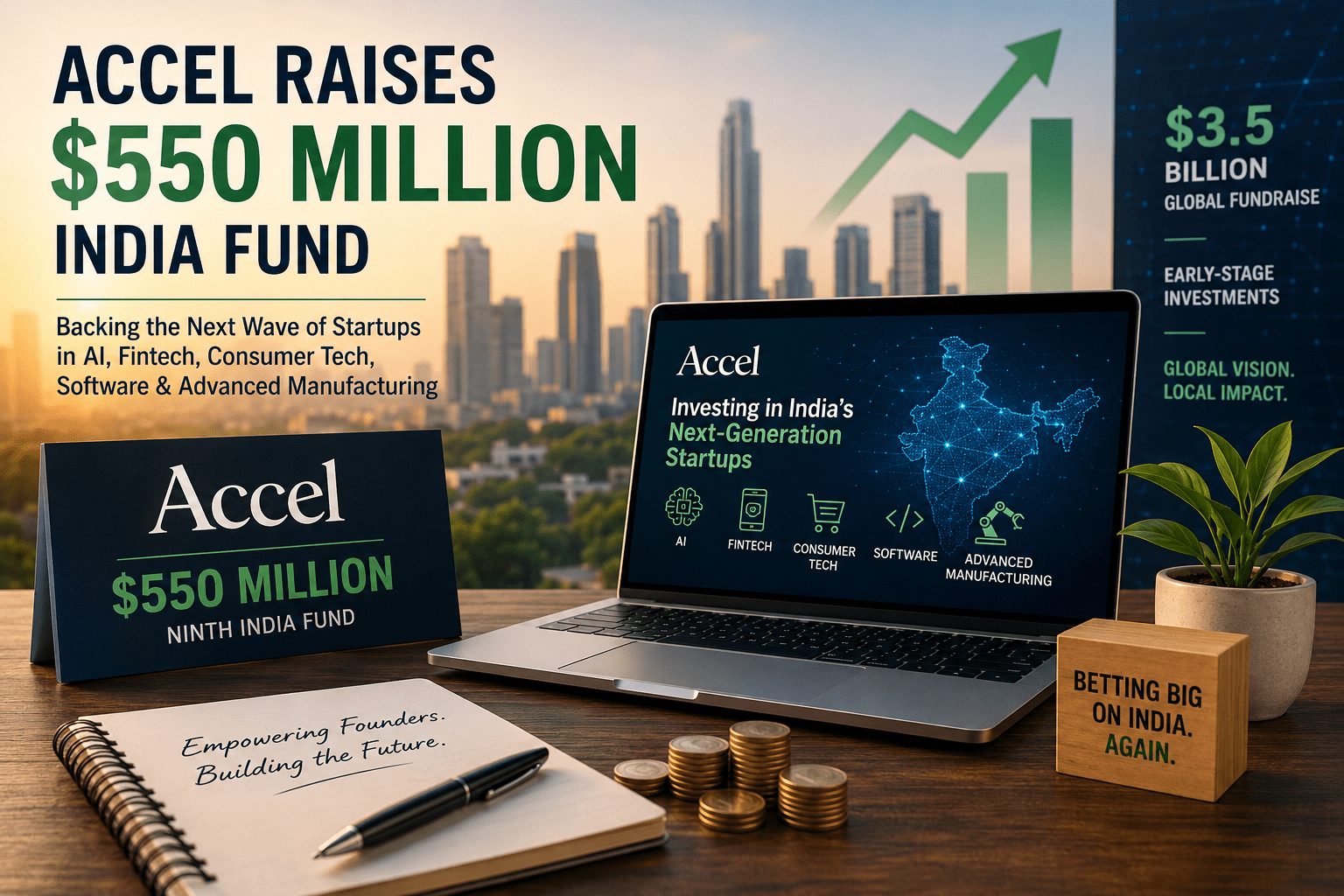
Global venture capital firm Accel has raised $550 million for its ninth India-focused early-stage fund, as investors continue to look for opportunities in artificial intelligence, fintech, consumer technology and advanced manufacturing.
The fund was announced on August 11, 2026, as part of Accel’s wider $3.5 billion global fundraising across four investment vehicles.
Accel’s latest India fund will focus on early-stage businesses.
The firm plans to invest in companies working across several sectors, including AI, consumer technology, fintech, software and advanced manufacturing.
The new fund is significant because it comes only around 18 months after Accel closed its previous $650 million India fund.
With the latest raise, Accel has committed substantial new capital to India’s startup ecosystem.
Artificial intelligence is at the centre of the new investment strategy.
However, Accel does not view AI as a separate sector alone.
Instead, the firm sees AI becoming a technology that can transform many industries.
This includes financial services, consumer businesses, software and manufacturing.
That approach could give startups using AI across different industries access to a larger pool of venture capital.
India’s startup ecosystem has changed significantly over the past decade.
The country now has companies operating across fintech, e-commerce, SaaS, healthcare, logistics, climate technology and deeptech.
Investors are also becoming more selective.
They are looking for businesses that can build strong technology, serve large markets and potentially expand beyond India.
Accel’s latest fund reflects this shift towards companies with ambitious growth plans.
Accel has built its India strategy around investing early.
The firm has backed companies such as Flipkart, Swiggy, Freshworks and Zetwerk at earlier stages of their growth.
Its latest fund continues that approach.
According to reporting from the Times of India, Accel expects to back around 15 to 30 companies each year through the new India fund.
Early-stage investment can be important because young companies often need capital before they have reached significant scale.
For investors, however, early-stage funding also carries higher risk.
Many startups may not become successful.
The potential returns can therefore be much higher, but so can the possibility of losses.
AI has quickly become one of the biggest themes in global venture capital.
The technology is being used to develop new software products, automate business processes and create entirely new services.
India has a large technology workforce and a growing base of entrepreneurs.
This combination has encouraged investors to look for Indian companies that can build AI products for both domestic and international markets.
Accel believes the opportunity extends beyond large language models.
The firm has highlighted opportunities in AI applications, infrastructure and software.
The new fund is not limited to AI.
Consumer businesses and fintech remain important investment areas.
India’s large population, expanding digital economy and increasing use of online financial services continue to create opportunities for startups.
Fintech companies, in particular, have benefited from India’s digital payments infrastructure and growing financial participation.
The challenge for new companies will be building sustainable businesses in an increasingly competitive market.
Another interesting focus is advanced manufacturing.
India is working to strengthen its manufacturing capabilities across electronics, industrial technology and other strategic sectors.
This creates opportunities for startups developing new technologies for factories, supply chains and industrial businesses.
For venture capital investors, advanced manufacturing offers exposure to a part of India’s economy that has traditionally attracted less startup funding than consumer internet and software.
The $550 million India fund is only one part of Accel’s latest fundraising.
The firm announced a combined $3.5 billion across four vehicles, covering early-stage strategies in the US, Europe, Israel and India, along with a separate growth vehicle.
This structure gives Accel the ability to support companies at different stages.
A startup can receive early funding when it is still developing its product.
If it grows successfully, later-stage capital can potentially support its expansion.
For founders, a new large venture fund means another potential source of capital.
But access to funding is only one part of building a successful company.
Startups still need strong products, capable teams, clear business models and large markets.
Competition for venture capital also remains intense.
Investors are likely to examine growth prospects, technology and the ability to build sustainable businesses before committing capital.
The fundraise is also important for India’s wider investment ecosystem.
When major global investors raise dedicated India funds, it indicates continued interest in the country’s entrepreneurial potential.
It can also encourage other investors to examine Indian startups.
More capital can support innovation, research and business expansion.
At the same time, investors need to remain disciplined because venture capital is inherently risky.
The Indian startup market is entering a different phase.
The focus is gradually moving beyond simply creating digital businesses.
AI, advanced manufacturing, enterprise software and deep technology are becoming more important.
This could lead to a new generation of companies built around complex technologies and global markets.
Accel’s latest fund is positioned to participate in that transition.
The new $550 million India fund is expected to begin deploying capital into new opportunities as Accel continues investing from its existing India fund.
The firm sees India’s next generation of founders as capable of building businesses with global ambitions.
Whether those expectations translate into major companies will depend on execution, market conditions and the ability of founders to scale.
Still, the size and timing of the fundraise send a clear message.
Global venture capital continues to see India as an important market for the next generation of technology and innovation.