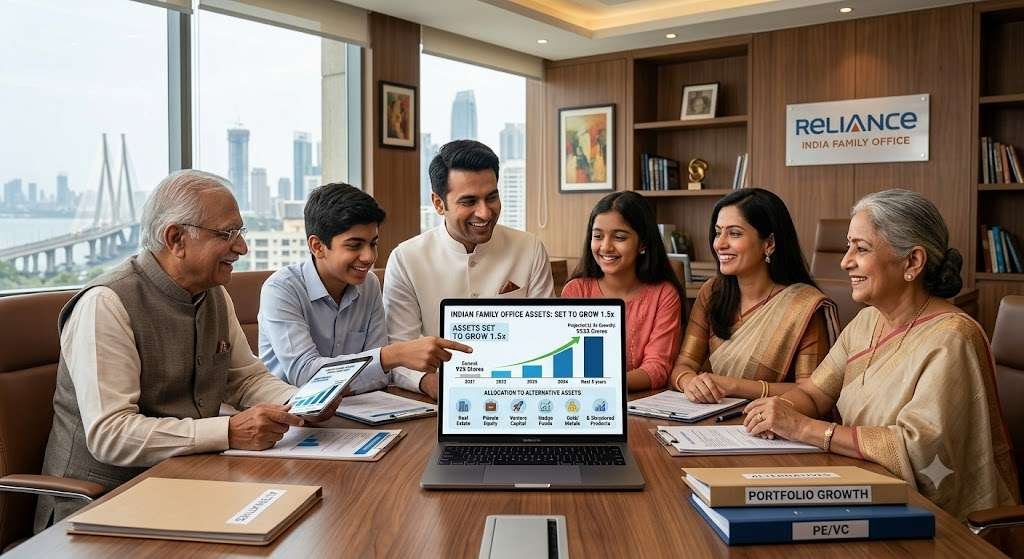
India’s family office ecosystem is entering a new phase as wealthy families increasingly look beyond traditional investments. A new Julius Baer–EY report estimates that Indian family office assets could grow by 1.5 times over the next three years.
The report highlights a wider shift in how India’s wealthy investors manage and deploy capital. Family offices are becoming more active in private markets, technology-led sectors and alternative assets.
India’s family office assets were estimated at around ₹70,000 crore in 2024. According to the report, this pool is expected to expand significantly over the next three years.
The growth is being supported by rising wealth creation, India’s startup ecosystem and a growing number of high-net-worth individuals.
India currently has more than 19,000 ultra-high-net-worth individuals (UHNIs). This number is expected to cross 25,000 by 2031.
At the same time, the country could see an estimated $1.3 trillion to $1.5 trillion in intergenerational wealth transfers over the next decade. This is creating a greater need for structured wealth management, succession planning and professional investment strategies.
One of the biggest changes is the growing interest in alternative investments.
According to the Julius Baer–EY report, family offices are allocating around 40% to 45% of their portfolios to alternatives in many cases.
These investments include:
This shift shows that wealthy investors are increasingly looking beyond conventional stocks and bonds.
Alternative assets can offer diversification and exposure to sectors that may benefit from India’s long-term economic growth. However, they can also involve higher risks, lower liquidity and longer investment horizons.
Technology is becoming another important part of family office investment strategies.
The report highlights growing interest in areas such as artificial intelligence, climate technology, renewable energy, semiconductors, electronics manufacturing, cloud services and data centres.
India’s rapid digital transformation is creating opportunities across these sectors.
For investors, the appeal is not limited to established companies. Family offices are also looking at direct investments and co-investment opportunities that allow them to participate more closely in emerging businesses.
This represents a change from simply preserving wealth to actively deploying capital into businesses and industries with long-term growth potential.
While technology is attracting significant attention, real assets continue to have an important role in diversified portfolios.
Real estate, REITs and infrastructure investment trusts are among the alternatives being considered by family offices.
Real assets can provide exposure to physical infrastructure and property-linked economic activity. For investors with a long-term approach, they can also complement financial market investments.
This broader approach is particularly relevant as investors increasingly focus on portfolio diversification rather than depending on a single asset class.
For individuals exploring opportunities such as real estate or managed farmland, the broader trend highlights the importance of understanding how tangible assets can fit within a diversified investment strategy.
The growth of family offices is also changing the way wealthy families manage their assets.
Earlier, wealth management could often be handled through informal family structures. Today, larger wealth pools require more formal systems.
The report points to increasing demand for:
Technology is also becoming central to modern family offices. AI-powered analytics and integrated reporting platforms are helping investors monitor portfolios and make more informed decisions.
Generational change is another factor shaping India’s investment landscape.
As wealth moves from one generation to another, younger family members may bring different investment preferences. They may have greater interest in technology, sustainability, entrepreneurship and global opportunities.
This could encourage family offices to diversify further.
The report suggests that India’s family offices are moving from being primarily wealth-preservation structures towards becoming long-term capital providers and strategic investors.
That change could have a wider impact on India’s private investment ecosystem.
The expansion of family office capital could create additional funding for Indian businesses and emerging sectors.
More capital could flow towards startups, infrastructure, technology, renewable energy and private markets.
It could also increase the role of domestic investors in India’s capital formation.
This is important because investment markets are influenced not only by foreign capital but also by the ability of domestic investors to deploy long-term funds.
As India’s wealth base expands, family offices could become an increasingly important source of patient capital.
The changing investment behaviour of India’s wealthiest families reflects a broader trend.
Investors are increasingly looking at assets through a long-term lens. Instead of focusing only on short-term market movements, they are considering diversification, real assets, private businesses and emerging industries.
However, diversification does not remove investment risk.
Alternative assets can have different levels of liquidity, valuation uncertainty and regulatory exposure. Investors therefore need to assess their objectives, risk tolerance and investment horizon before allocating capital.
India’s family office ecosystem is becoming more sophisticated.
With family office assets projected to grow 1.5 times over the next three years, the country’s private capital landscape could undergo significant changes.
The combination of rising wealth, intergenerational transfers and growing interest in alternative investments is creating a new investment environment.
From private equity and venture capital to real assets, infrastructure and technology, Indian investors are building portfolios designed for the long term.
For the broader investment market, this could mean more domestic capital supporting India’s next phase of economic growth.