India is taking a new step to strengthen its cotton market.
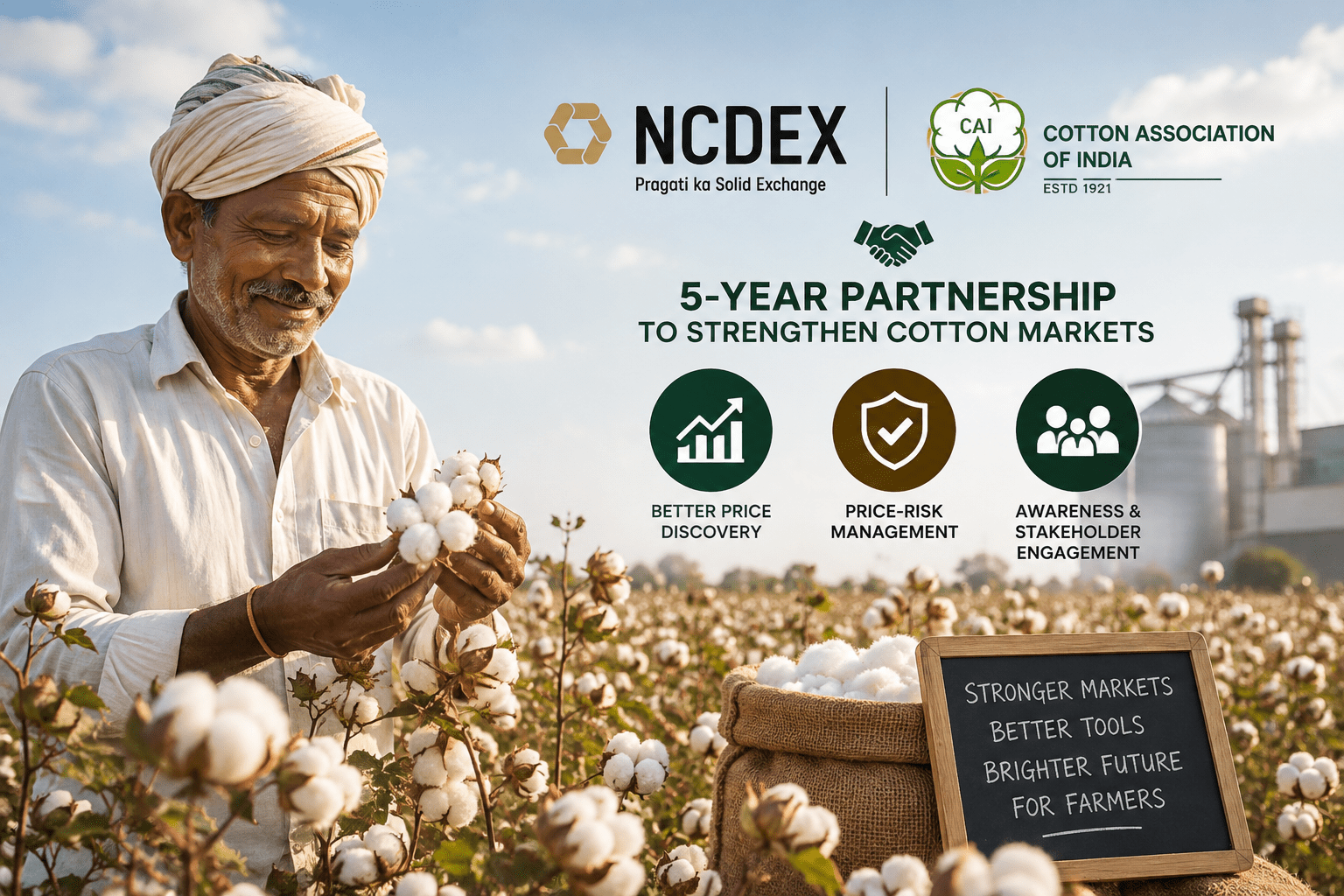
The National Commodity and Derivatives Exchange (NCDEX) has signed a five-year strategic partnership with the Cotton Association of India (CAI) to expand participation in cotton derivatives and improve price discovery.
The partnership aims to give farmers and other participants in the cotton supply chain better tools to manage price risks. It will also focus on creating greater awareness about futures markets.
The development comes at a time when India remains one of the world’s largest cotton producers, but its fragmented physical markets and relatively low use of derivatives have limited its influence on global cotton price discovery.
NCDEX and CAI signed the five-year agreement in Mumbai on September 2.
The partnership will focus on strengthening India’s cotton derivatives ecosystem.
Both organisations plan to work with farmers, ginners, spinners, exporters and traders. The objective is to encourage wider use of futures contracts for price-risk management.
The initiative could make cotton markets more transparent.
It could also help participants better understand how futures markets can be used to manage changing prices.
Cotton prices can change because of several factors.
Weather can affect production. Global demand can influence prices. Imports, exports and textile demand can also affect the market.
For farmers, these changes can create uncertainty between planting and selling.
A stronger price-discovery system can provide market participants with clearer price signals.
That is one of the key objectives behind the NCDEX and CAI partnership.
India has a major role in the global cotton industry.
The country accounts for around 20–23% of global cotton production and nearly 38% of global cotton-growing acreage, according to industry and market reports.
Despite this large production base, India’s influence on global cotton price discovery remains limited.
One reason is the fragmented nature of India’s physical cotton markets.
Another is the relatively low participation in commodity derivatives.
The new partnership is intended to address both challenges.
Cotton derivatives are financial contracts linked to cotton prices.
Futures contracts allow market participants to agree on a price for a commodity at a future date.
They can be used as a hedging tool against price fluctuations.
For example, a participant worried about falling cotton prices may use futures contracts to manage part of that risk.
However, derivatives are financial instruments and involve market risk. They require proper understanding before use.
Cotton does not move directly from a farm to the final consumer.
It passes through several stages.
Farmers grow and harvest cotton. Ginners process the raw cotton. Spinners convert it into yarn. Textile manufacturers then use the yarn and other inputs to produce fabrics and garments.
Exporters and traders are also part of this chain.
The partnership aims to improve participation across these different stages.
Low awareness has been one of the challenges limiting the use of cotton derivatives in India.
NCDEX and CAI plan to conduct stakeholder engagement and education programmes.
These programmes will help participants understand futures contracts and their potential role in managing price risk.
The initiative is expected to focus particularly on cotton-producing and processing regions.
Maharashtra, Gujarat, Punjab, Andhra Pradesh and Telangana are expected to be key focus areas.
These states have important cotton production and processing activity.
Greater awareness in these regions could help more participants understand the relationship between physical cotton markets and futures markets.
The approach could also help create stronger links between farmers and organised commodity markets.
The partnership will strengthen NCDEX’s existing cotton derivatives platform.
Its current cotton complex includes contracts linked to kapas, cottonseed oil cake and cotton wash oil.
The exchange wants to build greater participation around these products.
The broader objective is to develop a more reliable market framework for India’s cotton industry.
Price discovery is important because it helps markets determine prices through buying and selling activity.
A more active futures market can provide additional price information.
This information can be useful to farmers, processors and traders when making commercial decisions.
However, futures prices do not guarantee the price a farmer will receive in the physical market.
Instead, they can provide another reference point for understanding market expectations.
India’s cotton sector operates in a global market.
Changes in international production, textile demand and trade flows can influence domestic prices.
That makes risk management increasingly important for businesses across the cotton value chain.
A stronger domestic derivatives market could help Indian participants respond to these changes more effectively.
India produces a significant share of the world’s cotton.
Yet global cotton price discovery has historically been influenced by international benchmarks.
The NCDEX–CAI partnership aims to narrow this gap.
If participation increases, India could potentially develop a stronger domestic reference point for cotton prices.
That would be particularly significant for a country with such a large cotton-growing area.
For cotton farmers, the biggest potential benefit is better access to information and price-risk management tools.
The partnership does not mean farmers will automatically receive higher cotton prices.
Instead, it aims to improve their understanding of market movements and create more options for managing price uncertainty.
Education will therefore be just as important as the development of the market itself.
India’s cotton economy connects millions of agricultural and industrial participants.
A farmer’s crop eventually becomes part of a much larger textile supply chain.
Creating stronger links between physical markets and organised derivatives markets could make this system more transparent.
It could also help different participants make better-informed decisions.
NCDEX and CAI will now work on stakeholder engagement and awareness programmes.
The focus will be on increasing participation in cotton futures and improving understanding of hedging.
The success of the initiative will depend on how effectively these tools reach actual market participants.
Greater participation will also be important for creating meaningful price signals.
The five-year NCDEX–CAI partnership marks a significant development for India’s cotton sector.
India already has a huge cotton production base.
The next challenge is to build a market structure that allows farmers, processors, traders and exporters to manage price uncertainty more effectively.
If the partnership succeeds in increasing awareness and participation, India’s cotton market could become more organised and transparent.
For the country’s farmers, the development could bring something increasingly valuable in agriculture: better information before making important selling decisions.