
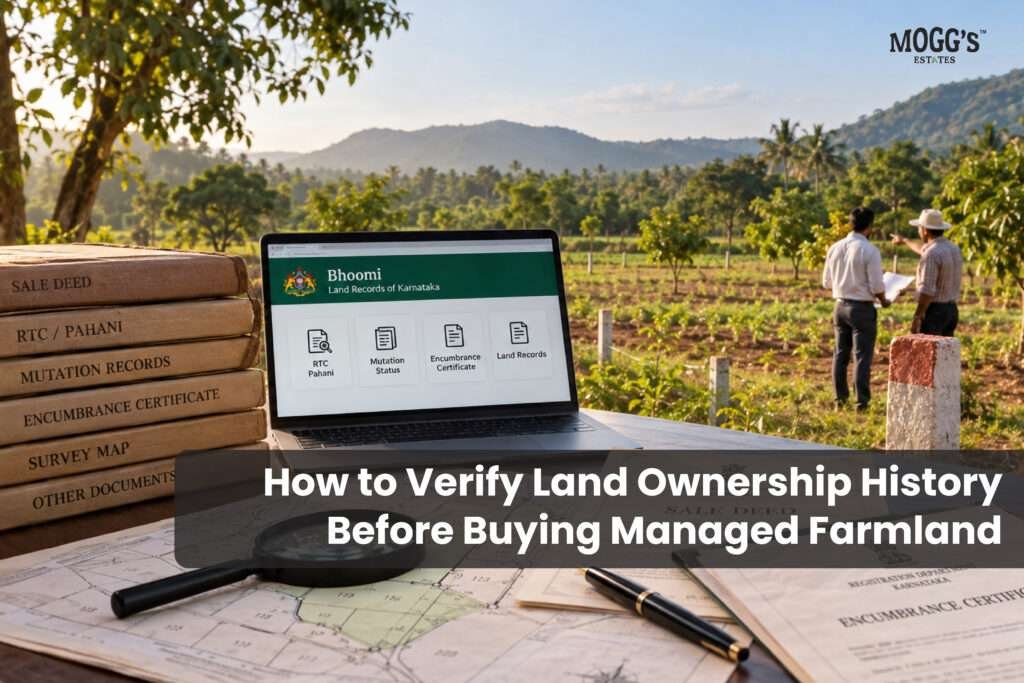
Buying farmland is not only about choosing a scenic location or comparing plot sizes. Before purchasing agricultural land, one of the most important checks is the ownership history. Knowing who owned the land before, how ownership changed, and whether any registered claims were attached to it can help you make a more informed decision.
For buyers exploring managed farmland in Karnataka, ownership verification should be an essential part of land due diligence. A clear chain of documents can make the transaction easier to understand and reduce the risk of discovering problems later.
What Is Land Ownership History?
Land ownership history is the documented chain showing how rights in a parcel of land have passed from one person or entity to another.
The chain may include sale, inheritance, partition, gift, release of rights, family settlement or court-related transfers.
The goal is to connect the current owner’s title with earlier documents and confirm that each transfer was properly documented.
In Karnataka, revenue records such as the RTC and mutation records can help trace changes recorded in the land records system. Karnataka’s Bhoomi system records ownership and other changes through mutation.
Step 1: Start With the Current Sale Deed
The current registered sale deed is one of the first documents to review. Check the seller’s name, survey number, extent, boundaries and registration details.
Do not look at the deed in isolation. The seller’s ownership should connect logically to the previous document in the chain.
If the seller acquired the land through an earlier sale, review that sale deed. If the seller received it through inheritance or partition, ask for the relevant supporting documents.
Step 2: Check the RTC or Pahani
For agricultural land in Karnataka, the RTC, commonly called Pahani, is an important revenue record. The Government of Karnataka describes Bhoomi as its land-records management system, where RTC changes such as ownership changes are recorded through mutation.
When checking an RTC, compare:
- Owner name
- Survey number and subdivision
- Total extent
- Nature of the land
- Relevant cultivation or tenancy details
These details should broadly match the title documents and the land being offered for purchase.
An RTC is important, but it is not a substitute for complete title verification.
For additional reading, see RTC and Farmland Near Bengaluru.
Step 3: Review the Mutation Records
Mutation records are useful when verifying ownership history because they show how changes in revenue records were recorded.
The Karnataka Government’s Bhoomi system provides access to mutation extracts and mutation status. Compare mutation entries with the underlying transaction documents.
For example, if a sale deed shows ownership changing from A to B, the corresponding revenue record should be checked for a compatible mutation entry.
If the mutation history appears incomplete, inconsistent or pending, get clarification and legal review before proceeding.
Step 4: Obtain an Encumbrance Certificate
An Encumbrance Certificate, or EC, is another important part of property due diligence. It is used to check registered transactions and encumbrances recorded against a property for the relevant period.
Review the EC alongside sale deeds and revenue records. Look for registered transactions, mortgages, releases or other entries that may affect the title.
Karnataka’s Department of Stamps and Registration provides an online process for applying for an EC through Kaveri 2.0.
An EC is one part of due diligence, not a complete guarantee that no legal issue exists.
Step 5: Trace Earlier Documents
For a stronger chain of title, go beyond the current owner’s sale deed.
Depending on the property, request previous sale deeds, partition deeds, gift deeds, release deeds, inheritance-related documents or court orders.
Your objective is simple: each transfer should have a reasonable documentary connection to the next owner.
If names, survey numbers, land extents or boundaries change unexpectedly, investigate before moving forward.
Step 6: Verify the Survey Number and Boundaries
A title document may look correct on paper but still require a physical and revenue-record comparison.
Verify the survey number, subdivision or hissa details, extent and boundaries against available survey records or sketches. Karnataka government documentation for land-related applications refers to records such as RTC, mutation extracts, EC and survey-related documents.
This is particularly useful for farmland because large agricultural parcels may have multiple survey numbers or subdivisions.
Step 7: Check for Gaps in the Ownership Chain
Create a simple ownership timeline:
2010 — Owner A purchases land
2015 — Owner A transfers land to Owner B
2020 — Owner B transfers land to Owner C
2026 — Owner C proposes a sale to Buyer
Now match every transition with the appropriate registered or supporting document.
A missing link does not automatically mean the property cannot be purchased, but the gap should be explained and legally reviewed.
This simple exercise can help identify inconsistencies before they become a larger issue.
Step 8: Take Independent Legal Verification
Property documents can become complicated when ownership spans several transactions or generations.
A property lawyer can review the chain of title, revenue records, encumbrances, inheritance documents, partitions, boundaries and other relevant issues. Independent legal verification is especially useful when documents contain inconsistencies.
For buyers considering managed farmland, legal verification should remain separate from the farm-management experience. Professional farm maintenance does not replace title due diligence. Mogg’s own guidance for managed farmland also emphasizes checking ownership structure, land documents, access, water availability and the management agreement.
Ownership History Checklist for Managed Farmland Buyers
Before completing a farmland purchase, keep a checklist covering:
- Current sale deed
- Previous title documents
- RTC/Pahani
- Mutation extract and status
- Encumbrance Certificate
- Survey number and subdivision details
- Survey sketch or applicable land records
- Partition, gift, release or inheritance documents, where relevant
- Land-use or conversion records, where applicable
- Independent legal title opinion
The exact documents required can vary by property and transaction structure, so a qualified professional should confirm the final list.
Why Ownership History Matters for Managed Farmland
Managed farmland can combine land ownership with professional agricultural management. Buyers may be attracted by plantation, farm maintenance, accessibility and the convenience of having operations managed on their behalf.
However, the foundation remains the land itself.
Before comparing managed farmland projects, understand who legally owns the land, how ownership has evolved, which documents support the title, and what exactly you receive through the registered transaction and management agreement.
For more information, explore managed farmland near Bengaluru and related resources on land due diligence.
Final Takeaway
Verifying land ownership history is not a single-document exercise. It means connecting the current title with earlier ownership records, checking revenue updates, reviewing registered transactions, confirming land identifiers and investigating gaps.
For anyone researching managed farmland in Karnataka, combine document verification with independent legal due diligence. A clear ownership trail can give you a better understanding of the property before committing to the purchase.
Always verify current records and applicable laws with the relevant government authorities and a qualified property lawyer before completing a transaction.