A khata vs B khata is the most common question for anyone buying property in Bengaluru. A khata is a municipal register entry for a property. A-khata properties are generally those recorded after meeting building bylaws, tax norms, and other rules. B-khata properties are recorded separately because they have compliance gaps, such as approval or construction violations. A khata is not proof of ownership. Buyers still need the registered sale deed, title history, and encumbrance certificate, and they should confirm whether the property can be converted from B-khata to A-khata before paying.
What Does “Khata” Mean?
“Khata” means register. In Bengaluru, a khata is the municipal record that lists a property for property-tax purposes. The Bruhat Bengaluru Mahanagara Palike (BBMP) created the system after its formation in 2007, when property tax collection involved several bodies. A single register simplified collection and gave each property one municipal record.
Since then, the municipal structure has changed, and Bengaluru now operates through the Greater Bengaluru Authority and its city corporations. Check the current process with the official office, because older articles still refer to BBMP throughout.
What Is an A Khata?
An A khata is the register entry for properties considered legally compliant. These are properties that meet building bylaws, tax requirements, and other government regulations. A property with an A khata usually has a clearer record for resale, loans, and municipal services.
An A khata does not prove title. It shows that the property is recorded correctly in the municipal system. You still need to verify ownership, approvals, and encumbrances separately.
What Is a B Khata?
A B khata is the register entry for properties that are semi-legal or non-compliant with some or all local bylaws and regulations. The category was created to bring such properties into the tax system, so they could be assessed and taxed while their status was resolved.
A B khata does not automatically mean a property is illegal. Its status depends on the specific violation, such as a building bylaw breach, construction on revenue land, an unauthorised layout, or a missing completion certificate. Each case needs individual review.
Khata Certificate and Khata Extract
For A khata properties, the municipality issues two documents:
- Khata certificate: Shows the owner’s name and the property address.
- Khata extract: A more detailed record with the property’s area details, property identification number, and the data used to calculate property tax.
Buyers of B khata properties usually receive a B khata extract, but not a khata certificate. Fees and forms change, and older articles quote specific amounts. Confirm the current charges on the official portal or at the office before budgeting.
Khata Transfer After You Buy
For a resale property, the buyer needs a khata transfer, which puts the property in the new owner’s name in the municipal records. The transfer is also needed for many later steps, such as water or gas connections and certain licences.
Karnataka’s municipal law sets a time limit for khata transfer after purchase, so check the current rule and deadline with your lawyer. New apartment buyers follow a different route, because the flat needs its own registration under the khata of the land parcel.
Documents Usually Required for Khata Work
Requirements vary by property type and office, so confirm the current list. Commonly requested documents include:
- Notarised sale deed
- Encumbrance certificate
- Conversion certificate, where the land was converted from agricultural use
- Occupancy certificate
- Last paid property tax receipt
- Receipts for betterment or improvement charges
- For Karnataka Housing Board or BDA properties: allotment documents and possession certificate
- For some layouts and high-rise buildings: approved building plan, measurement details, and location map
A Khata vs B Khata: Key Differences
| Factor | A khata | B khata |
|---|---|---|
| Legal compliance | Generally compliant with bylaws and norms | Non-conforming in some or all respects |
| Ownership proof | No, but usually a cleaner record | No, and the record is weaker |
| Resale and transfer | Generally straightforward | Usually more difficult |
| Trade and building licences | Can usually be applied for at the address | Often cannot be applied for |
| Renovation and expansion | Construction permits generally available | Harder to get approval |
| Bank building loans | Generally available | Generally not available |
| Conversion path | Not needed | B-to-A conversion may be possible |
These differences depend on the rules in force, so confirm each one for the property you are considering.
How to Convert a B Khata to an A Khata
The conversion route is generally available for properties with minor deviations from the building rules. The usual steps are:
- Convert the land use: from agricultural to non-agricultural by paying the District Commissioner’s charges, where the land was agricultural.
- Clear all overdue property tax: so the tax status is current.
- Obtain the B khata extract: and use it to complete the conversion application.
- Submit the documents: to the municipal office or the Assistant Revenue Officer, including certified tax receipts, sale and title deeds, conversion payment receipts, blueprints, betterment charge receipts, and an occupancy certificate.
Processing times and fees change, and older sources quote a timeline of several weeks. Ask the office for the current timeline in writing.
Conversion is not guaranteed. Eligibility depends on the violation, the property’s history, and the rules at the time of application. Courts have ruled on B khata properties in the past, so ask a lawyer for the current legal position before relying on any conversion plan.
Is a B Khata Property Worth Buying?
Some buyers buy B khata properties at a lower price, expecting to convert them later. That can work, but only after a full review. Before you pay, check:
- The specific reason the property is in the B category
- Whether the title documents are clear
- Whether the land conversion is valid, where required
- Whether building approvals can be obtained or regularised
- Whether there are outstanding violations or tax dues
- Whether a conversion is realistic for this property, and what it will cost
- Whether a bank will lend against the property before and after conversion
Do not buy on a seller’s promise that the khata will be converted later. Ask for the conversion eligibility in writing from the relevant authority.
Khata vs Title Deed
A khata and a title deed do different jobs. A khata is a municipal tax register. A title deed, in the form of a registered sale deed, records the transfer of ownership. A property can have an A khata and still face title problems, and a property can have a clean title and a B khata.
For ownership, check the sale deed chain and the encumbrance certificate. For municipal status, check the khata record. You need both.
What to Check Before Buying a Bengaluru Property
- Sale deed: Confirm the registered deed and the seller’s ownership.
- Title chain: Trace previous transfers to confirm a clear history.
- Encumbrance certificate: Check for loans, charges, and other registered claims.
- Khata record: Confirm whether the property is A khata or B khata, and get the extract.
- Property tax: Check for outstanding dues.
- Conversion documents: Where agricultural land was converted, verify the conversion order.
- Approvals: Check building approvals and occupancy certificate.
- Site and boundaries: Compare the documents with the actual plot.
- Lawyer review: Have an independent property lawyer check the file before you sign.
Farmland Buyers: Khata Is Not the Whole Picture
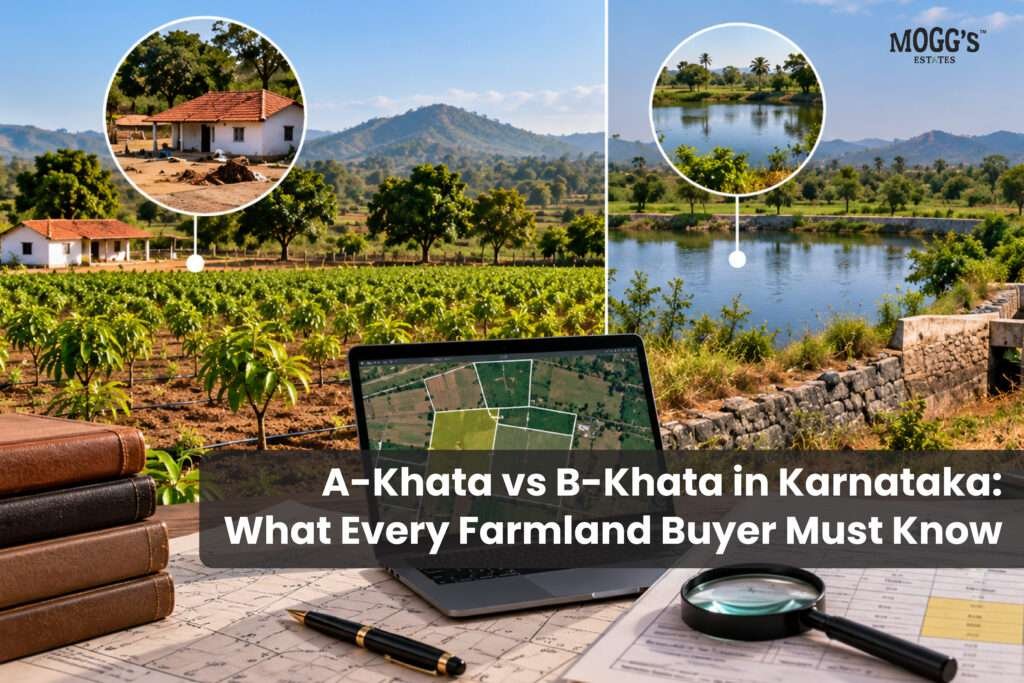
Khata categories apply to municipal property. Agricultural land is recorded mainly through RTC or pahani records, mutation entries, survey records, and revenue documents. If you are buying genuine farmland outside the municipal framework, a khata may not be the main document to check.
For farmland, ask what the land’s legal status is, which records establish ownership, and what use the law permits, along with the title, encumbrance history, and conversion status.
Common Mistakes Buyers Make
- Assuming A khata means the property is fully legal. Title and approvals still need checking.
- Assuming B khata means the property cannot be bought. Each case depends on the violation.
- Believing tax payment cures a violation. Paying tax does not fix title or approval problems.
- Relying on a broker’s assurance that the property will convert.
- Using outdated fees or rules from older articles.
- Confusing the khata with the title deed.
Final Thoughts:
A khata vs B khata matters, because it affects resale, loans, licences, and renovation. But the category is only one part of due diligence. A safe purchase depends on the sale deed, the title chain, encumbrances, approvals, tax status, and the current khata record, all checked against official sources and a property lawyer’s advice.
FAQs:
What is the difference between A khata and B khata?
A khata is the municipal register for properties that meet building bylaws, tax norms, and other rules. A B khata is for properties that are non-compliant with some or all of those requirements. Both are used for property-tax records.
Is A khata proof of ownership?
No. A khata is a municipal tax record. Ownership is shown by the registered sale deed and the title chain.
Is a B khata property illegal?
Not automatically. The status depends on the specific violation. Verify the reason for the B classification, the title, and the approvals before deciding.
Can a B khata be converted to A khata?
It may be possible for properties with minor deviations. The process includes land conversion where needed, clearing tax dues, and submitting documents to the municipal office. Eligibility must be confirmed for each property.
What is a khata extract?
A khata extract is a detailed municipal document that shows the property’s area details and identification number, and the data used to calculate property tax. Buyers of B khata properties usually receive only the extract.
Do I need to transfer the khata after buying a resale property?
Yes. A khata transfer puts the property in the buyer’s name in the municipal records. Check the current deadline under the applicable municipal law with your lawyer.
Can I get a bank loan on a B khata property?
Lenders often hesitate, and some do not lend for building loans against B khata properties. Check with the bank before you commit.