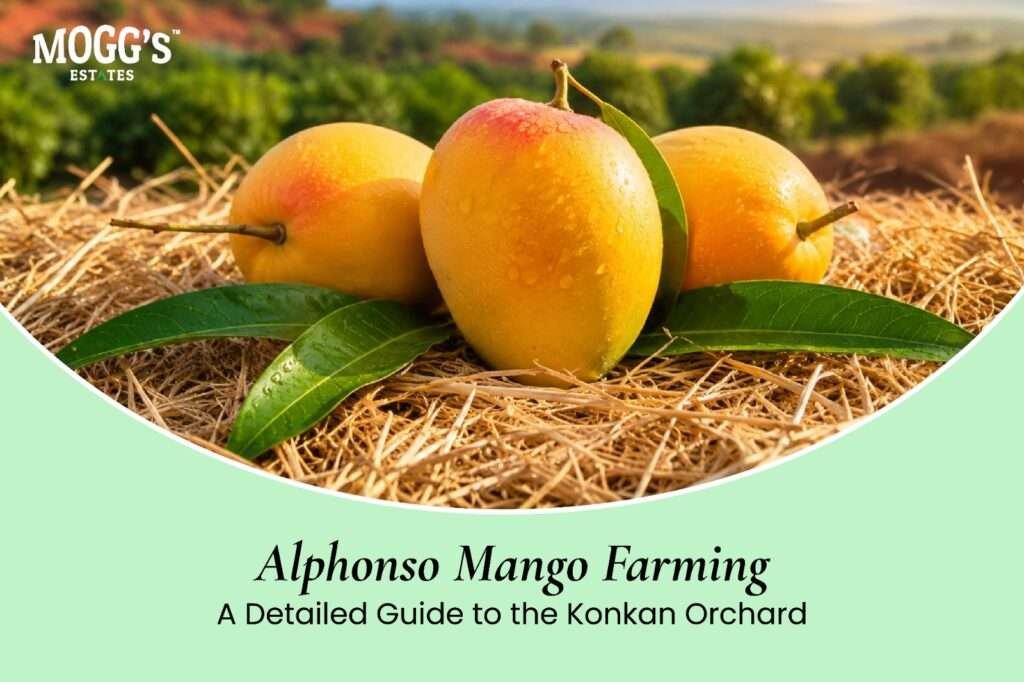
Every Alphonso mango farming plan starts with the site. Alphonso mango farming works best in the warm, humid Konkan coast of Maharashtra, on well-drained laterite or loamy soil. The variety is terroir-sensitive, and it demands careful planning from the first sapling to the final harvest. Growers establish orchards with grafted plants, use de-blossoming to build the young tree’s frame, and then run a yearly cycle of controlled flowering, fruit protection, and a short harvest. Its two defining challenges are biennial bearing, which swings yields between heavy and light years, and spongy tissue disorder, which damages fruit quality without any outward sign. Anthracnose and fruit fly add pressure during the wet and fruiting seasons. Confirm practices for your site with a horticulture expert or Krishi Vigyan Kendra, and verify any orchard claim before you pay.
This guide covers the practical side of Alphonso mango farming, not only the variety’s history. For general mango practices across Karnataka, such as district variety choice and routine orchard hygiene, see our mango farming in Karnataka guide.
Alphonso Mango Farming and the Geographical Indication
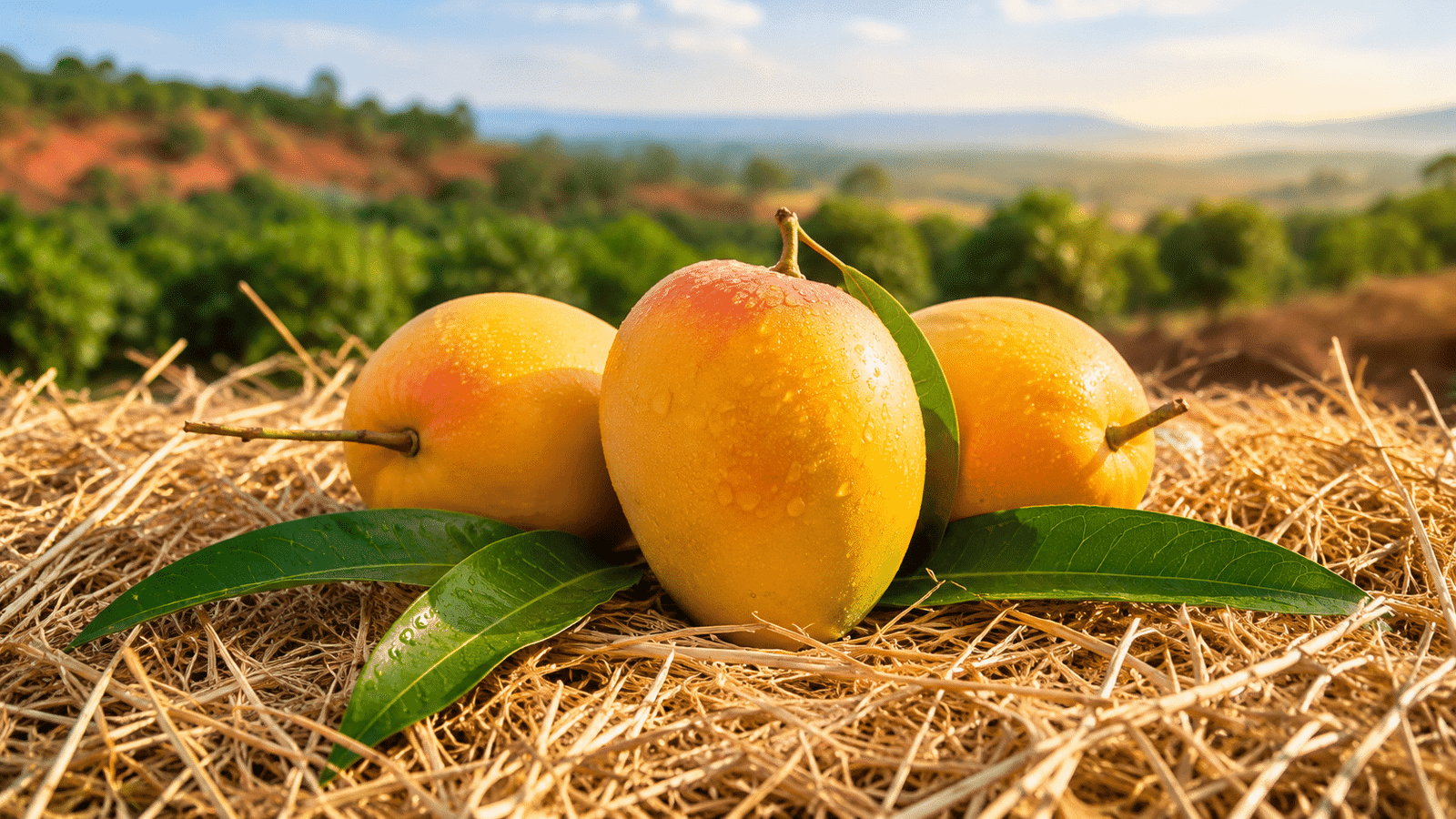
Alphonso, known in Marathi as Hapus, is valued for its smooth, non-fibrous pulp, its aroma, and its golden colour. A Geographical Indication (GI) tag was granted in 2018 for Alphonso from defined areas of the Konkan region of Maharashtra. The GI restricts the Hapus designation to fruit from those recognized areas. A grower outside them cannot sell fruit under that name, however good it looks.
The GI shapes planning. Before choosing a site, confirm whether it lies within the recognized area, and whether the fruit it produces can qualify for the GI name. Check the districts and conditions directly on the official GI registry rather than relying on a summary.
The variety’s history is often told through popular accounts that link it to Portuguese introduction on the western coast. The details are debated, so this guide does not present any origin story as established fact.
The Konkan Terroir and Why Location Matters
The Konkan coast combines laterite soils, sea breezes, high humidity, and a distinct rainfall pattern. Growers and researchers generally link the variety’s flavour and texture to this combination. The same character cannot be reliably reproduced by planting the tree in any warm climate.
Outside the Konkan, the tree may still flower and fruit. The fruit can be sound and pleasant, but its character, disease pressure, and yield may differ. Alphonso grown in Karnataka or South Gujarat should be described by its actual origin and quality, not as GI-grade Hapus. North India’s dry climate is generally considered unsuitable for the variety.
For a site decision, compare the site’s climate, soil, and water with Konkan conditions. Ask a horticulture expert whether the variety will perform at the yield and quality you need, and whether the fruit will meet the market you plan to supply.
Site Requirements for Alphonso Mango Farming
Every Alphonso mango farming plan starts with the site.
Drainage. The variety does not tolerate waterlogged roots. Choose land that drains quickly after heavy rain, and avoid low pockets where water stands for more than a short time.
Soil. Well-drained laterite or loamy soil is the usual choice, with a pH generally in the mildly acidic to neutral range. Test the soil for pH, nutrients, organic matter, and depth before planting. Shallow or compacted soil restricts root growth and makes the orchard more sensitive to drought and waterlogging.
Water. Young trees need regular irrigation, and mature trees need steady moisture during fruit development. Check the water source for yield and reliability through the dry season.
Exposure and wind. Strong winds can damage flowers and young fruit. Consider the wind pattern of the site, and plan windbreaks where exposure is high.
Access. The harvest is short and intense, so trucks and labour must reach the orchard in April, May, and June. Test the access road during the monsoon.
Grafted Planting Stock and Nursery Records
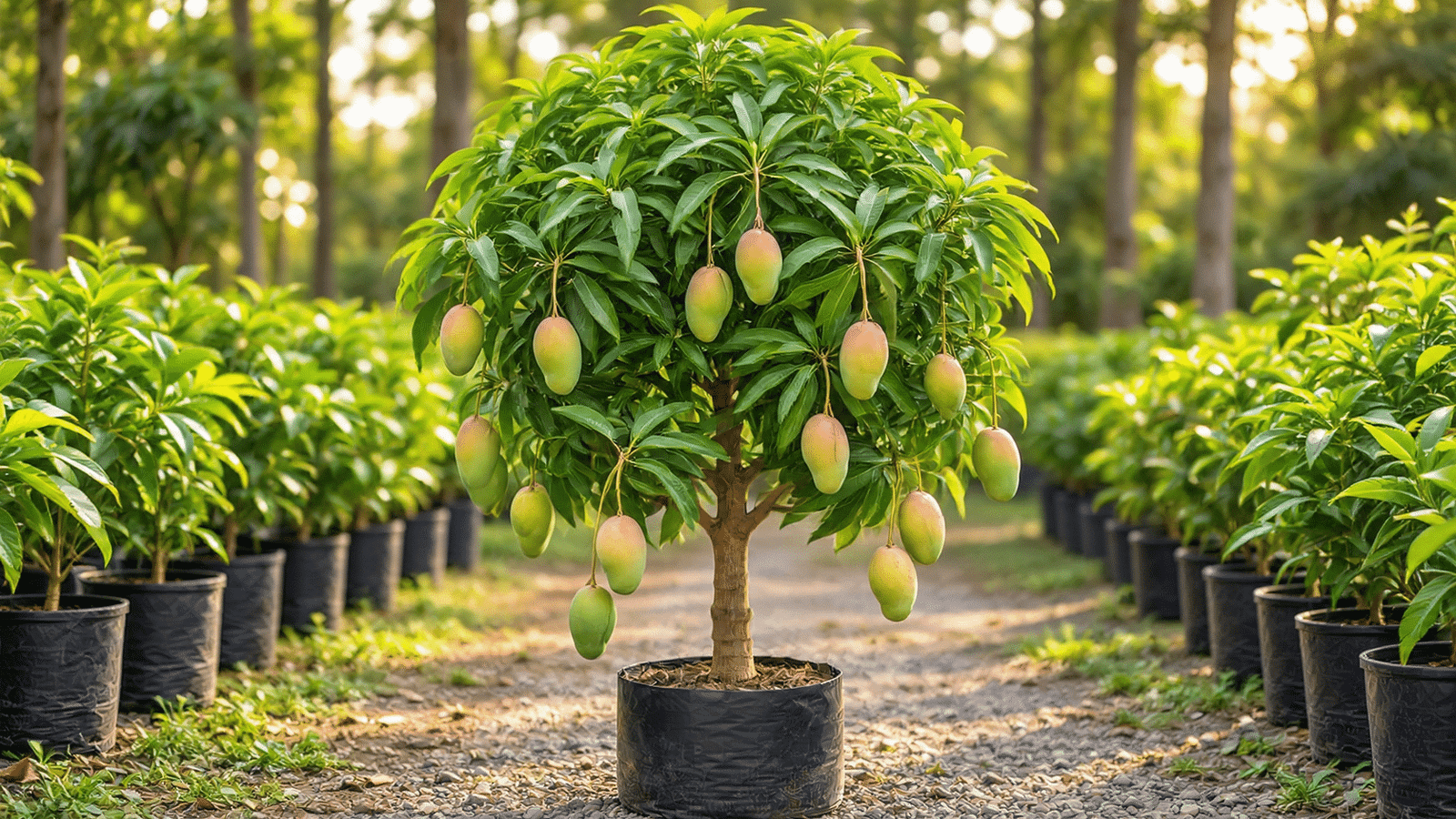
Good planting stock is the foundation of any Alphonso mango farming project. Alphonso must be propagated by grafting. Seed-raised trees do not reliably carry the variety’s qualities, and they can produce fruit that is not true to type. Buy grafted plants only from a nursery that can show the source of the mother stock, the rootstock used, and its grafting records.
Ask the nursery for:
- The mother tree or source, with a record of how it was selected
- The rootstock, and whether it suits the soil and climate of your site
- The age and health of the plants at dispatch
- A written guarantee on variety identity, with a replacement policy for plants that prove untrue to type
Keep your own planting map, recording the row, position, planting date, and nursery batch for each tree. These records help with later decisions and with any dispute about variety or performance.
Alphonso Mango Farming Spacing and Orchard Layout
Spacing shapes the orchard for decades, so the decision should be made with an expert. Traditional orchards commonly use wide spacing of about 8 to 10 metres, which gives large canopies and long-lived trees. Closer high-density systems, sometimes around 4 to 5 metres, produce more trees per acre and earlier yields, but they need tighter pruning, canopy control, and more careful management.
Whatever spacing you choose, lay out rows so that machinery, spraying equipment, and harvest workers can reach every tree. Mark planting positions accurately before digging, leave access lanes at the edges and across the orchard, and avoid planting in any natural drainage path.
The Juvenile Phase: De blossoming and Frame Building
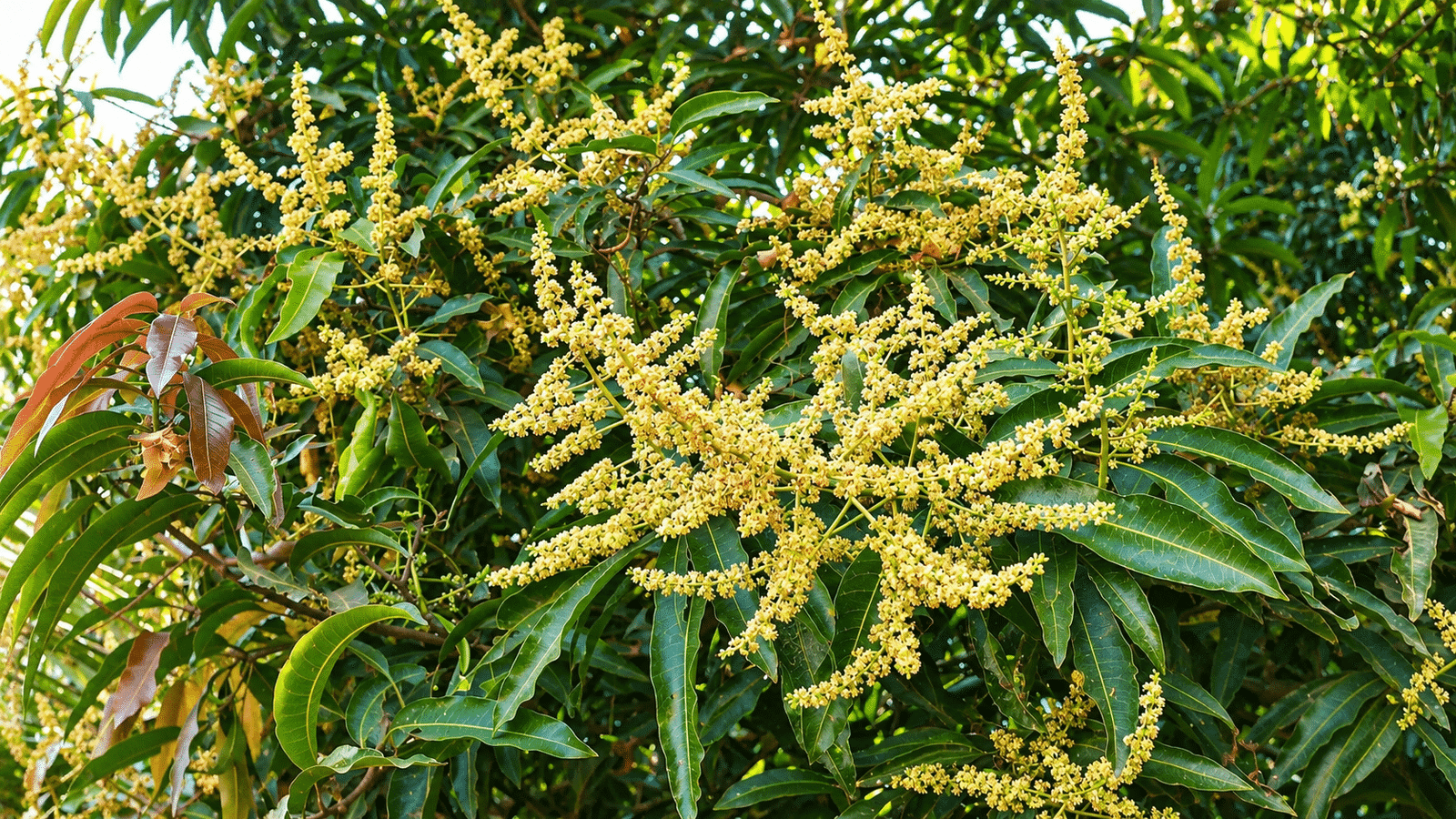
Young Alphonso trees are usually not allowed to carry a full crop. In the early years, growers remove early flowers, a practice called de-blossoming, so that the tree directs its energy into a strong frame of branches and roots. A tree that bears too early often grows poorly, carries weak branches, and produces a poor crop for years afterward.
The timing and the number of years depend on the tree’s growth, the district, and the expert’s recommendation. Record each year’s de-blossoming, so the tree’s history is clear when you plan the first commercial crop. Ask the horticulture adviser to set a schedule that matches the frame and vigour of your trees.
Canopy Management and Pruning
Pruning shapes the canopy, removes dead or diseased wood, opens the centre of the tree to light and air, and keeps fruiting wood within reach for harvest and spraying. Good pruning also reduces the spread of disease and supports flowering.
Prune after harvest, when the tree is recovering and the wood can heal before the next flowering. Remove crossing and crowded branches, and keep the canopy open. In high-density orchards, canopy control is more demanding, and it must be planned from the start rather than corrected later.
Clean pruning tools between trees, and remove infected material from the orchard so that it does not become a source of anthracnose.
Irrigation and Nutrition Through the Year
Water and nutrition decide much of the output in Alphonso mango farming. Alphonso’s water needs change through the year. Young trees need regular watering while their roots establish. Mature trees need steady moisture during fruit development, but they should not be watered heavily around flowering, when a dry spell before flowering helps the tree set fruit.
Drip irrigation is widely used because it delivers water near the roots without waterlogging the soil. Install the system before planting, test it for even flow, and check emitters regularly. Irrigate according to soil moisture and the tree’s stage, not only a fixed calendar.
Nutrition should follow soil test results. Apply major nutrients and organic matter in the amounts and timings recommended for the orchard’s stage. Avoid over-application, which can encourage vegetative growth at the expense of flowering. Keep a record of every application.
Controlled Flowering and Fruit Set
Flowering is the most important stage of the Alphonso year, because the fruit crop is set during it. Temperature, humidity, rain during flowering, and the tree’s condition all affect the result. Rain or high humidity at flowering can encourage fungal disease and reduce fruit set.
Growers influence flowering in several ways. They manage water and nutrition in the months before flowering, and some orchards use growth regulators under expert guidance. Paclobutrazol is one such regulator. Its dose, timing, and method must be set by a qualified adviser for the specific orchard and variety, and must follow the product label and local rules.
During flowering, monitor the orchard regularly for hoppers and disease. Time any protective spray so that it does not harm pollinators unnecessarily.
Biennial Bearing in Alphonso Mango Farming
Biennial bearing, also called alternate bearing, is the defining yield challenge for Alphonso. A heavy crop often leaves the tree short of reserves, and the tree may then produce few flowers the next year. The result is a pattern of heavy and light years that complicates both planning and income.
Growers manage biennial bearing rather than expecting to eliminate it. The main approaches are:
- De-blossoming in heavy years, to reduce the fruit load and protect the tree’s reserves
- Careful nutrition, so the tree can rebuild after a heavy crop
- Growth regulation, where recommended, to encourage flowering in the right year
- Branch management, including ringing or girdling in some systems, under expert guidance and with the risks explained
Each practice has trade-offs, and some carry risks to the tree if done incorrectly. Apply them only with a qualified adviser who knows the orchard. Record each year’s crop, so the on and off pattern can be modelled over time.
Anthracnose and Fruit Fly
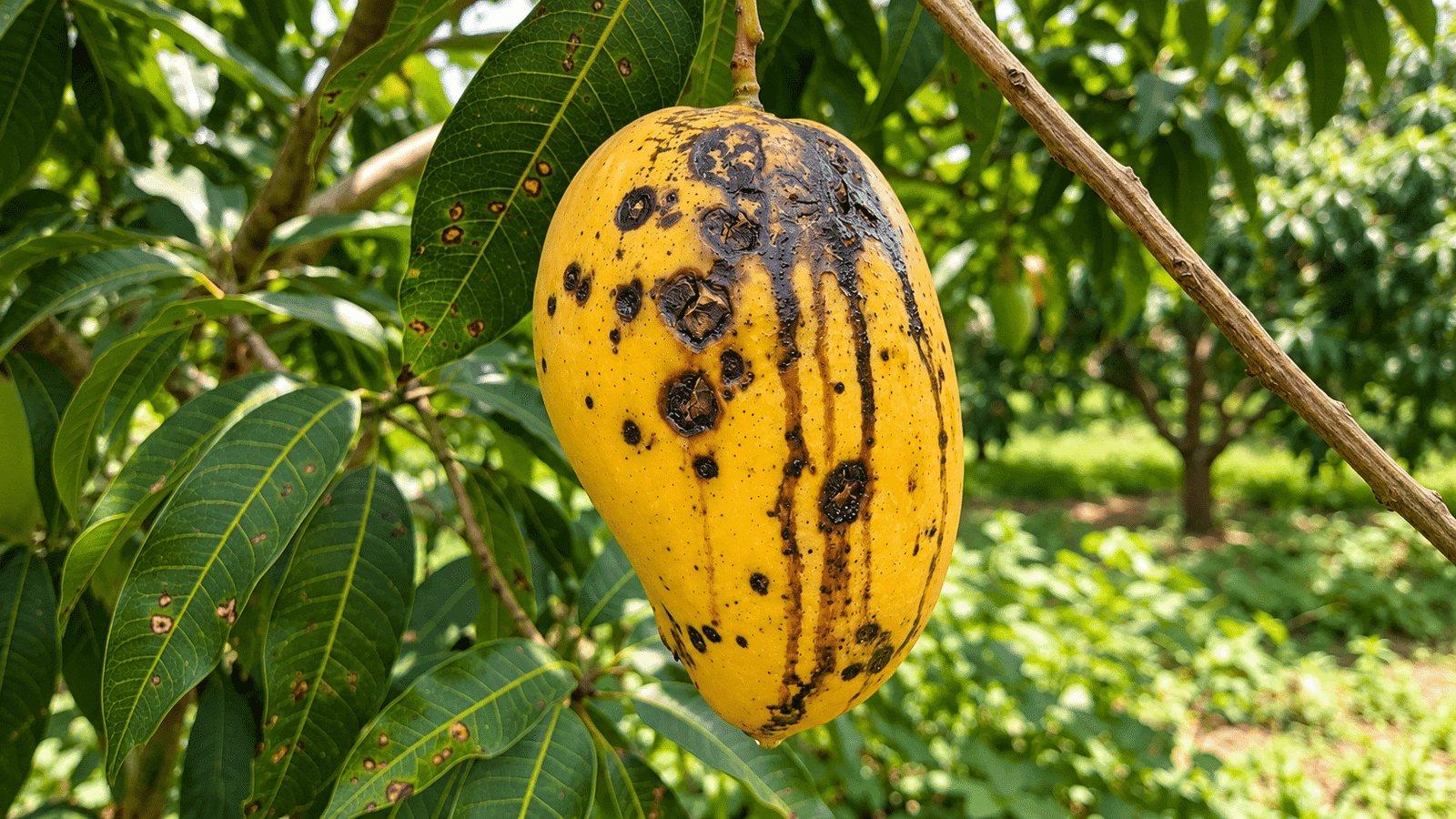
Disease control is one of the hardest parts of Alphonso mango farming in humid coastal areas. Anthracnose is the main disease concern in the humid conditions Alphonso needs. It can attack flowers, young fruit, and leaves, and it can continue to damage fruit after harvest. Prevention includes orchard hygiene, removal of infected material, timely protective treatments, and avoiding conditions that keep leaves and flowers wet.
Fruit fly is a serious pest of ripening fruit, and it affects marketability as well as yield. Traps where recommended, sanitation of fallen fruit, and approved control measures help protect the crop. Follow local advice on timing, and observe withholding periods and residue limits for the market you supply.
Other pests, including mango hoppers, mealybug, and powdery mildew, also need monitoring. Confirm the local pest calendar and approved treatments with the Horticulture Department or a Krishi Vigyan Kendra.
Spongy Tissue Disorder
Spongy tissue disorder is a physiological problem that affects Alphonso quality. Part of the pulp fails to ripen properly, so the affected area stays soft, fibrous, or discoloured while the rest of the fruit ripens normally. The defect is not visible from outside, so a fruit can look perfect and still be unsaleable when cut.
The disorder is associated with conditions that disturb normal ripening, including high temperatures and heat stress during development and after harvest. Growers reduce the risk through practices such as mulching to moderate soil temperature, maintaining good tree nutrition, and controlling post-harvest temperature exposure. Ask a horticulture expert to confirm the practices that apply to your orchard and climate.
Because the defect cannot be seen from outside, buyers and exporters often cut samples to check quality. Plan for this, and keep records of the heat conditions and handling steps for each lot.
Maturity, Harvest, and the Short Window
Alphonso should be harvested at the right maturity. Picking too early can leave fruit that does not ripen properly, and picking too late can cause softening and loss in transit. Growers judge maturity from fruit shape and shoulder development, skin colour change, and the number of days from flowering, with details confirmed for the local crop.
The harvest is concentrated into a short window, usually from late March into May and June, with the core often within about three to four weeks. This compression makes the harvest the highest-risk stage of the year. Labour, grading, packing, cooling, and transport must all be ready before the fruit is, and a shortage in any one of them can cause losses.
Harvest with care. Use cut stems, avoid bruising, and handle fruit gently. Damage at harvest is one of the most common causes of loss and rejection.
Post-Harvest Handling, Cooling, and Ripening
After harvest, fruit must be handled to protect its quality. The key steps include sorting, cleaning, grading, careful packing, and cooling where the market or handling system requires it. Cooling slows ripening and helps reduce the risk of spongy tissue and damage during transport.
Ripening should be done only through approved methods. Calcium carbide is prohibited as a ripening agent in India, and using it can expose sellers to penalties and health risks. Growers and traders should follow food safety rules and confirm current requirements with the Food Safety and Standards Authority of India and local regulators.
Export markets often apply specific protocols, including treatments and inspections. These depend on the importing country and change over time, so confirm them with the exporter, APEDA, and the importing authority before the season begins.
Grading, Packing, and Standards
Alphonso is sold by grade. Size, colour, shape, freedom from defects, and internal quality all affect price. Premium buyers often expect a specific size and presentation, and some require a particular packaging format.
Packing should protect fruit from pressure and heat. Use clean, suitable containers, and label each lot with the orchard, date, and grade. Traceability helps when a buyer asks about origin or quality, and it supports any GI claim.
Agree grading standards with the buyer in writing before the harvest. Settle the criteria, the inspection method, and what happens to fruit that does not meet the standard.
Markets and Price Reality
Alphonso sells through wholesale markets, retail outlets, direct sales, and export buyers. Each channel has its own requirements for grade, packing, timing, and payment. Before planting, identify at least one buyer, and understand the price basis, the payment terms, and whether the arrangement is written and binding.
Prices vary widely with the season, grade, year, weather, and the volume reaching the market. The first fruit of the season often sells at a premium, and prices typically soften as volume rises. Do not use a single price figure as a benchmark. Ask local buyers and check recent market records before estimating income.
Modelling the Alphonso Cycle
A realistic budget is essential for Alphonso mango farming, because income comes in uneven years. Alphonso income is uneven. A heavy year can produce a large crop, and a light year very little. Model the cycle over several years rather than using one average figure.
The cost side includes land, saplings, drip irrigation, support and maintenance, spraying, growth regulation where used, labour for pruning and harvest, cooling, packing, and transport. These costs fall in the years before full production, when the orchard produces little income against a larger outlay.
Build the model with a conservative case, a central case, and a poor case. Include a heavy year and a light year, and test a price drop at harvest. If the poor case produces a loss you cannot absorb, the orchard needs more reserves or a different plan.
Alphonso on Managed Farmland: Aira Farms Phase 1
Mango is part of the established plantation at Aira Farms Phase 1, a managed farmland project of about 20 acres near Kanakapura, about 50 kilometres from Bangalore. The project lists coconut, mango, lemon, custard apple, chikoo, jackfruit, and arecanut trees, along with tomato as another crop. The project is Aira Farms.
What the project page states:
- Mango is among the established fruit and plantation trees on the farm.
- Each plot has access to a dedicated water pipeline, and the property has a water tank with a storage capacity of more than 25 lakh litres.
- Borewell facilities and drip irrigation are listed, along with water management.
- Four full-time farm workers are assigned to support plot care and ongoing maintenance.
What the project page does not state:
- The mango varieties planted, and whether any of them is Alphonso
- The number of mango trees on each plot, and their ages
- The year the trees were planted, and when they are expected to bear
- The yield, the harvest arrangements, and who sells the produce
Kanakpura lies outside the Konkan coast, so a mango orchard there should not be described as Alphonso or GI-grade Hapus unless the variety and origin are confirmed in writing. Ask which variety each tree is, which rootstock was used, and how the trees are managed through flowering, biennial bearing, and anthracnose and fruit fly control.
For the general cultivation guide, see mango farming in Karnataka. For the wider model, see managed farmland in Kanakpura.
Who Should Consider Alphonso
Alphonso mango farming suits some growers more than others:
- Has a site that matches the Konkan terroir, or can confirm the variety will perform locally
- Can wait four to five years for a commercial crop, and accept early losses
- Can manage de-blossoming, pruning, flowering, and fruit protection with expert help
- Has a buyer, or a credible route to market, before planting
- Can absorb a light year without distress, and plan for it
It may not suit someone who needs quick income, cannot supervise the orchard through the short harvest, or expects a fixed yield.
Alphonso at a Glance
| Question | Short answer |
|---|---|
| Where does it grow best? | The Konkan coast of Maharashtra |
| Is it GI-protected? | Yes, from defined areas, granted in 2018 |
| How is it propagated? | Grafting; seed-raised plants are not reliable |
| Soil and drainage? | Well-drained laterite or loam; intolerant of waterlogging |
| Time to commercial crop? | Usually four to five years, after de-blossoming |
| Main yield challenge? | Biennial bearing |
| Main disorders? | Spongy tissue disorder; anthracnose and fruit fly |
| Harvest window? | Late March into May and June, core period of three to four weeks |
| Ripening rule? | Calcium carbide is prohibited; use approved methods only |
Key Takeaways
- Alphonso is a GI-protected variety, and its best-known quality is tied to the Konkan terroir.
- Grafted planting stock with verified records is essential. Seed-raised trees are not a reliable substitute.
- De-blossoming in the early years builds the frame the tree needs to carry a crop later.
- Biennial bearing is the central yield challenge, and it must be planned for every year.
- Spongy tissue disorder is invisible from outside, so quality checks and heat management matter.
- Anthracnose and fruit fly must be managed through hygiene, monitoring, and approved treatments.
- The harvest window is short, so labour, cooling, and transport must be ready in advance.
- Calcium carbide ripening is prohibited, and sale and export must follow current food safety rules.
- Aira Farms Phase 1 lists mango among its established trees, but varieties, numbers, and management terms must be confirmed for each plot.
FAQs:
Why is Alphonso called a terroir-sensitive variety?
Its best quality is generally linked to the Konkan coast’s soil, climate, and humidity. Outside that region, the fruit can differ in character and yield, so the origin should be described accurately.
How long does an Alphonso orchard take to produce a crop?
A grafted tree usually reaches commercial fruiting in about four to five years, after a juvenile phase in which early flowers are removed to build the frame.
What is biennial bearing in Alphonso?
It is a pattern in which a heavy crop in one year is often followed by a light crop the next. Growers manage it through de-blossoming in heavy years, nutrition, and growth regulation where recommended.
What is spongy tissue disorder?
It is a defect in which part of the pulp fails to ripen, staying soft or dis-coloured while the rest of the fruit ripens normally. It cannot be seen from outside, so it is checked by cutting.
Can calcium carbide be used to ripen Alphonso?
No. Calcium carbide is prohibited as a ripening agent in India. Use approved methods that comply with food safety rules.