
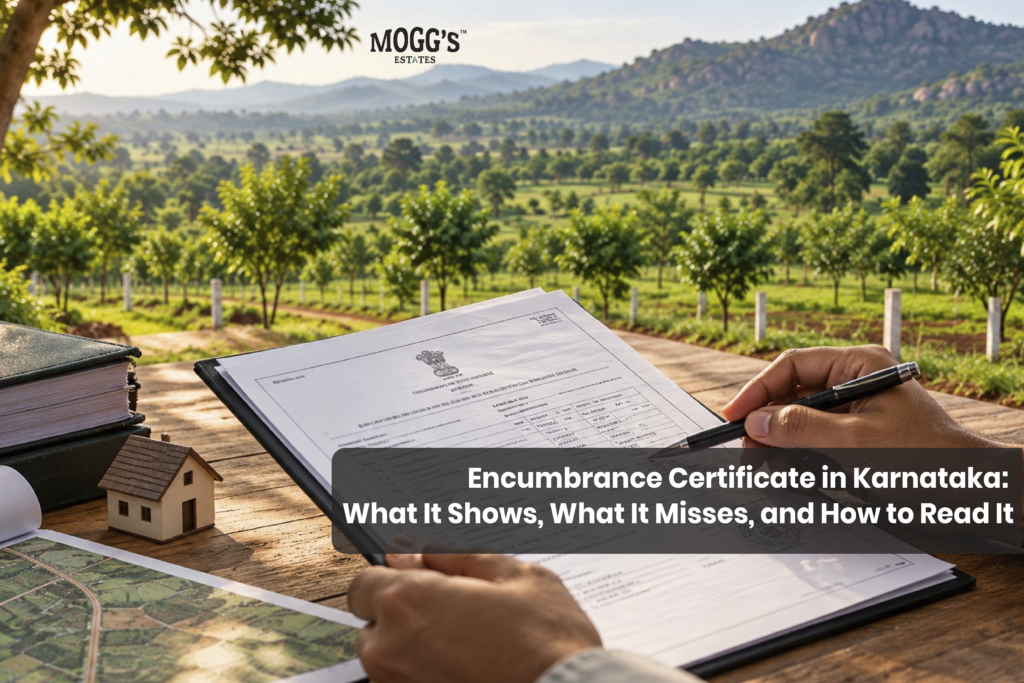
Quick answer: An encumbrance certificate (EC) in Karnataka is an official record of registered transactions affecting a property over a period you choose. It shows sales, mortgages, releases, gifts, and similar entries. A nil EC (Form 16) means no registered entries were found for that period. An EC does not prove who owns the land, and it cannot show unregistered agreements or disputes that were never recorded. For farmland, you also need to check the survey number, the RTC or pahani, and the mutation records.
Most buyers receive an EC at some point in a property deal, often because a bank asks for one. Many read only the word “nil” and move on. This guide explains what the document covers, how to apply, how to read every entry, and what to check beyond it.
What Is an Encumbrance Certificate in Karnataka?
An encumbrance certificate is issued by the Sub-Registrar’s office under the Department of Stamps and Registration. In Karnataka, it is available through the Kaveri online services portal, and it can also be requested in person at the Sub-Registrar’s office.
The word “encumbrance” refers to any charge, claim, or liability attached to a property. An EC lists the registered documents that create or record such charges during the period you choose. It does not give a verdict on whether the title is good. It gives a dated list of registered events.
What an Encumbrance Certificate Shows
An EC can include several kinds of registered entries:
- Sale deeds: Transfers of ownership from one person to another
- Mortgage deeds: Property pledged as security for a loan
- Release deeds: Records that a mortgage has been cleared
- Gift deeds: Transfers made without payment
- Partition deeds: Division of property among family members
- Settlement deeds: Documents that resolve a dispute between parties
- Court attachments: Orders that restrict the property, where they have been registered
- Lease deeds: Long-term leases, if they were registered
For each entry, the certificate typically records the property details, the date, the nature of the transaction, the parties, and the registered document number. Some entries also show the amount of consideration.
What an Encumbrance Certificate Does Not Show
This is the point most buyers miss. Because an EC is built from registered documents, it generally cannot show:
- Unregistered agreements, including some sale agreements and family arrangements
- Court cases that have not been formally recorded against the property
- Unpaid property tax or society maintenance dues
- Whether the seller’s title is valid in the first place
- Whether the land is agricultural or converted, or whether it has a valid khata
- Mutation status in the revenue records
A clean EC is a good sign. It is not the same as a clean title. Treat it as one strong signal among several.
Form 15 vs Form 16: What the Result Means
The EC comes in one of two forms. You do not choose between them. The result depends on what the records show for the period you searched.
Form 15 is issued when registered transactions are found in the search period. It lists each entry in date order. Your task is to account for every entry, and especially every mortgage.
Form 16, often called a nil EC, is issued when no registered entries are found for the period searched. It is useful evidence, but only for that period and only for registered records.
Two practical points follow. First, a Form 16 for a short period tells you little about older history. Second, the form number does not tell you whether the title is clean. You still need to read the document and check it against the sale deed.
Why an Encumbrance Certificate Matters for Farmland and Plots
An EC is searched by property details, usually the survey number. For agricultural land, that makes the survey number critical. Three risks are specific to farmland:
- Sub-division. If a survey number was divided into sub-plots (hissa), earlier entries may sit under the old number. A search on the new number alone can miss them.
- Partial sales. If you are buying part of a survey number, the EC for the whole number may not show the exact portion you are buying. The 11E sketch identifies that portion, and it should be matched to the EC.
- Revenue records. The EC does not show the RTC or pahani, the cultivation details, or whether mutation has been completed. These must be checked separately.
For these reasons, an EC for farmland should always be read alongside the sale deed, the RTC, the mutation status, and the survey documents.
How to Apply for an Encumbrance Certificate Online
The online route is through the Kaveri portal of the Karnataka Department of Stamps and Registration. Use the official government site, not a third-party page. The general steps are:
- Visit the Kaveri online services portal at kaveri.karnataka.gov.in and register or log in.
- Open the encumbrance certificate service from the services menu.
- Choose the district, the taluk, and the Sub-Registrar office that covers the property.
- Enter the property details exactly as they appear in the sale deed or the revenue record, including the survey number.
- Select the search period.
- Verify your details, including any OTP confirmation.
- Pay the fee the portal calculates.
- Download the digitally signed certificate once it is issued.
Accuracy matters more than speed. A wrong survey number can produce a certificate for a different property, or one that misses the entries you need.
How to Apply Offline at the Sub-Registrar’s Office
If the portal does not cover the years you need, or you prefer to apply in person, go to the Sub-Registrar’s office that covers the property. Ask for the application form, which is commonly referred to as Form 22. Confirm the current form and its requirements with the office.
Bring the property details, identity proof, and the sale deed or revenue record that shows the survey number. Pay the prescribed fee and keep the acknowledgement. Older records may be held in manual registers, so a long search period can require a manual search in addition to the online result. Ask the office which years the online records cover.
How Many Years Should an Encumbrance Certificate Cover?
The search period is one of the most important choices in the process. Practice varies, but many property lawyers recommend a search of at least 13 years for a basic check and about 30 years for a purchase. The longer the search, the more likely you are to see an old mortgage, a partition, or a break in the chain.
A short search can look reassuring while hiding an older problem. If the property has been owned by several families over time, ask your lawyer for a longer period.
Fees and Processing Time: Check the Portal
Fees and processing times for encumbrance certificates vary across sources, and government fees can change. Some guides quote fees per year of search with separate service charges. Processing can range from a day or two for an online certificate to a week or more, depending on the office and the records.
Do not rely on a figure from any article, including this one. Check the fee and timeline on the Kaveri portal or with the Sub-Registrar’s office before you apply, and budget for a possible delay before any token amount or loan deadline.
How to Read an Encumbrance Certificate, Entry by Entry
Reading the certificate is the step that protects your money. Work through it in this order.
- Check the period: Confirm that the certificate covers the years you asked for.
- Check the property details. The survey number, village, and taluk should match the sale deed. A mismatch means the wrong property may have been searched.
- List every entry. Note the date, the document type, the parties, and the document number.
- Trace the chain. Each transfer should link to the next. The buyer in one sale should be the seller in the next.
- Match every mortgage with a release. A mortgage with no later release may still be live.
- Check the names. Spelling changes and name changes should be explained, not ignored.
- Verify the certificate. Digitally signed copies can be checked on the official portal.
A simple example:
Suppose one entry reads: a sale deed registered in 2015, by Mr A to Mr B. That entry says the property moved from A to B in 2015. Your next questions are whether there is a later transfer that brings ownership to your seller, and whether any link is missing.
Red Flags in an Encumbrance Certificate
Some entries call for a closer look before you proceed:
- A mortgage with no matching release
- Two transfers of the same property that overlap in time
- A gift or settlement deed in the middle of the chain, which can change who had the right to sell
- A sudden change in the survey number, extent, or boundaries between entries
- Names that appear in the EC but not in the sale deed, or the reverse
- A search period that is too short to reveal the full history
None of these automatically means the deal is unsafe. Each one means you need an explanation, and that explanation should come from the underlying documents, not the summary alone.
EC vs Khata vs RTC vs Title Deed
Buyers often confuse these documents. Each answers a different question.
| Document | What it shows | What it does not show |
|---|---|---|
| Encumbrance certificate | Registered transactions and charges over a period | Unregistered deals, tax dues, revenue status |
| Sale deed | The transfer between buyer and seller | Whether the seller’s own title was clean |
| Title chain | The sequence of ownership transfers | Anything not documented in the chain |
| Khata (urban land) | Municipal tax register entry | Mortgages or charges |
| RTC or pahani (agricultural land) | Owner, survey number, extent, and cultivation details | Full title history or registered mortgages |
| Mutation record | Whether the revenue record shows the current owner | The validity of the underlying transfer |
For a complete check, read the EC with the sale deed, the title chain, the khata or RTC, and the mutation status. No single document is enough.
Common Mistakes Buyers Make With an EC
- Reading only the word “nil.” A nil result still needs checking against the sale deed.
- Searching too short a period. A few years can hide an old problem.
- Using the wrong survey number. This can produce a certificate for the wrong land.
- Ignoring sub-division history. Earlier entries may sit under the old survey number.
- Assuming a clean EC means a clean title. The EC does not cover unregistered agreements or disputes.
- Skipping the EC because the seller is trusted. Trust is not a document.
- Ordering the EC too early. An EC shows only the period up to the date of the search.
When to Get an Encumbrance Certificate
Get an EC at three points in a property deal:
- Before paying a token amount or advance. This is the cheapest point to walk away.
- Before a bank sanctions a loan. Lenders usually ask for one, and may set the period.
- Shortly before the sale deed is registered. A new EC will show any entries made since the first search.
An EC covers only the period up to the date it was issued. Anything registered afterwards will not appear, so timing matters.
Encumbrance Certificate Checklist for Farmland Buyers
Before you pay beyond a refundable booking amount, confirm that you have:
- An EC for the full search period your lawyer recommends
- A matching survey number, extent, and village on the EC and the sale deed
- A full chain of registered transactions with no gaps
- A release for every mortgage shown on the EC
- The RTC or pahani for the same survey number
- Mutation status showing the seller as the current owner
- The 11E sketch, if you are buying part of a survey number
- A fresh EC shortly before registration
- A written review from a qualified property lawyer
How Managed Farmland Buyers Can Use the EC
Buyers evaluating managed farmland face one extra question. The land may be owned by the buyer, while farm operations are handled by the operator. The EC applies to the land, not to the management arrangement.
Ask any managed farmland operator for the EC and the title documents for your specific plot before you pay beyond a booking amount. Compare the survey number, extent, and boundaries on the EC with the plot the operator shows you. A clear EC does not replace a site visit, a lawyer’s review, or a reading of the management agreement, but it is one of the first documents to request.
If you are comparing managed farmland options, including Mogg’s Terra Hill, use the same checklist for every project. Ask each operator for the same documents, and do not treat any brochure as a substitute for them.
Final Thoughts:
The encumbrance certificate is a valuable check. It shows the registered history of a property, and it can reveal a mortgage or charge that would otherwise go unnoticed. Its limits matter just as much. It records only registered documents, it depends on the survey number you enter, and it says nothing about revenue records or unregistered agreements.
Get the EC at the right time, choose a search period long enough to cover the property’s history, and read every entry. Then check the result against the sale deed, the RTC, and the mutation status. A careful review of these documents, with a qualified property lawyer, is what turns a certificate into a decision you can rely on.
FAQs:
What is an encumbrance certificate in Karnataka?
It is an official record of registered transactions affecting a property over a period you choose. It shows sales, mortgages, releases, gifts, and similar entries.
What is the difference between Form 15 and Form 16?
Form 15 lists registered entries found in the search period. Form 16, often called a nil EC, means no entries were found for that period.
Is a nil encumbrance certificate proof of a clean title?
No. It shows that no registered entries were found for the period searched. It does not cover unregistered agreements, unrecorded disputes, or revenue records.
How many years should an encumbrance certificate cover?
Many lawyers recommend at least 13 years for a basic check and about 30 years for a purchase. Ask your lawyer for the right period for the specific property.
Can I get an encumbrance certificate online in Karnataka?
Yes, through the Kaveri online services portal. Check the current fee and processing time on the portal before you apply.
Does an encumbrance certificate show the RTC or khata?
No. The EC shows registered transactions. The RTC or pahani and the khata are separate records, and both should be checked.
What if my farmland was sub-divided?
Earlier entries may appear under the old survey number. Ask your lawyer to check the sub-division history and the EC under all relevant numbers.
When should I get a fresh encumbrance certificate?
Get one shortly before the sale deed is registered. An EC covers only the period up to its issue date, so a new search captures any entries made since the first one.