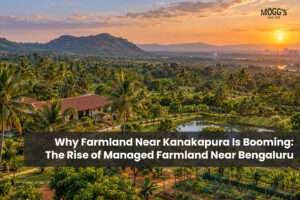

For years, investors in Bengaluru have largely focused on apartments, commercial properties, plotted developments and financial assets. But as the city grows denser and urban living becomes more expensive, another asset class is quietly gaining attention farmland near Bengaluru.
Farmland offers something that many conventional investments cannot — ownership of a tangible, finite resource combined with the possibility of long-term appreciation and a lifestyle connection to nature. For investors who think beyond short-term gains, agricultural land can form an interesting part of a diversified portfolio.
The growing interest is also visible around Bengaluru, where managed farmland communities are attracting professionals, entrepreneurs and families looking for land outside the city without taking on the entire responsibility of managing a farm themselves. Recent reporting has highlighted the increasing popularity of managed farmlands around Bengaluru, driven by demand for weekend retreats, sustainable living and long-term land ownership.
Farmland Is a Tangible Asset
One of the biggest reasons farmland remains attractive is simple: it is real.
Unlike many financial assets that exist primarily as numbers on a screen, land is a physical resource. It cannot be manufactured or reproduced. As cities expand and available land around major urban centres becomes more limited, well-located agricultural land can become increasingly valuable.
This scarcity gives farmland a different investment profile from assets that can be created in large numbers.
For someone considering farmland for sale, however, location remains critical. Accessibility, surrounding development, water availability, soil quality, documentation and future infrastructure can all influence the property’s long-term potential.
The goal should not simply be to buy land. It should be to buy the right land.
Bengaluru’s Expansion Is Changing the Farmland Story
Bengaluru continues to expand beyond its traditional urban boundaries. As residential, commercial and infrastructure development moves outward, areas surrounding the city are attracting increasing attention.
This creates an interesting opportunity for investors who are willing to take a long-term view.
Land on the outskirts can offer a combination of relatively open surroundings, improving connectivity and proximity to a major economic centre. The appeal becomes stronger when the property is located along established or emerging growth corridors.
However, appreciation should never be treated as guaranteed. Farmland is a long-term asset, and its performance depends heavily on location, legal status, infrastructure and market conditions.
Managed Farmland Makes Ownership More Convenient
Traditional farmland ownership can involve considerable responsibility. Farming requires knowledge, labour, irrigation, crop planning, maintenance and regular supervision.
For a busy Bengaluru professional, managing all of this personally may not be practical.
This is where managed farmland offers a different ownership model.
In a managed farm, professional teams can take care of activities such as plantation management, irrigation, maintenance, security and general upkeep, depending on the project structure. This allows the owner to enjoy the benefits of owning agricultural land without necessarily handling every operational detail.
The concept has gained attention among urban buyers precisely because it bridges two worlds: land ownership and convenience.
For buyers considering managed farmland, it is important to understand exactly what the management agreement covers, what the recurring charges are and what responsibilities remain with the landowner.
Farmland Can Add Diversification to a Portfolio
A strong investment portfolio is rarely built around a single type of asset.
Equities, bonds, deposits, gold and real estate each respond differently to economic conditions. Farmland adds another dimension because its value is connected to physical land, location, agricultural activity and surrounding development.
This does not mean farmland should replace financial investments. Instead, it can be considered as one component of a broader long-term wealth strategy.
Investors should also avoid comparing farmland with stocks or fixed deposits purely on headline returns. Each asset has different liquidity, risks, costs and time horizons.
Farmland is generally better suited to investors who can think in years rather than months.
The Lifestyle Value Is an Important Advantage
There is another reason farmland is becoming attractive: people increasingly want more than financial returns from their properties.
A piece of farmland can become a place to slow down, spend weekends with family and reconnect with the outdoors.
For some owners, the vision may include a farmhouse surrounded by greenery. For others, it may simply be an orchard, plantation or peaceful retreat away from the city’s traffic and noise.
This lifestyle element gives farmland a unique position between an investment and an experience.
It is also one reason why farm communities with recreational facilities, nature-focused spaces and resort–style amenities are gaining attention among urban buyers.
Farmland Can Support Long-Term Thinking
Investments are often evaluated through short-term performance. Farmland encourages a different mindset.
Trees grow. Landscapes develop. Infrastructure changes. Cities expand. New roads and economic activity can gradually transform areas that once seemed distant from the urban centre.
That makes farmland particularly interesting for investors with a long-term perspective.
However, patience is essential. Agricultural land should not be viewed as a quick-profit opportunity. The strongest investment decisions are generally based on fundamentals rather than promises of rapid appreciation.
Before purchasing, buyers should examine the title, survey records, land classification, access, water availability, applicable land-use rules and any restrictions associated with the property.
Karnataka’s land laws have also evolved over time. The 2020 amendments removed the earlier restrictions under Sections 79A and 79B that had limited agricultural land purchases by non-agriculturists and certain entities.
Even so, buyers should conduct proper legal due diligence because eligibility to purchase does not automatically mean that every use or construction activity is permitted.
The Importance of Location Near Bengaluru
When evaluating farmland near Bengaluru, location should be considered from more than one angle.
A property may look attractive because it is inexpensive, but accessibility and surrounding development can have a major influence on its future appeal.
Investors should consider:
- Distance and travel time from Bengaluru
- Quality of approach roads
- Nearby highways and major infrastructure
- Water availability
- Soil and agricultural suitability
- Surrounding development
- Legal documentation and title history
- Maintenance and security arrangements
- Future usability of the property
Growth corridors around Bengaluru, including areas toward Hoskote, Kanakapura, Kunigal and Maddur, have attracted increasing interest as the metropolitan region expands.
The right location can make the difference between simply owning land and owning an asset with genuine long-term potential.
Farmland Versus Conventional Urban Property
Apartments provide a home and can generate rental income. Commercial properties can provide income through tenants. Plotted developments can offer exposure to urban expansion.
Farmland offers something different.
It combines land ownership with agricultural potential and lifestyle value. There are also fewer built structures to depreciate compared with conventional residential properties.
For buyers looking at farmhouses or weekend properties, farmland can provide a larger connection to open space than a conventional city home.
The important distinction is that farmland should not be purchased with the expectation that it can automatically be converted into residential or commercial property. Land-use regulations matter, and buyers should verify what is legally permissible before making a decision.
What Smart Farmland Buyers Should Look For
The most attractive farmland opportunity is not necessarily the cheapest one.
A thoughtful buyer should look for a combination of location, legal clarity, accessibility, management and long-term potential.
Documentation should be reviewed independently. The property’s survey details should be verified. Water and access should be assessed. If the property is professionally managed, the management agreement should be read carefully.
Buyers should also be cautious about claims of guaranteed returns or fixed appreciation. No legitimate investment can eliminate market risk.
The better approach is to evaluate the underlying asset first and the marketing story second.
A Different Kind of Investment for a Changing Bengaluru
Bengaluru is changing rapidly. The city is expanding, lifestyles are evolving and investors are beginning to look beyond traditional property formats.
That is why farmland deserves attention as an alternative asset class.
For the right investor, farmland can offer tangible ownership, long-term potential, diversification and a lifestyle advantage. Managed models can make that ownership more convenient, particularly for people who want the experience of owning a farm without managing every agricultural activity themselves.
Whether the objective is long-term wealth creation, a weekend retreat or eventually building a personal connection with the land, the appeal of farmland goes beyond numbers.
For those exploring farmland for sale around Bengaluru, the most important question is not simply, “How much can this land appreciate?”
It is, “What makes this land valuable today, and what could make it valuable tomorrow?”
That is the question that turns a land purchase into an informed investment decision.
Final Thought
Farmland may not offer the instant gratification of a new apartment or the daily visibility of a stock portfolio. Its strength lies elsewhere — in its physical presence, limited supply, agricultural purpose and potential to become more valuable as the world around it changes.
For investors seeking a long-term asset with both financial and lifestyle relevance, farmland near Bengaluru is becoming increasingly difficult to overlook.