
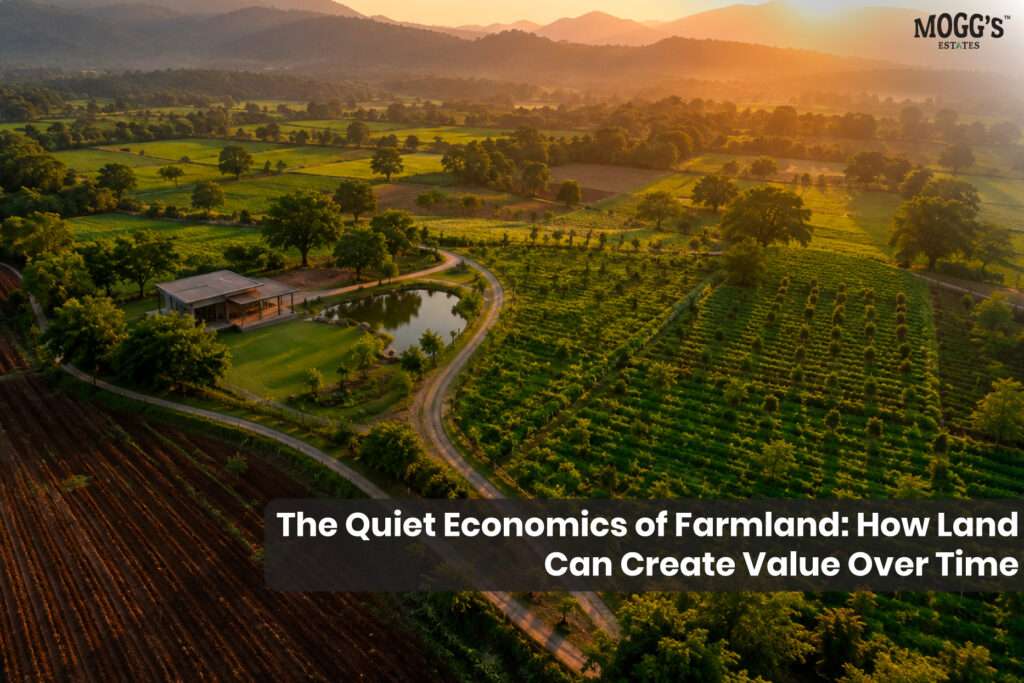
Returns Start With More Than a Price Tag
When people hear the word investment, they often think about stocks, apartments, gold or commercial property.
Farmland rarely enters the conversation first.
Yet agricultural land has a unique quality. It is a real, physical asset with several possible sources of value.
The land itself can appreciate. Productive farming can generate agricultural income. Better infrastructure can improve accessibility. Professional management can make ownership easier. Over time, changing demand can also influence the value of well-located land.
This is why understanding how farmland generates returns requires looking beyond its purchase price.
Farmland is not simply about buying land and waiting.
It is about understanding what creates value around that land.
1. Land Appreciation: The Long-Term Engine
One of the most important ways farmland can generate returns is through appreciation in land value.
Land prices do not move for just one reason. Location, accessibility, infrastructure, development activity, demand and availability can all influence future value.
Consider land on the outskirts of a growing city.
At one point, it may be surrounded mainly by agricultural fields. Over time, roads may improve. New communities may appear. Commercial activity may expand. Travel times may reduce.
The character of the surrounding area can gradually change.
This is particularly relevant when looking at Bengaluru’s growth.
As the city expands outward, areas beyond the traditional urban boundary can attract greater attention from different types of buyers. That does not mean every parcel will appreciate at the same rate. However, it highlights why location remains one of the most important factors in farmland investment.
2. Productive Land Has a Second Layer of Value
Farmland is different from many other forms of property because it can remain productive.
A well-maintained agricultural property can support crops, plantations, orchards or other farming activities, depending on the land and applicable regulations.
This creates another potential source of value.
The land is not simply sitting idle.
It can be part of an agricultural system.
For farmers, productivity is naturally central to land ownership. For urban investors, understanding this agricultural dimension can provide a broader view of what they are actually buying.
Soil quality, water availability, crop selection, farm practices and maintenance can all influence agricultural performance.
The result is an asset that can combine ownership value with productive use.
3. Location Can Change the Investment Story
A common mistake in property investment is looking only at today’s location.
Long-term investors often look at what could happen around an asset.
This does not mean predicting the future with certainty. It means studying the fundamentals.
Is infrastructure improving?
Are major roads becoming more accessible?
Is the surrounding region attracting businesses or residential development?
Is the area becoming easier to reach from a major city?
These questions matter because accessibility can influence demand.
For investors considering farmland near Bengaluru, connectivity can therefore become an important part of the evaluation.
The best land is not necessarily the land closest to the city.
It may be land positioned in a location where accessibility, agricultural character and long-term demand come together.
4. Scarcity Gives Land a Natural Advantage
There is another factor that makes land interesting: it cannot simply be manufactured.
Buildings can be constructed. New housing projects can be developed. More commercial spaces can be added.
But the amount of land in a particular location is finite.
As urbanisation continues, open spaces around major cities can become increasingly valuable because demand for land continues to evolve while supply remains limited.
This is one reason farmland investment is often considered with a long-term perspective.
Scarcity does not guarantee appreciation.
However, it can become an important part of the value equation when combined with good location, accessibility, land quality and sustained demand.
5. Managed Farmland Changes the Ownership Experience
Owning agricultural land can sound appealing.
Managing it is another matter.
Traditional farmland ownership may involve irrigation, planting, pruning, maintenance, labour coordination, crop care and regular supervision.
For someone living in a city, these responsibilities can become difficult.
This is where managed farmland has gained attention.
A managed model can place agricultural operations and routine maintenance under a professional team. The exact services vary by property, but the basic idea is to make farm ownership more convenient.
This does not automatically increase financial returns.
What it can do is improve the way the asset is maintained and reduce the operational burden on the owner.
Good management can therefore become an important part of preserving the property’s long-term appeal.
6. Infrastructure Can Create New Possibilities
Infrastructure is one of the strongest forces shaping land markets.
A new road can reduce travel time.
Better connectivity can bring previously distant locations closer to a city.
Improved infrastructure can also encourage residential, commercial and recreational activity in surrounding areas.
For farmland investors, this creates an important distinction.
The value of land today is one thing.
The value of being well-connected to tomorrow’s growth is another.
This is why serious land evaluation should consider both present conditions and the broader development pattern of a region.
7. Agricultural Management Matters More Than Many Investors Realise
The condition of the land itself plays a major role.
Healthy soil, appropriate crops, efficient irrigation and regular maintenance can support better agricultural performance.
Technology is also changing modern farming.
Weather monitoring, drip irrigation, satellite imagery, soil testing and digital farm management can help owners and farm operators make more informed decisions.
This is creating a new intersection between agriculture and technology.
The modern farm does not have to rely entirely on traditional methods.
Better information can support better decisions.
For investors, this makes the quality of farm management an important consideration when evaluating agricultural property.
8. Lifestyle Value Is Part of the Equation
Not every return appears in a bank statement.
This is particularly true with farmland.
A farm can provide something that many conventional investments cannot: personal use.
Families can spend weekends outdoors. Children can experience agriculture. Owners can grow food, walk through plantations or simply spend time away from a busy city environment.
This is one reason the modern idea of farmland is evolving.
For some buyers, the asset serves two purposes.
It can be part of a long-term investment strategy while also becoming a place for family and personal use.
That combination can make farmland attractive even when the buyer is not a full-time farmer.
9. Returns Should Be Measured Over Time
Farmland is generally better understood through a long-term lens.
Unlike assets that may be bought and sold frequently, agricultural land often requires patience.
The potential return can come from several factors working together:
- Growth in land value
- Agricultural productivity
- Better infrastructure
- Improved accessibility
- Professional farm management
- Increasing demand for well-located land
- Personal and lifestyle utility
These factors do not operate independently.
A productive piece of land in a poorly connected location may face different challenges from well-connected farmland with strong agricultural fundamentals.
That is why investors should evaluate the complete picture rather than focus on one expected return.
10. What Smart Farmland Investors Look At
Before making any investment decision, buyers should examine the fundamentals carefully.
Start with the land title and ownership records.
Then look at access, water availability, soil quality and the surrounding environment.
Understand how the land is currently being used.
If the property is professionally managed, ask what services are included and how agricultural operations are handled.
Most importantly, understand the applicable legal and regulatory requirements before purchasing agricultural land.
A good investment decision begins with due diligence.
The objective should not be to find land that promises the fastest return.
It should be to identify land with strong fundamentals and a clear long-term purpose.
Where Land Meets Opportunity
Farmland generates value differently from many conventional assets.
Its story is not based on one number or one market movement.
It is built gradually through land quality, productive use, location, scarcity, infrastructure and demand.
That is what makes agricultural land interesting.
As cities expand and investors search for tangible assets, farmland is becoming part of a wider conversation about long-term wealth.
The opportunity is not simply in owning a piece of land.
It is in understanding what that land can become over time.
For anyone exploring farmland investment, that is perhaps the most important question to ask:
What creates value here today, and what could create more value tomorrow?
That question turns a simple land purchase into a much more informed investment decision.