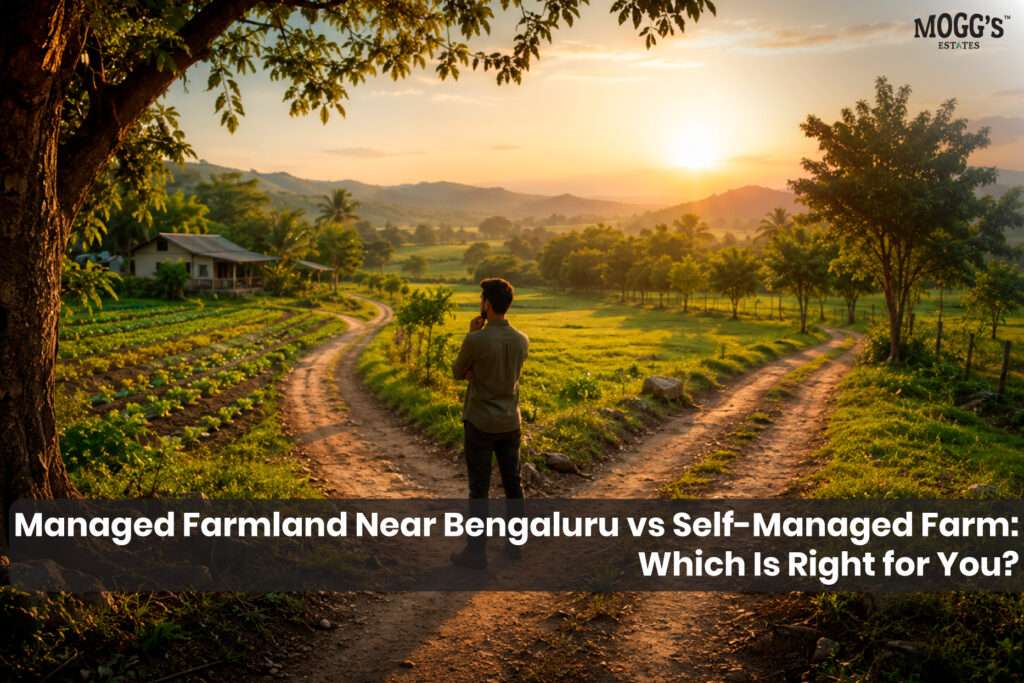
For many people in Bengaluru, owning farmland sounds like the perfect combination of nature, ownership, and long-term value. It offers open space, greenery, and an opportunity to stay connected with agriculture. But there is one important question to answer before buying: Do you want to manage the farm yourself, or would you prefer a professionally managed model?
This is where the difference between managed farmland and a self-managed farm becomes important.
Both models give you the opportunity to own agricultural land. However, the level of involvement, responsibility, time commitment, and day-to-day management can be very different.
For busy professionals, entrepreneurs, families, and investors looking at farmland near Bengaluru, understanding this difference can help them make a more informed decision.
What Is a Self-Managed Farm?
A self-managed farm is agricultural land that you purchase and operate independently.
You are responsible for almost every aspect of the farm. This can include choosing crops, arranging labour, managing irrigation, maintaining fencing, monitoring soil health, dealing with pests, and planning harvesting.
You also need to stay connected with people working on the farm.
For someone with farming experience or strong local connections, this can be rewarding. You have complete control over how the land is used and how the farm is operated.
However, that freedom also comes with responsibility.
A farm cannot simply be left unattended for months. Crops need water. Plants need care. Equipment requires maintenance. Labour needs supervision. Security and boundaries need attention.
This means that a self-managed farm can demand considerable time and involvement.
What Is Managed Farmland?
Managed farmland follows a different approach.
In a managed farmland model, the owner owns the land while a professional team takes care of agreed farming and maintenance activities.
Depending on the project and management agreement, these services may include plantation, irrigation, farm maintenance, labour coordination, soil management, security, and regular upkeep.
The exact services vary from one project to another. Therefore, buyers should always read the management agreement carefully and understand what is included.
The basic idea is simple:
You own the farmland, while professionals manage the farm operations.
This model has become increasingly relevant for urban buyers who want to own agricultural land without turning farming into a second full-time responsibility.
The distinction between land ownership and farm operations is also a key feature of the managed-farmland model.
Managed Farmland vs Self-Managed Farm
The biggest difference is not necessarily the land itself. It is the ownership experience.
With a self-managed farm, you are both the landowner and the person coordinating operations.
With managed farmland, you remain the owner while a management team handles defined responsibilities.
Here are some of the main differences.
1. Time Commitment
Time is one of the biggest considerations.
A self-managed farm requires regular involvement. Even when you have a caretaker, you may still need to monitor the property, review expenses, inspect the farm, and make operational decisions.
For someone living in Bengaluru and working a demanding job, frequent travel to the farm may not always be practical.
Managed farmland can reduce this operational burden because routine activities are handled by a designated management team.
That does not mean the owner has no involvement. It simply changes the nature of involvement from daily supervision to periodic monitoring and decision-making.
2. Farming Knowledge
Running a farm requires more knowledge than simply buying land.
Crop selection, irrigation, soil health, pest management, pruning, fertilisation, harvesting, and seasonal planning all influence agricultural performance.
Karnataka’s agriculture ecosystem includes specialised departments and services because different agricultural activities require specialised knowledge and experience.
A self-managed farm therefore works best for owners who are willing to learn farming or already have access to experienced agricultural professionals.
Managed farmland can be more convenient for owners who prefer to rely on an experienced farm-management team.
3. Control
Self-management offers maximum control.
You decide what to plant, when to plant it, how to maintain the land, which vendors to use, and how to develop the property.
Managed farmland usually follows a predefined management plan.
This means you may have less control over day-to-day operations, but you also have fewer operational responsibilities.
The right choice depends on what you value more: control or convenience.
4. Maintenance and Infrastructure
Owning farmland involves more than cultivating crops.
The property may require fencing, irrigation systems, water storage, internal access, plantation maintenance, security, and periodic repairs.
With a self-managed farm, you coordinate these requirements yourself.
In a managed farmland community, many of these responsibilities may be handled through the management structure, depending on the agreement.
This can make ownership more practical for people who live several hours away from their farm.
5. Lifestyle
Farmland is not always purchased purely for financial reasons.
For many buyers, it is also about lifestyle.
A farm can become a place where families spend weekends, children experience nature, and owners take a break from city life.
A self-managed farm can provide this experience, but the owner may also find themselves spending weekends dealing with maintenance and operational issues.
Managed farmland can offer a different experience. When routine maintenance is handled professionally, owners can potentially spend more of their time enjoying the property.
This is one reason the concept of managed farmland near Bengaluru is attracting attention among urban land buyers.
What About Investment and Growth?
Farmland can be considered as part of a long-term asset strategy, but it should not be viewed as a guaranteed-return investment.
The value of agricultural land can be influenced by location, accessibility, water availability, soil quality, surrounding development, demand, agricultural productivity, and broader market conditions.
Similarly, farm income depends on crop choice, yields, weather, input costs, labour, and market prices.
So, when considering a farmland investment, it is better to focus on the fundamentals rather than a promised percentage return.
A strong location, clear ownership documents, suitable agricultural planning, reliable water resources, and professional management can all contribute to a better ownership experience.
For buyers considering invest farmland opportunities, due diligence should come before expected growth.
Which Model Is Better for You?
There is no single answer.
A self-managed farm may suit you if:
- You have farming experience.
- You live close enough to visit regularly.
- You enjoy hands-on agricultural work.
- You want complete operational control.
- You already have reliable local labour and agricultural support.
Managed farmland may suit you if:
- You have limited time.
- You live in Bengaluru or another city.
- You want professional support for farm operations.
- You prefer a structured ownership experience.
- You want to own farmland without managing every daily activity yourself.
The decision should ultimately depend on your lifestyle, experience, objectives, and willingness to take on operational responsibility.
What Should You Check Before Buying Managed Farmland?
The word “managed” should never be the only reason to purchase a property.
Before making a decision, carefully examine the land documents, ownership structure, survey details, access, water availability, land-use rules, and development permissions applicable to the property.
You should also understand the management agreement.
Ask:
Who manages the farm?
What services are included?
What are the annual management charges?
Who pays for additional infrastructure or repairs?
How often will the owner receive updates?
What happens if the management agreement ends?
What exactly does the owner legally own?
These questions can help you distinguish a genuinely structured managed farmland model from a property that simply uses the word “managed” in its marketing.
The Bigger Picture: Land Ownership With Less Operational Pressure
The comparison between managed farmland and a self-managed farm ultimately comes down to one simple question:
How involved do you want to be?
If you want to be deeply involved in agriculture, a self-managed farm can give you control and a strong connection with the land.
If you want the experience of owning farmland while reducing the burden of daily farm operations, managed farmland can provide a more structured alternative.
For people exploring managed farmland near Bengaluru, the opportunity is not simply about owning a piece of land. It is about choosing an ownership model that fits their time, lifestyle, knowledge, and long-term goals.
Farmland can be both a place to reconnect with nature and a long-term asset. But the best decisions come from understanding what you are buying, how it will be managed, and what responsibilities remain with you.
In the end, the smarter choice is not necessarily the one that promises the highest return.
It is the one that matches your goals, your time, and your ability to manage the land for the long term.
Final Takeaway
A self-managed farm gives you maximum control with maximum responsibility.
Managed farmland gives you land ownership with a structured approach to farm management.
Neither model is automatically better for everyone.
The right choice is the one that allows you to enjoy the value of farmland without taking on responsibilities that do not fit your lifestyle.