

A sale agreement records the terms of a farmland deal, and a sale deed transfers ownership. The agreement, often called an agreement to sell, sets the price, the payment schedule, the conditions, and the completion date, and it binds both parties to the deal. It does not by itself transfer ownership. The sale deed is the final instrument that transfers title, and it must be registered with the sub-registrar to serve as the main evidence of the transfer. Buyers should not treat a signed agreement as ownership, and they should check the title and records before signing either document. Whether an agreement must be registered, and what remedies apply if a deal fails, depend on the wording of the document and the law in force, so a qualified lawyer should review both.
Many buyers see both documents during a land purchase and are unsure which one matters most. Both matter, but they do different jobs and come at different stages. This guide covers each document in detail, the differences between them, what each should contain, the stages of the transaction, what happens when a deal goes wrong, and the checks to make before you sign.
Why the Difference Matters for Farmland
Farmland transactions often run over several weeks or months. A buyer may pay a booking amount, sign an agreement, complete the checks, pay the balance, and then register the sale. Each document marks a different point in that process.
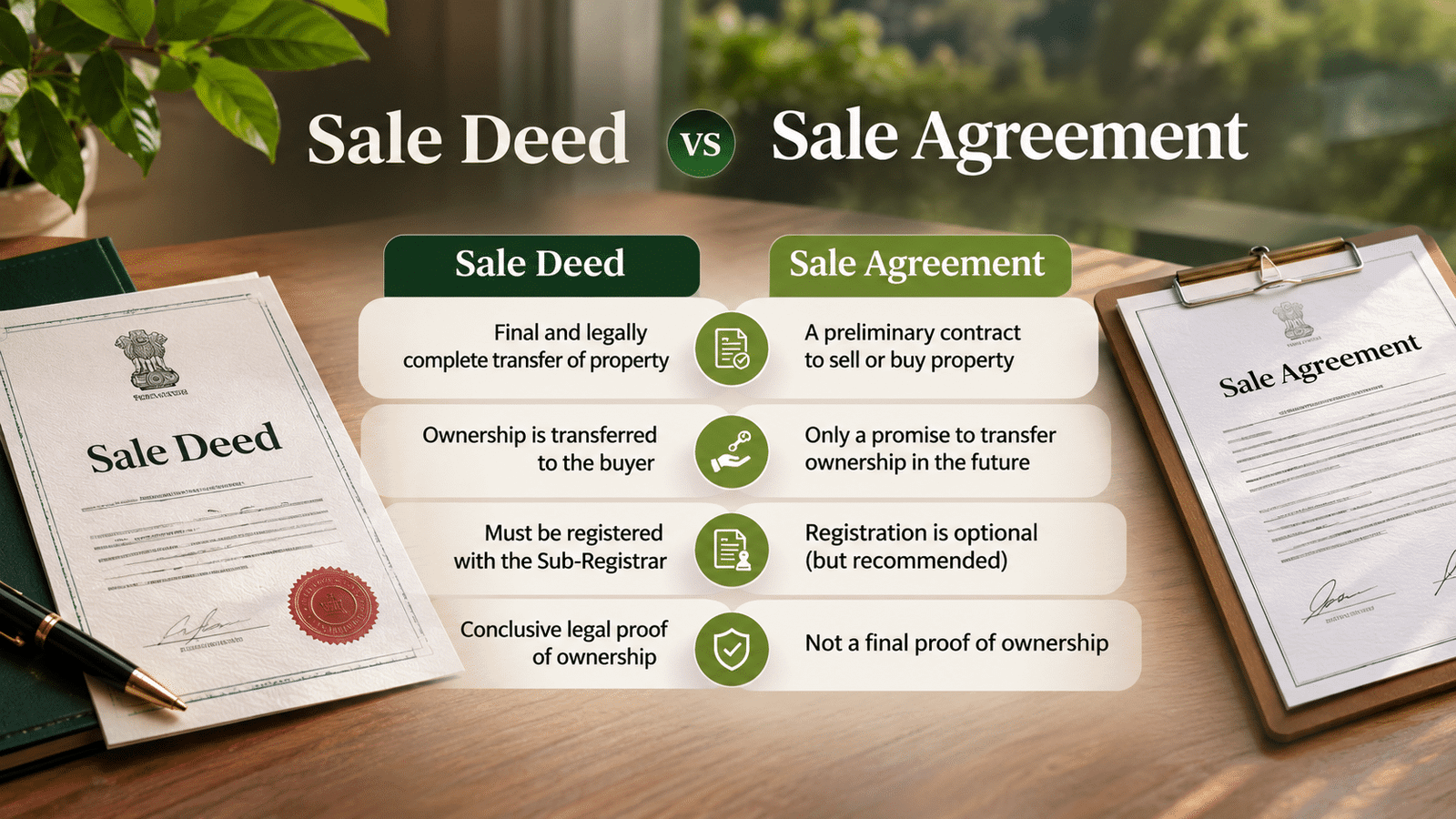
The risk comes from confusing them. A buyer who believes a signed agreement is ownership may pay heavily before the title is verified. A seller who thinks an agreement is final may refuse to honour a refund that the agreement permits. Knowing what each document does protects both parties.
What a Sale Agreement Is
A sale agreement is a contract between the seller and the buyer. It records what both sides have agreed, usually before the sale deed is prepared. It is commonly called an agreement to sell, because its main effect is to bind the parties to sell and buy on the agreed terms once the conditions are met.
An agreement creates obligations and rights. The seller agrees to transfer the land and to give clear title. The buyer agrees to pay the price on the schedule. Both agree to complete the sale by a date, and to follow the conditions and the default clauses. The agreement is a promise to transfer, not the transfer itself.
What a Sale Deed Is
A sale deed is the instrument that transfers ownership of property from the seller to the buyer. It is executed by the parties, witnessed, and presented to the sub-registrar for registration. Once registered, it is the main evidence that the buyer holds the land.
The deed describes the property in full, with the survey number, hissa, extent, boundaries, and classification. It states the consideration, the seller’s title, the encumbrance position, the possession terms, and the registration details. For a farm plot, the deed should match the RTC, the mutation records, and the sketch exactly.
Our guide to the agricultural land sale deed checklist sets out what the deed must contain, and our guide to sale deed registration in Karnataka explains the registration process.
The Core Differences
The two documents differ in purpose, timing, effect, and the evidence they provide. The table below summarizes them.
| Point | Sale agreement | Sale deed |
|---|---|---|
| Main purpose | Records the terms and creates obligations | Transfers ownership |
| When it is signed | Usually first, once terms are agreed | At completion, after the checks |
| Registration | Depends on its terms and the law; many agreements are not registered as a transfer | Registered with the sub-registrar |
| Transfers ownership? | No | Yes, once registered |
| Evidence of title | Not on its own | The main registered evidence of the transfer |
| Refunds and default | Usually governed by its clauses | Not usually the place for these terms |
| Typical stage | Promise, payment schedule, conditions | Final transfer |
Whether an agreement must be registered, and how a court will treat it, depends on its wording and the rules in force. A lawyer should confirm the position for the specific document.
Why a Signed Agreement Is Not Enough
A signed agreement gives the buyer contractual rights, but it does not give the buyer the registered title that a sale deed gives. A buyer who pays most of the price on the strength of an agreement, without a registered deed, is exposed in several ways.
The seller may not hold clear title, and the defect may surface only when the deed is prepared. The seller may sell the land to someone else. A lender may refuse a loan without a registered deed, which can stop the purchase. A dispute may arise among family members or claimants that prevents completion. In each case, the buyer may have to rely on a remedy under the agreement, which takes time and cost.
For this reason, the agreement should protect the buyer until the deed is registered, and the buyer should pay only a refundable booking amount until the conditions are met.
The Stages of a Farmland Purchase
A typical transaction moves through these stages. The order and the detail depend on the parties, the land, and the lawyer’s advice.
Stage 1: Due diligence: Check the title, the RTC, the mutation records, the Encumbrance Certificate, the sketch, and the land classification. Confirm the buyer’s eligibility. Do this before the agreement is signed.
Stage 2: The sale agreement: Sign the agreement once the terms are agreed and the checks are satisfactory. Pay only a refundable booking amount at this stage, unless the lawyer advises otherwise.
Stage 3: Conditions and clearance: Satisfy the conditions in the agreement. These may include clearing dues, obtaining a sketch for a sub-divided parcel, completing a mutation, and confirming the title.
Stage 4: The draft deed: Prepare the draft sale deed, and check it against the agreement and the records.
Stage 5: Payment of the balance: Pay the balance, through a traceable channel, against the registered deed or under an agreed mechanism.
Stage 6: Execution and registration: Sign the deed and register it with the sub-registrar, after paying stamp duty and the registration fee.
Stage 7: Mutation and possession: Apply for mutation so the revenue records show the new owner, and take possession on the agreed terms.
Our guide to sale deed registration in Karnataka explains the registration stage in detail.
What the Sale Agreement Should Include
A sale agreement for farmland should cover these points in clear language:
- The property: The survey number, hissa, extent, boundaries, village, hobli, taluk, and district, consistent with the RTC and the sketch.
- The parties: Full names, addresses, and identity details of the seller and the buyer.
- The price: The total consideration, and how it is calculated, including any per-acre basis and any adjustment for Kharab or other excluded land.
- The payment schedule: The advance, any instalments, the balance, and the dates on which each is due.
- The conditions: Title verification, encumbrance clearance, payment of dues, mutation or sub-division where needed, and confirmation of eligibility.
- The completion date: The date by which the sale deed is to be executed and registered.
- Possession: When and how possession passes, and what happens to the land in the meantime.
- Costs: Who pays stamp duty, the registration fee, legal fees, and any arrears of land revenue or property tax.
- Refund terms: What happens to the advance and the payments if a condition fails, and on what grounds.
- Default and remedies: The consequences if either party does not perform, and any agreed liquidated sum or other remedy.
- Governing law and disputes: The law that applies, and how disputes are to be resolved.
- Seller’s warranties: The seller’s assurance of clear title, no disputes, no undisclosed charges, and the accuracy of the disclosed details.
A lawyer should draft or review the agreement before it is signed. Verbal assurances that are not in the agreement are difficult to enforce.
What the Sale Deed Should Include
The sale deed should match the records and the agreement. It should state the parties, the property, the consideration, the seller’s declaration of clear title, the encumbrance position, the possession terms, the buyer’s eligibility, and the registration details. It must be signed by the parties and the witnesses, and presented to the sub-registrar for registration.
Before the deed is executed, compare the draft with the agreement, the RTC, the mutation records, the Encumbrance Certificate, and the sketch. Resolve any difference first, because a mismatch found at the sub-registrar’s office is harder to fix on the day.
What Happens If a Deal Fails
A farmland deal can fail for many reasons: a defect in title, an undisclosed charge, a dispute, a failure to clear dues, a failed loan, or a change of mind by one party. What happens next depends on the agreement’s terms, the reason for failure, and the applicable law.
Refund clauses: The agreement may provide for a refund of the advance, sometimes with a deduction, if the seller cannot complete. The conditions for refund should be clear in writing.
Default clauses: The agreement may provide for compensation or a forfeiture if the buyer fails to pay. The amount and the mechanism should be stated, and a lawyer should check that they are reasonable under the law.
Remedies under the law: In some cases, a party may seek performance of the agreement, or a refund and damages, through the courts. Whether that is possible depends on the terms, the conduct of the parties, and the law. Enforcement can take time and cost money, so it is not a substitute for proper checks before signing.
A buyer whose deal is failing should consult a lawyer quickly, because the timeline in the agreement and the conduct of the parties can affect the remedy available.
How Advances and Payments Should Be Handled
Pay only a refundable booking amount until the title and records are satisfactory. Make every payment by traceable means, such as bank transfer or cheque, and keep the receipts. Confirm in writing what each payment is for, and whether it is refundable.
Avoid cash payments without a written receipt. Where the seller asks for payment to a third party, confirm that party’s authority and the reason in writing.
Common Mistakes Buyers Make
Treating the agreement as ownership: A signed agreement does not transfer the land. The registered deed does.
Paying most of the price before the deed: Pay only a refundable amount until the conditions are met.
Signing before the checks: An agreement signed before the title is verified can bind the buyer to a deal that cannot be completed.
Missing the conditions: An agreement without clear conditions makes it harder to exit if the title fails.
Ignoring the refund and default terms: A buyer who does not know what happens to the advance may lose it when a condition fails.
Signing a deed that differs from the agreement: Check the final deed against the agreement and the records before signing.
Understating the price in the deed: A lower figure in the deed to reduce stamp duty creates penalty and tax risk. Discuss the correct treatment with a lawyer.
Common Questions About Each Document
Is a sale agreement enough to own farmland? No. Ownership passes through the registered sale deed.
Do I need to register the agreement? Registration rules for agreements depend on their terms and the law. Ask a lawyer whether the agreement must or should be registered.
Can the seller cancel the agreement? Only in the ways the agreement allows, and under the applicable law. Read the default and refund clauses carefully.
What if the seller will not complete the sale? Consult a lawyer quickly, because the agreement’s terms and the timeline will decide the next step.
Who should prepare the agreement and the deed? A property lawyer should review or prepare both, and confirm that they match the records and the law.
Checklist Before You Sign the Agreement
- The title chain is complete, with each transfer documented.
- The RTC, mutation records, and sketch agree with the survey number and extent in the agreement.
- The Encumbrance Certificate shows no unreleased charge, for the period your lawyer selected.
- Land revenue and property tax dues are clear, with receipts.
- Your eligibility to buy agricultural land has been confirmed in writing.
- The land classification fits your intended use.
- The payment schedule and the booking amount are refundable on the stated grounds.
- The conditions, completion date, and default clauses are clear.
- A lawyer has reviewed the agreement.
Checklist Before You Sign the Sale Deed to Sale Agreement
- The draft deed matches the agreement, the RTC, the mutation records, and the sketch.
- The consideration in the deed is the amount actually agreed.
- Stamp duty and the registration fee are calculated and paid.
- All parties and witnesses have their identity documents ready.
- Any power of attorney is valid and covers this transaction.
- The appointment at the sub-registrar’s office is booked.
- A lawyer has reviewed the final draft.
Key Takeaways
- A sale agreement records the terms and creates obligations. It does not by itself transfer ownership.
- A sale deed transfers ownership, and it must be registered to serve as the main evidence of the transfer.
- Check the title and the records before signing the agreement, and check the draft deed against the agreement and the records before registration.
- Pay only a refundable booking amount until the conditions are met, and keep every receipt.
- The agreement should set out conditions, refund terms, default remedies, and seller warranties in clear language.
- If a deal fails, the agreement’s terms and the law decide the remedy, so consult a lawyer quickly.
FAQs:
What is the difference between a sale deed and a sale agreement?
A sale agreement records the terms and creates the obligation to sell and buy. A sale deed transfers ownership and is registered with the sub-registrar.
Does a sale agreement transfer ownership of farmland?
No. Ownership passes through the registered sale deed.
Is a sale deed the same as an agreement to sell?
No. An agreement to sell is a promise to transfer on the agreed terms. A sale deed is the instrument of transfer, and it is usually signed and registered at completion.
Should I sign the agreement before the title is checked?
It is better not to. Check the title, the records, and your eligibility first, so that the agreement reflects what has been verified.
Can I get my advance back if the sale does not complete?
It depends on the agreement’s refund clauses and the reason the sale fails. Read the terms carefully, and take legal advice promptly if a condition fails.
Can I enforce a sale agreement in court?
In some cases a party may seek performance or a refund and damages, depending on the terms and the law. Enforcement can take time and cost money, so the best protection is the due diligence and the clear terms before signing.
Who should prepare the agreement and the deed?
A property lawyer should review or prepare both, and confirm that they match the records and the law.