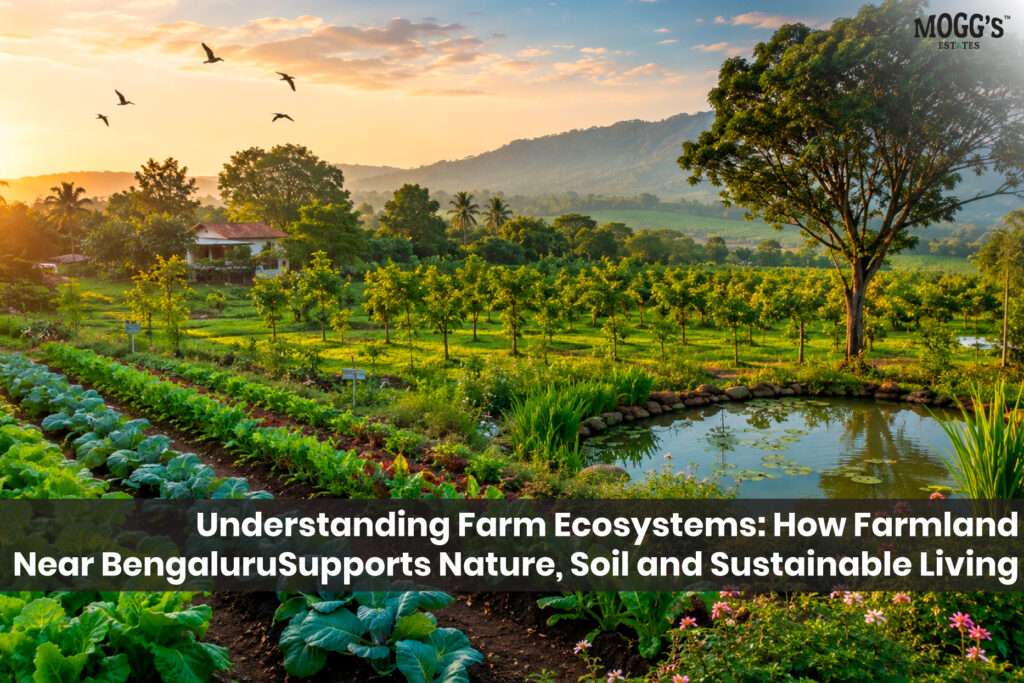
A farm is more than a piece of land where crops are grown. Look closely, and you will find a living system made up of soil, plants, insects, birds, water, microorganisms and people. Each part has a role to play. Together, they create a farm ecosystem that can support agriculture while also contributing to biodiversity and environmental balance.
For anyone exploring farmland near Bengaluru, understanding this ecosystem can offer a different perspective on what makes agricultural land valuable. A healthy farm is not defined only by its size or location. Its soil, water, vegetation and surrounding biodiversity can also shape the long-term character of the land.
What Is a Farm Ecosystem?
A farm ecosystem, also known as an agroecosystem, is the interaction between living organisms and the physical environment within and around agricultural land.
The living elements include crops, trees, grasses, insects, birds, animals, earthworms, fungi and microorganisms. The non-living elements include soil, sunlight, water, air and temperature.
These elements constantly interact. Plants depend on soil, water and sunlight to grow. Soil organisms help break down organic matter and recycle nutrients. Bees and other pollinators support the reproduction of many plants. Birds and beneficial insects can help regulate certain pest populations.
According to the Food and Agriculture Organization (FAO), biodiversity supports important agricultural functions such as nutrient cycling, pollination, pest regulation, soil health and water management.
This is why a farm should be viewed as a connected system rather than a collection of individual elements.
Soil: The Foundation of Every Farm
Healthy farmland begins beneath our feet.
Soil is home to a vast community of microorganisms and small organisms that contribute to decomposition and nutrient cycling. Organic matter, plant residues and naturally occurring organisms interact to support soil structure and fertility.
Practices such as adding organic matter, maintaining plant cover and reducing unnecessary soil disturbance can help support soil biodiversity. FAO notes that soil organisms play important roles in nutrient cycling, decomposition and the development of soil structure.
For a landowner, this makes soil quality an important part of understanding farmland. A healthy soil system can support plants while helping the farm remain productive through changing conditions.
Plants Do More Than Produce Crops
When people think about agriculture, crops are usually the first thing that comes to mind. However, a well-designed farm ecosystem can include much more than cultivated plants.
Trees, flowering plants, grasses, shrubs and cover crops can provide habitats for insects and birds. They can also contribute to soil protection and help create a more diverse farm landscape.
Plant diversity can also improve the resilience of an agricultural system. Crop rotation, mixed planting and agroforestry are examples of approaches that combine different types of vegetation within a farming environment. Such diversity can support soil fertility, water management and pest regulation.
This is one reason why modern managed farmland can be approached as more than agricultural land alone. With thoughtful planning and responsible management, farmland can become a balanced environment where cultivation and nature work together.
The Invisible Workforce: Microorganisms
Some of the most important members of a farm ecosystem are too small to see.
Bacteria, fungi and other microorganisms live in the soil and around plant roots. They help break down organic materials and contribute to nutrient cycling. These processes make nutrients available within the soil and support plant growth.
This invisible biological activity is one of the reasons healthy soil cannot be judged simply by its appearance.
A productive farm ecosystem depends on countless interactions taking place underground. Protecting these natural processes can therefore be an important part of responsible farm management.
Pollinators and Beneficial Insects
Walk through a farm during flowering season and you may notice bees, butterflies and other insects moving from plant to plant. These small visitors have an important role in agriculture.
Pollinators support the reproduction of many flowering plants and are particularly important for orchards, horticultural crops and other agricultural systems. FAO identifies pollination as one of the important ecosystem services supported by agricultural biodiversity.
Not every insect on a farm is a threat. Some insects are natural predators of agricultural pests. Maintaining a diverse farm environment can help support these beneficial relationships.
This highlights an important principle of farm ecosystems: not every organism needs to be controlled. Sometimes, the right approach is to create conditions where nature can perform part of the work.
Water Is Part of the Ecosystem
Water connects different parts of a farm.
Rain enters the soil, moves through the landscape and supports vegetation. Healthy soil and adequate plant cover can help improve infiltration and reduce runoff and erosion. Agricultural biodiversity can also contribute to water quality and soil moisture retention.
For farmland around Bengaluru, where seasonal rainfall plays an important role in agriculture, understanding water movement is particularly relevant.
Farm planning should therefore consider not only how much water is available, but also how efficiently the land can retain and use it.
Trees, Birds and Wildlife Add Another Layer
A farm ecosystem does not stop at the crop boundary.
Trees can provide shade and habitat. Birds can become part of the food web. Small animals and insects interact with plants and soil organisms. Natural vegetation around cultivated areas can create additional habitat and support biodiversity.
FAO describes agricultural biodiversity as including both planned biodiversity, such as crops and livestock, and associated biodiversity, including soil organisms, pollinators, predators and other species living in agricultural landscapes.
This interconnected environment can make a farm feel very different from a conventional developed property.
Why Farm Ecosystems Matter to Landowners
For someone considering farmland for sale, the value of land is often discussed in terms of location, access, infrastructure and future potential. These factors are important, but the ecological character of the land deserves attention too.
A farm with healthy vegetation, functioning soil systems, water management and biodiversity can offer a richer experience of agricultural land.
This is particularly relevant to people looking for a land resort or a countryside retreat. The appeal is not simply having land outside the city. It is the opportunity to experience a landscape where trees, crops, open spaces and natural surroundings come together.
For those exploring managed farmland near Bengaluru, professional farm management can also help maintain agricultural activities and the overall landscape over time. The exact management practices will vary from one property to another, so prospective buyers should always understand what is included before making a decision.
Managed Farmland and the Future of Farming
Urban growth is changing how people experience rural land. Many city residents want a connection with nature but may not have the time or expertise to manage agricultural land independently.
This is where the concept of managed farmland becomes relevant.
A managed farm can combine agricultural planning, maintenance and land stewardship under a structured approach. Depending on the project, management may involve crop planning, irrigation, landscaping, farm maintenance and other activities.
The broader goal should be to maintain the land as a functioning agricultural environment rather than treating it simply as an empty plot.
Building a More Resilient Farm Ecosystem
A resilient farm ecosystem is built through many small decisions.
Maintaining soil health, protecting water resources, encouraging biodiversity, planting suitable vegetation and managing pests responsibly can all contribute to a healthier agricultural environment.
FAO highlights biodiversity as an important factor in making agricultural systems more resilient to environmental stresses and changing conditions.
The lesson is simple: agriculture does not have to work against nature. When natural processes are understood and supported, they can become part of the farming system.
The Bigger Picture
Understanding farm ecosystems changes the way we look at farmland.
It is not simply soil waiting to be cultivated. It is a living network where plants, microorganisms, insects, birds, water and people interact every day.
For people searching for farmland near Bengaluru, this perspective can make the process of evaluating land more meaningful. Instead of looking only at acreage and location, it encourages buyers to consider the health, character and long-term management of the farm environment.
A well-managed farm can offer more than agricultural production. It can provide a connection to nature, a slower pace of life and an opportunity to understand how food, soil and biodiversity are connected.
Ultimately, the strongest farm ecosystems are those where agriculture and nature are not treated as separate worlds. They are managed together, creating farmland that can remain productive, diverse and enjoyable for years to come.