Ladakh is preparing to give travellers a completely new way to experience the Himalayas.
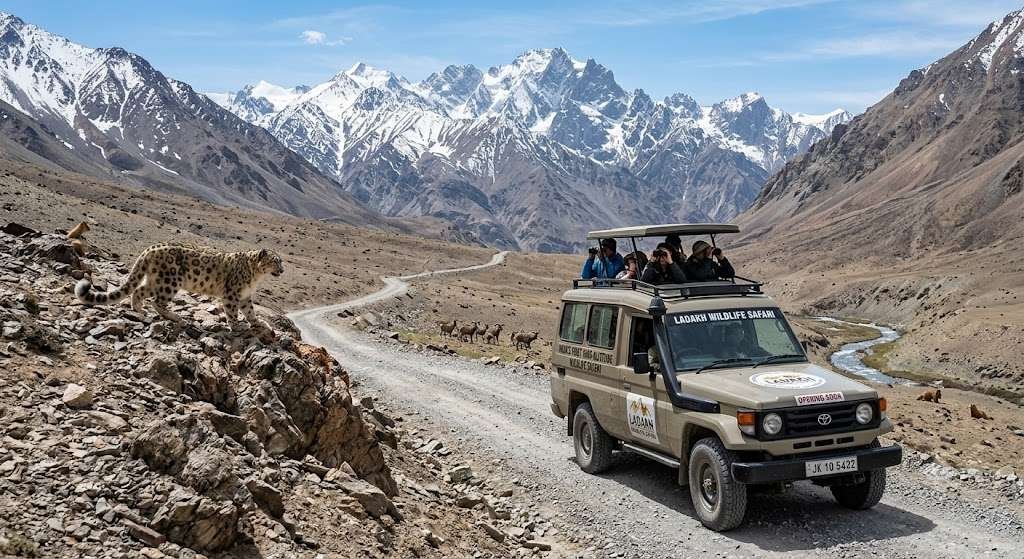
The Union Territory has approved India’s first high-altitude wildlife safari, bringing guided wildlife experiences to some of Ladakh’s most remote landscapes.
The initiative was approved on August 6, 2026, by Ladakh Lieutenant Governor Vinai Kumar Saxena. It will focus on snow-leopard and bird-watching trails while promoting responsible tourism and protecting the region’s fragile ecosystem.
Unlike traditional wildlife safaris in India’s forests and national parks, Ladakh’s new experience will take visitors into a high-altitude cold-desert landscape.
The Forest Department has been directed to develop guided jeep safaris using specially designed open-back vehicles. Trained local drivers and guides will operate these experiences.
The idea is to give travellers a closer look at Ladakh’s wildlife without allowing uncontrolled vehicle movement in sensitive areas.
The administration says the initiative will help reduce illegal off-roading and minimise disturbance to wildlife.
The biggest attraction will be the elusive snow leopard.
Ladakh is home to an estimated 477 snow leopards, out of India’s estimated population of 718. This makes the region an important habitat for one of the world’s most difficult big cats to spot in the wild.
But the safari will not be limited to snow leopards.
Ladakh is also home to more than 38 mammal species, around 340 bird species and nearly 1,800 vascular plant species.
For nature lovers, this creates an opportunity to experience a much wider range of Himalayan wildlife and landscapes.
Potential safari routes are being explored across several wildlife-rich areas.
These include Hemis National Park, Changthang and Karakoram Wildlife Sanctuaries, along with regions such as Nubra, Zanskar, Sham, Kargil and Drass.
The exact routes are still being worked out.
This means travellers should not assume that every location will immediately be open for safari operations. The administration is still developing the framework and visitor arrangements.
The most interesting part of the announcement is that the safari is being designed around conservation.
The objective is not simply to bring more tourists to Ladakh.
The administration wants tourism to help protect the region’s wildlife while creating opportunities for local communities.
The newly formed Snow Leopard and High-Altitude Nature (SHAN) Conservation Society is working on a broader roadmap for community-led wildlife conservation, waste management, plastic-free tourism and sustainable livelihoods.
This makes the initiative more than a tourism project.
It is an attempt to connect travel with environmental responsibility.
Local people are also expected to become an important part of the new tourism model.
Twenty local young people will be selected and trained in birdwatching, bird identification and bird-spotting skills. They will also receive equipment such as binoculars.
Ten bird-watching hides are planned at major hotspots.
This could create new opportunities for young people while giving visitors access to trained local knowledge.
For travellers, this can make the experience more meaningful.
Instead of simply passing through a landscape, visitors can learn about the animals, birds and communities that are part of it.
Travel preferences are changing.
Many travellers today are looking beyond crowded tourist attractions. They are searching for experiences that combine nature, adventure and a sense of discovery.
Ladakh’s proposed wildlife safari fits into this growing interest in nature-based and responsible tourism.
A snow leopard experience in its natural habitat is very different from a conventional sightseeing trip. It requires patience, respect for wildlife and an understanding of the environment.
That can make the journey itself part of the experience.
Ladakh’s beauty is also its vulnerability.
Its high-altitude ecosystem is extremely sensitive. Uncontrolled vehicle movement, littering and irresponsible tourism can put pressure on wildlife and natural habitats.
The new safari model is therefore intended to regulate visitor movement rather than encourage unrestricted access.
Guided tours, trained drivers and designated routes can help create a more controlled tourism experience.
The administration has specifically linked the initiative to preventing illegal off-roading and reducing disturbance to wildlife.
The administration has directed departments to prepare for the safari before the winter snow-leopard sighting season.
That could give Ladakh another attraction during a period when travellers increasingly seek unusual winter experiences.
However, the exact launch arrangements, routes and visitor procedures are still being developed.
For now, the announcement represents the beginning of a new tourism model rather than a fully operational safari programme.
Ladakh’s high-altitude safari is significant because it reflects a larger change in the way people experience travel.
The modern traveller is increasingly interested in experiences that feel authentic, local and connected to nature.
Wildlife tourism can provide that connection, but it also carries responsibility.
If managed carefully, tourism can generate income for local communities while creating stronger incentives to protect wildlife and natural habitats.
Ladakh is now attempting to build exactly that balance.
The upcoming high-altitude wildlife safari could therefore become more than a new attraction.
It could represent a new idea of luxury travel — one where the experience is not about escaping nature, but experiencing it responsibly.