When Rohan bought his first apartment in Bangalore, it felt like a milestone. It came with EMIs, paperwork, and a sense of achievement. His parents were proud. His friends congratulated him. It was a symbol of progress. But a few years later, while standing on his small balcony overlooking rows of identical buildings, he felt something unexpected, a quiet question in his mind. Is this the only kind of legacy I want to leave behind?
The thought did not disappear. It grew stronger when his father once mentioned the ancestral land their family had sold long ago. “Land stays,” his father said softly. “Buildings come and go.” That sentence lingered in Rohan’s mind for months. In a world where investments are tracked through apps and measured in percentages, he began to wonder whether true wealth was something more tangible.
One weekend, almost on impulse, he decided to visit a managed farmland project by Mogg’s Estates. He had been seeing increasing conversations about farmland near Bangalore and how premium managed farmland was attracting urban professionals. At first, he was sceptical. Farming felt distant from his corporate lifestyle. But curiosity led him to take the drive.
The journey itself felt like a transition. As he moved away from city traffic and glass towers, the air felt lighter. The noise faded. When he reached the farmland site, he noticed something different immediately: space. Open skies. Rows of young mango and coconut trees. Soil that looked alive and carefully maintained. It did not feel like a random agricultural field. It felt planned, structured, and thoughtfully developed.
The team explained the concept of managed farmland in simple terms. Owners purchase legally clear agricultural land, while professional experts handle everything, including soil preparation, irrigation systems, crop planning, and ongoing maintenance. This model removes the operational burden while preserving the benefits of land ownership. For someone like Rohan, who had no farming background, this clarity made all the difference.
As he walked through the plantation, he began to see farmland differently. This was not just about crops. It was about continuity, unlike apartments that age or commercial properties that depend on tenants, farmland matures. Trees grow stronger each year. Soil fertility improves with proper care. And land, especially the best farmland near Bangalore, becomes more valuable as urban expansion continues.
Rohan realized something important that day. Most modern investments are designed for liquidity. We buy with the intention of selling. We measure success in short cycles. But legacy is not built in short cycles. Legacy is built over decades. It requires patience, vision, and something permanent to hold on to.
The idea of premium managed farmland appealed to him because it combined tradition with structure. It was not an emotional buy. It was strategic investing. Bangalore is growing rapidly, and farmland near Bangalore is becoming limited. As infrastructure develops and demand increases, agricultural land near the city is attracting serious investors. But beyond appreciation potential, it offers diversification. In uncertain economic times, when markets fluctuate, and job security feels fragile, owning land provides a different kind of confidence.
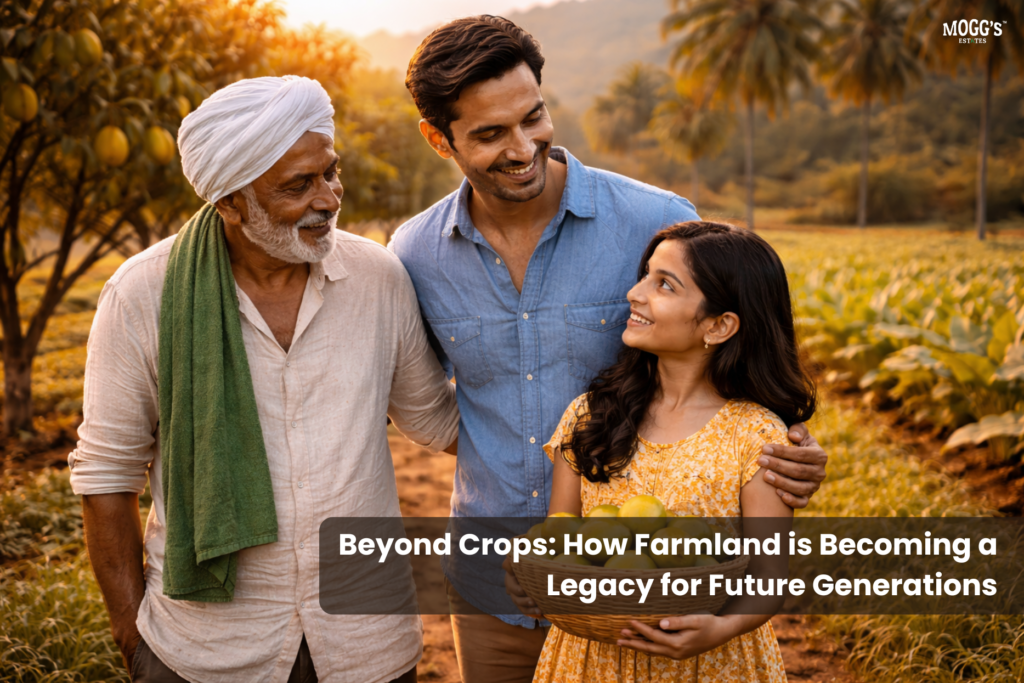
He imagined bringing his parents there. He imagined future family gatherings under fully grown trees. He imagined telling his children one day, “This land belongs to us.” That vision felt stronger than any spreadsheet projection.
A few weeks later, after careful thought, Rohan invested in one acre of managed farmland with Mogg’s Estates. It was not a rushed decision. It was deliberate. He saw it as a long-term commitment, not just financially, but emotionally as well. His friends questioned him at first. Why farmland? Why not another apartment? But he understood something they did not yet see. Land is finite. Cities expand, concrete multiplies. But soil remains scarce.
Over time, his connection with the land deepened. He received updates about plantation growth. He visited occasionally and noticed subtle changes, such as taller saplings, healthier soil, and organised irrigation channels. The farmland was evolving quietly, steadily. And with it, his understanding of wealth evolved, too.
He rerealized that wealth is not only about income. It is about ownership. It is about holding something real that can outlast economic cycles. Managed farmland offers stability because it is rooted in fundamentals, food, soil, and sustainability. As global conversations around sustainable living grow stronger, agricultural land is becoming increasingly relevant. Premium managed farmland aligns financial goals with ecological responsibility.
Farmland is also becoming a bridge between generations. Children raised in apartments may grow up disconnected from nature. But when they visit land that belongs to their family, something shifts. They see where food comes from. They understand patience. They witness growth in its natural rhythm. These lessons cannot be taught solely through screens or classrooms.
Today, more professionals are searching for the best farmland near Bangalore not only to diversify portfolios but to build something lasting. Managed farmland projects provide legal clarity, professional oversight, and agricultural expertise. This structure reduces risk while preserving long-term potential. It transforms farmland from a rural uncertainty into an organized asset class.
Rohan often reflects on that first weekend visit. He had gone out of curiosity. He returned with a new perspective. His apartment represents achievement. But his farmland represents continuity. One is about present comfort. The other is about future security.
Beyond crops, farmland has become his statement of belief that a true legacy is not built in haste. It grows slowly, season after season. It carries stories, memories, and meaning. It connects generations not just through inheritance, but through shared ownership of something living.
In a fast-moving world where everything feels replaceable, farmland offers permanence. It is not flashy. It does not promise instant results. But it stands firm. It appreciates quietly. It supports sustainability. And most importantly, it can be passed on.
Because at the end of the day, legacy is not about what we consume in our lifetime. It is about what we nurture for the next one. And sometimes, that legacy begins with a single acre of premium managed farmland near Bangalore, land that grows not just crops, but generational wealth.