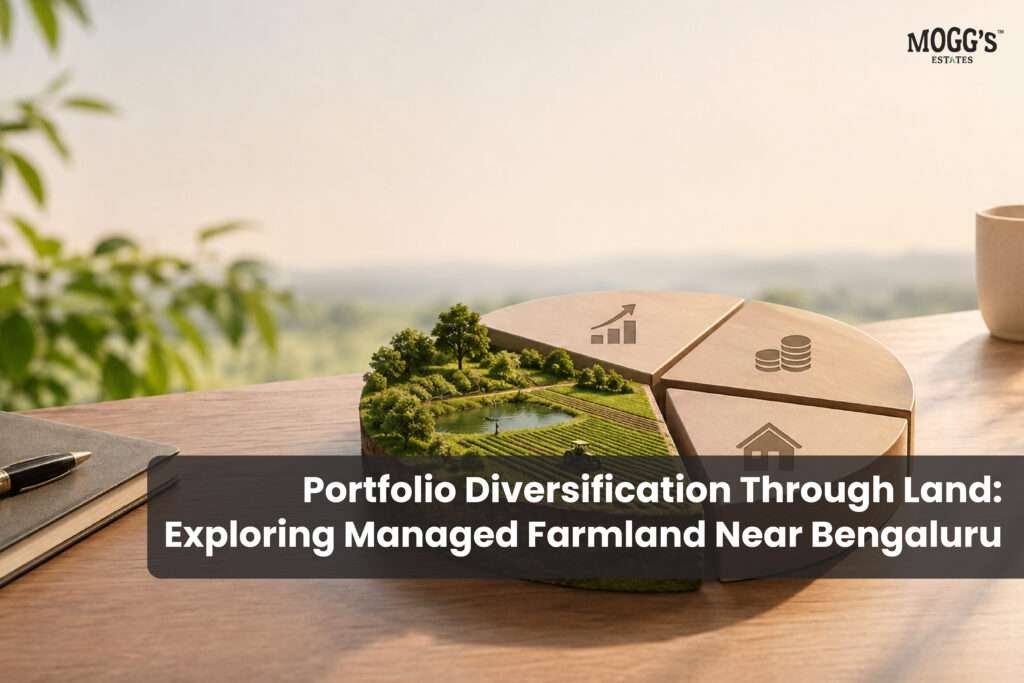
Quick answer: Portfolio diversification through land means adding a tangible, location-specific asset alongside financial holdings such as shares, mutual funds, and bonds. Land can offer a different kind of exposure from market-linked assets, but it also brings its own limits, including lower liquidity, location risk, documentation checks, and ongoing management needs. Managed farmland near Bengaluru can make the day-to-day side of ownership more structured, but no management service removes agricultural or market risk. Review the land, the management terms, and your overall asset allocation before you decide.
A diversified portfolio is not built by putting everything into one type of asset. It is built by understanding each asset class and deciding how each one fits your wider financial plan. Agricultural land can be one part of that plan. This guide explains what land can and cannot do for a portfolio, what a managed farm involves, and how to evaluate a managed farmland project before you commit.
Why Diversification Starts with Balance
Diversification spreads your financial exposure across assets that respond to different conditions. When one holding falls, another may hold steady. The aim is balance, not a guaranteed outcome.
Many investors already hold shares, mutual funds, bonds, fixed deposits, or residential property. Each of these has its own risks and liquidity. Adding land can change the mix, but only if it complements what you already own. Buying another property does not automatically diversify a portfolio. If most of your wealth is already tied to real estate, a second property may increase your concentration rather than reduce it.
For this reason, the first question is not “Should I own land?” It is “How would farmland fit into my existing asset allocation?”
What Portfolio Diversification Through Land Means

Portfolio diversification through land means including land as one component of a broader portfolio. The land sits next to your other holdings, not in place of them.
Land differs from many financial assets in three important ways. It is tangible, so you can see and walk it. It is location-specific, so its character depends heavily on where it sits. And it is tied to documents, so its legal history matters as much as its physical condition. These differences make land an asset to evaluate carefully, rather than one to accept on appearance or assumption.
Agricultural land adds another dimension. Unlike a vacant plot, farmland can support cultivation, trees, and other agricultural activity when it is properly developed and maintained. That active use is one reason some buyers look at farmland differently from other property.
Why Some Buyers Consider Land
Land has a physical presence that financial securities do not. Some buyers value being able to see, visit, and care for an asset they own. Others appreciate the connection between land, agriculture, and long-term stewardship.
Agricultural land can also serve more than one purpose. A property may be used for farming, as a weekend retreat, or for family time in the countryside. The mix of use and ownership is part of what makes farmland appealing to some people, although the right balance depends on each buyer’s goals.
Even so, appeal is not a reason to skip the analysis. The attractions of land should be weighed against its practical limits.
The Practical Limits of Owning Land
Land brings real constraints, and a balanced portfolio plan takes them into account.
- Liquidity: Land can be harder to sell quickly than listed securities. Selling a property takes time, and the price achieved depends on the market at that moment.
- Location: Demand, access, and surrounding development strongly influence a property’s usefulness, and they change over time.
- Documentation: Ownership, title, and revenue records must be verified before purchase.
- Ongoing care: Farmland needs regular attention, and that attention costs money.
- Weather and water: Rainfall, water availability, and crop conditions can affect farm operations in ways no owner fully controls.
These limits do not make land a poor choice. They do mean land should be judged on its own terms, with realistic expectations about time, cost, and control.
What Managed Farmland Near Bengaluru Involves
Buying agricultural land is only the start. A farm needs attention long after the sale is complete. Crops need monitoring, trees need pruning, irrigation systems need supervision, and fencing, pathways, and other infrastructure need upkeep. Weeds and pests must be observed and managed.
For someone who lives in Bengaluru, handling all of this personally may not be practical. This is where managed farmland near Bengaluru becomes relevant. In a managed farmland model, a professional team handles agreed agricultural and maintenance activities on behalf of landowners.
The key distinction is this: the owner holds the title to the land, while the management team carries out the farm activities covered by the management agreement. The exact services differ from project to project, so the agreement should always be read closely.
What a Managed Farm Does Day to Day
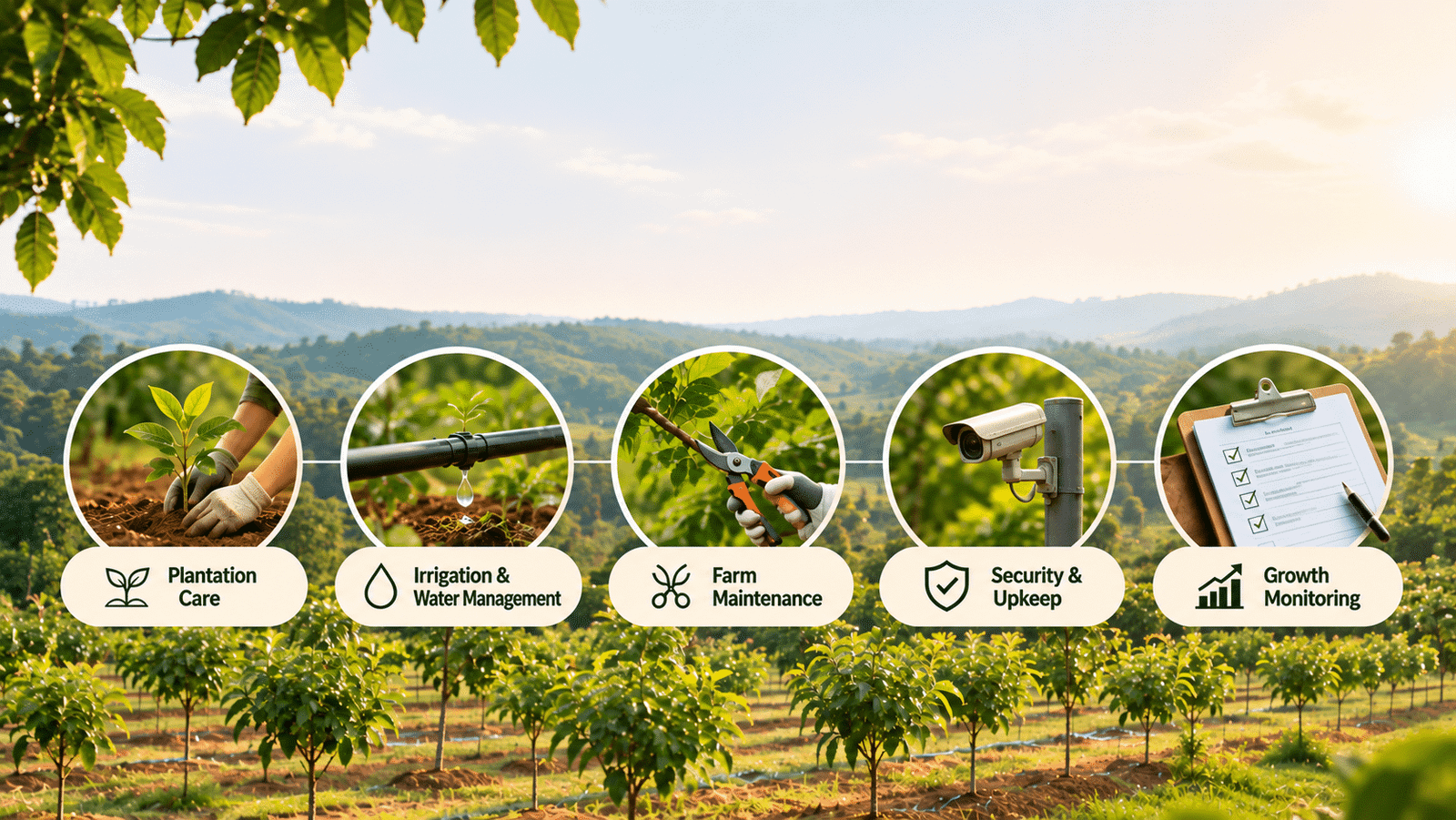
A managed farm, sometimes called managed agricultural land, is supported by an organized system for farming and maintenance. Instead of each owner arranging every task, the management team may coordinate activities such as:
- Crop and tree maintenance
- Irrigation and water management
- Weed control and pest monitoring
- Pruning and seasonal work
- Soil-related activities
- Farm infrastructure maintenance and general property upkeep
This structure can help owners who live far from their land or who visit only occasionally. Still, professional management does not remove the uncertainties of agriculture. Weather, crop health, and water availability can all affect results, and no team can control them completely.
Managed agricultural land also changes constantly. Seasons bring different requirements. Water needs shift, crops move through growth stages, and trees need different care at different ages. Good management therefore means ongoing attention rather than occasional visits. A managed farm should be judged by the consistency and quality of its care, not by how green it looks on a single visit.
Why Professional Farm Management Matters
A farm does not stop growing when the owner stops visiting. Professional farm management provides coordination and consistent care, even when the owner is working, travelling, or living in another city.
Depending on the project, professional teams may coordinate crop and tree monitoring, irrigation, weed control, pest observation, seasonal pruning, soil care, infrastructure upkeep, and general property supervision. The purpose is to provide structured, consistent care. Management should not be presented as a guarantee of agricultural income, price growth, or any particular return. The value of management lies in how well the work is done and how clearly it is explained to the owner.
What to Check Before Choosing Fully Managed Farmland
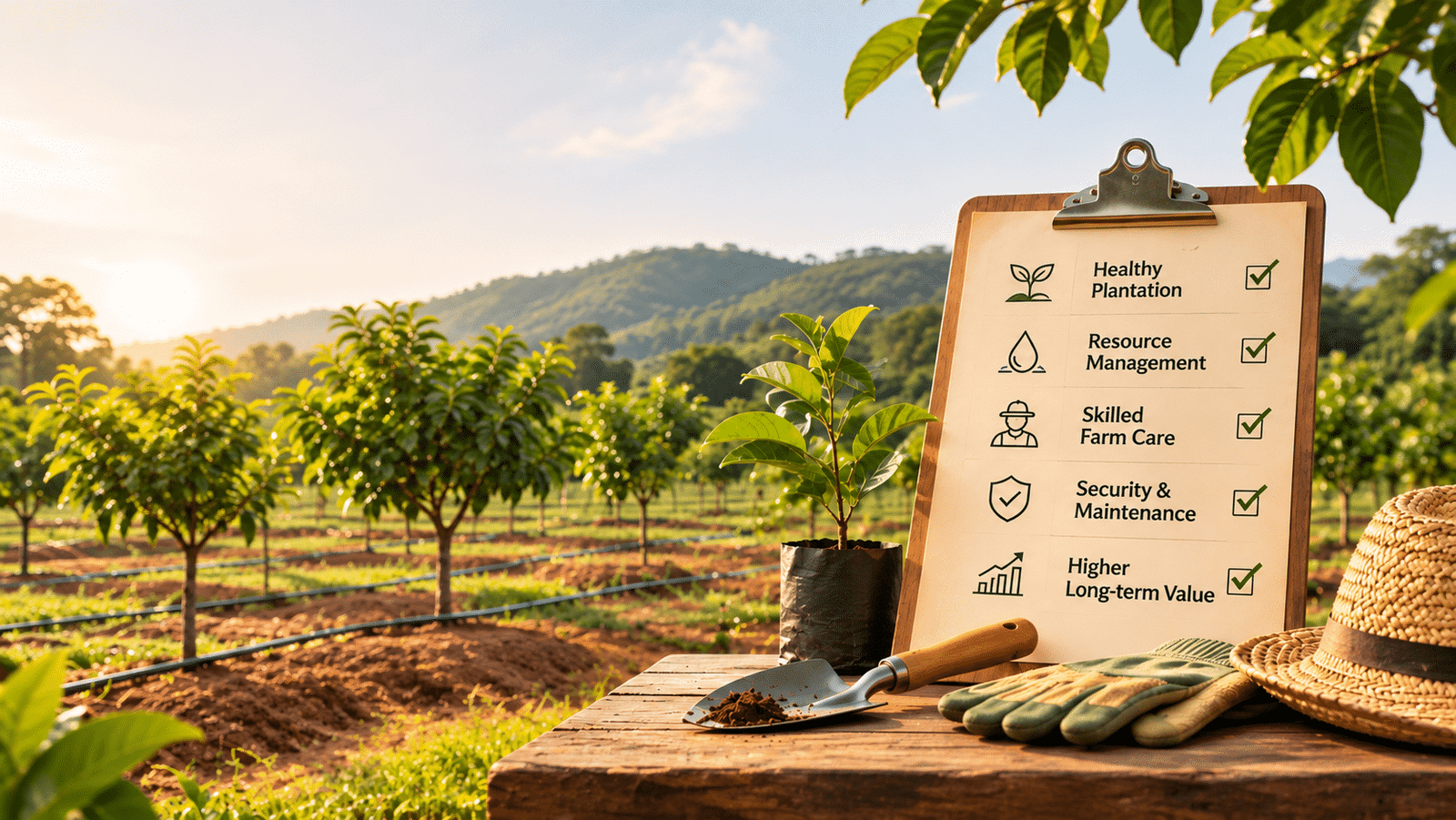
The phrase “fully managed farmland” can mean different things from one project to another. Before you buy, make sure you know exactly what the management arrangement covers.
Ask these questions in writing:
- Who will manage the farm, and what is their experience?
- Which services are included in the management fee?
- What are the management and maintenance charges, and how often do they change?
- How often is the property inspected or monitored?
- How is irrigation managed, and who is responsible for it?
- Who employs and supervises agricultural workers?
- How are crop or tree problems identified and addressed?
- How and how often are owners updated on the condition of the farm?
- Which services may cost extra?
A fully managed farm should have clearly defined responsibilities. Reading the management agreement carefully prevents misunderstandings later. Verbal assurances should be written into the contract, or they should not be relied on.
Farm Management Services and Long-Term Ownership
Farm management services bring several agricultural responsibilities under one organized system. Rather than coordinating workers, irrigation, crop care, and maintenance separately, an owner can rely on a professional team to handle these tasks as part of the service structure.
Farmland management services can also cover broader property maintenance alongside agricultural operations. For city-based owners, this can make ownership more practical, because routine farm responsibilities no longer depend entirely on the owner’s physical presence. Over the long term, the quality of this arrangement often matters as much as the land itself.
Location Still Matters
Professional management cannot make up for weak due diligence or a poorly chosen location. When you evaluate managed farmland near Bengaluru, consider the following:
- Accessibility from Bengaluru, including realistic travel times at busy hours
- Road connectivity and the legal status of the access route
- Surrounding development and nearby infrastructure
- Agricultural suitability of the soil and climate
- Water availability and its reliability in the dry season
- Local conditions and long-term usability
A property should be assessed beyond its appearance on a site visit. Its location and surrounding context are central to the decision, and they can change over time.
Do Not Overlook Land Documentation
Before you commit to agricultural land, review its legal and ownership records. Your lawyer should verify ownership and title, and check the records that apply to the property.
Depending on the land, these may include the Encumbrance Certificate, RTC (pahani) records, and mutation entries. A property title search and land title verification can show the property’s legal history and reveal any gaps, disputes, or encumbrances. Independent professional advice is valuable at this stage, because documents often reveal what a site visit cannot.
Can Land Really Diversify a Portfolio?
Land can represent a different asset category within a broader portfolio, but its suitability depends on the individual. Someone with substantial exposure to financial markets may view farmland differently from someone whose wealth is already concentrated in property.
Several personal factors shape the answer:
- How long you can hold the asset without needing the money
- Whether you may need liquidity at short notice
- How much real estate you already own
- Your financial goals and time horizon
- Your capacity to absorb a loss or a slow sale
- The ongoing costs of ownership, including management fees and maintenance
Each of these factors should be considered before adding land to your portfolio. A plan that works for one investor may not suit another.
From Managed Agriculture to End-to-End Farm Management
A structured managed agriculture model brings different farming responsibilities together under professional supervision. Agricultural management services may cover cultivation, crop care, irrigation, and farm maintenance. Some providers offer broader end-to-end farm management, which coordinates several operational needs through a single system.
If you are considering a managed agricultural property, understanding these services can matter as much as understanding the land itself. Ask how each service is delivered, who is accountable for it, and how its quality is measured.
Mogg’s Estates follows a professionally managed farmland approach. Its agricultural properties are developed and maintained through professional farm management. As with any project, the terms, services, and documents should be checked independently before you decide.
A Simple Checklist Before Adding Land to Your Portfolio
Before you buy, look at three areas together.
The land. Check the location, accessibility, agricultural characteristics, infrastructure, and documentation. Confirm that the title is clear and the records match.
The management. Understand who manages the property, what the agreement includes, what it costs, and what happens if the arrangement changes.
The plan. Consider your time horizon, your need for liquidity, your existing asset allocation, and your tolerance for risk.
This three-part approach gives you a fuller view than focusing on the purchase price or the appearance of the property alone.
Land Is One Piece of a Larger Financial Picture
Portfolio diversification through land is ultimately about deciding whether a tangible asset has a suitable place in your wider financial strategy. Land can be one component of a diversified portfolio, but it should not be the entire strategy.
For anyone considering managed farmland near Bengaluru, the decision goes beyond the purchase itself. Location, documentation, farming practices, management services, ongoing costs, liquidity, and personal goals all deserve attention. A professionally managed farm can make the operational side of ownership more structured. It cannot guarantee returns or remove the risks of agriculture and property ownership.
When you understand the land, the management, the documents, and your own financial position, you can judge how farmland fits your portfolio. That is the point at which land becomes one useful part of a diversified plan, rather than a promise to be accepted on faith.
Key Takeaways
- Portfolio diversification through land adds a tangible, location-specific asset alongside financial holdings, but it does not diversify a portfolio automatically.
- Land has real limits, including lower liquidity, location dependence, documentation checks, ongoing care, and weather risk.
- Managed farmland near Bengaluru shifts day-to-day farm work to a professional team, under the terms of a written agreement.
- Professional management provides structured care. It does not guarantee agricultural income, price growth, or returns.
- Review the land, the management terms, and the legal documents before you commit.
- Judge farmland against your own time horizon, liquidity needs, and existing asset allocation.
FAQs:
What does portfolio diversification through land mean?
It means including land as one component of a broader portfolio that also holds financial assets and other property. The land should complement existing holdings and fit your overall asset allocation.
Does buying farmland automatically diversify a portfolio?
No. If most of your wealth is already in real estate, another property can increase your concentration rather than reduce it. Review your current holdings before deciding.
What is managed farmland?
Managed farmland is agricultural land where a professional team handles agreed farming and maintenance activities on behalf of the owner. The services and their costs vary by project, so read the management agreement carefully.
Does a managed farm guarantee income or returns?
No. Professional management provides structured care, but weather, crop health, water availability, and market conditions can all affect results. Ask for written terms, and treat any projection as an estimate.
How liquid is farmland compared with shares or mutual funds?
Farmland is generally less liquid. Selling a property can take time, and the price depends on market conditions and the property’s location and documentation.
What should I check before buying managed farmland near Bengaluru?
Check the title and ownership records, the Encumbrance Certificate, RTC and mutation entries, survey numbers and boundaries, access, water availability, and the management services and charges. A property lawyer should review these before you pay.
Is land suitable for every investor’s portfolio?
No. Suitability depends on your time horizon, liquidity needs, existing real estate exposure, financial goals, and ability to absorb losses. A qualified financial adviser and a property lawyer can help you assess these factors.