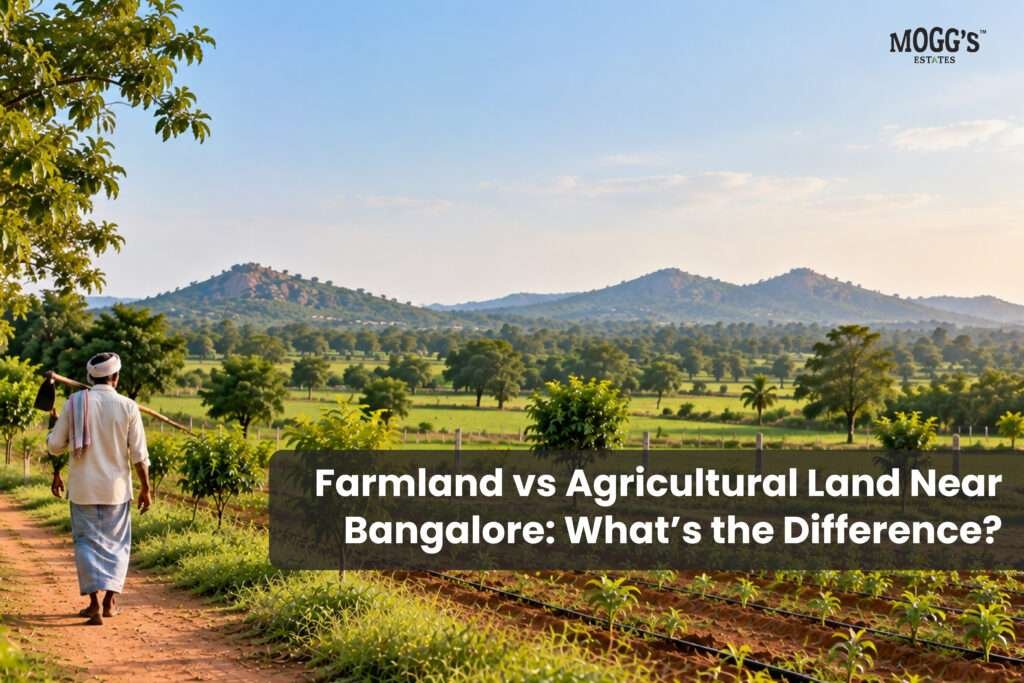
If you search for farmland near Bangalore, you will quickly see agricultural land for sale near Bangalore described in the same breath. Farmland vs Agricultural Land Near Bangalore Many listings use the two terms interchangeably, and most buyers assume they mean the same thing. In everyday conversation, they largely do. In property law and revenue records, however, the difference matters a great deal. A plot can be called farmland in an advertisement and still carry a classification that limits what you can build, grow or sell.
This guide explains where the two terms overlap, where they diverge, and why the distinction affects your purchase. It also covers how agricultural land around Bangalore is classified, what conversion involves, and how to match the right kind of land to your plans.
The Short Answer
In plain language, farmland is land used or suited for farming, while agricultural land is land recorded as agricultural in government records. Farmland describes what the land does or can do. Agricultural land describes how the law and the revenue department classify it. A parcel can be both, one without the other, or somewhere in between.
For a buyer, the practical question is not what the listing calls the land. It is whether the land’s official classification, its physical condition and its legal eligibility all support what you want to do with it.
Why the Terms Get Mixed Up
“Farmland” is an everyday word. Sellers, brokers and online portals use it to attract people who want land for crops, orchards, a weekend property or a long-term holding. It is a friendly term that tells a buyer the land is rural and open.
“Agricultural land” is closer to a formal category. Karnataka’s land laws and revenue records use agricultural classification to decide how land may be held, transferred and used. When a revenue record describes a plot as agricultural, that description has legal weight.
The confusion grows because many listings use “agriculture land” as a casual variant, and some use “farm plot” or “farm land” to describe parcels that are not classified as agricultural at all. A plot marketed as a farm may sit in a village where conversion is already under way, or in a zone where the revenue record has not been updated. Read the listing as a starting point, then check the records.
What Farmland Usually Means Around Bangalore
When buyers talk about farmland near Bangalore, they usually mean land with a cultivation purpose. That might be a plot for ragi, vegetables, mango or coconut. It might be a parcel where the buyer plans to grow fruit trees over several years or to set up a small organic farm. In each case, the land’s value depends on its soil, water, access and the buyer’s ability to farm it.
Farmland is also used loosely to describe weekend properties with open space. Some owners plant trees, keep livestock or grow vegetables for family use without running a commercial operation. That kind of use is common, but it still has to fit within the legal classification of the land.
The key point is that farmland is a description of use and potential. It does not, by itself, guarantee any legal right. A plot that looks like farmland from the road might be restricted in ways that only the revenue records reveal.
What Agricultural Land Means in Karnataka
Agricultural land is a classification that appears in revenue and land records. In Karnataka, the Record of Rights, Tenancy and Crops, known as the RTC or Pahani, is the main document that shows how a parcel is recorded. It identifies the owner, the crops grown, any tenancy and, importantly, the land’s classification.
The classification determines several things. It affects who may buy the land, since state rules on agricultural holdings apply to certain buyers. It affects how much land a single household can hold in some cases. It also affects what the land may be used for. Agricultural land is generally meant for farming and related activities. Using it for residential layouts, commercial buildings or most non-farm construction usually requires formal conversion to another classification.
Because classification sits in the records rather than on the ground, a parcel with fields and trees might still be legally agricultural even if nearby plots have already been converted. Equally, a barren plot might have been converted and be legally available for building, though it does not look like farmland at all.
Farmland vs Agricultural Land Near Bangalore: Key Differences
Consider two buyers. The first purchases a plot marketed as a farm near Bangalore, planning to grow vegetables and build a small storage shed. The second buys a plot listed as an agricultural site, but the RTC shows no conversion and the nearby layouts are residential. The first buyer’s plan may fit the land’s classification. The second buyer may discover that building a house is not possible without a conversion process that takes months and may not succeed.
Both situations show why the label on a listing is not enough. Buyers who understand the difference ask better questions. They check the RTC for classification, they confirm whether any conversion has been approved, and they ask a lawyer whether the intended use is allowed.
The difference also affects price. Land that is agricultural and unconverted usually sells for less than land with a clear path to non-agricultural use. Sellers sometimes price a plot as if conversion is already done. A buyer who pays that premium without written evidence of conversion may be overpaying for a use the land cannot legally support.
Agricultural Land Around Bangalore: Where It Sits
Agricultural land around Bangalore falls in a range of zones. Some parcels are close to the urban edge, where development pressure is high and conversion is a live issue. Others lie in more distant taluks, where farming remains the dominant use and the land is less exposed to conversion pressure.
Land nearer the city often carries higher prices because buyers expect it to become more valuable, either for residential use or for infrastructure. That expectation may be right, but it is not guaranteed. Land further out tends to be cheaper and more clearly agricultural, which suits buyers who want to farm, hold for the long term or enjoy a rural property.
Whichever zone you consider, check whether the parcel falls within any notified development area, master plan or project corridor. Such designations can restrict use or change the land’s value over time. Local revenue offices and planning authorities can confirm the current position for a specific survey number.
Conversion: The Bridge Between the Two
Conversion is the formal process of changing a parcel’s classification from agricultural to another use, such as residential or commercial. In Karnataka, conversion is typically handled through the local revenue authorities, often at the level of the Deputy Commissioner’s office, under the state’s land revenue framework. The process involves an application, verification of the land and approvals, and it can take a considerable time.
Conversion is not automatic. Being near the city or close to a new road does not mean a plot will be converted. Authorities consider the land’s location, the zoning, the availability of services and other factors. A buyer should never assume conversion will be approved, and should never pay a premium based only on a seller’s promise.
If you plan to build beyond basic farm structures, such as a sheds for equipment or storage, ask a lawyer and the local revenue office what is permitted under the current classification. Some agricultural structures do not require conversion, but a residential farmhouse often does.
How to Choose Between Farmland and Agricultural Land
Your purpose should drive your choice more than the label on a listing.
If you want to grow crops or run an orchard, agricultural land with reliable water and soil is usually the right choice. Its classification fits your plan, and its price reflects its farming value rather than speculative development.
If you want a weekend property with a small house, the situation is more complicated. You may need land already converted or a parcel where conversion is realistic. Plan for the time and uncertainty involved, and make the purchase conditional on the approvals you need where the agreement allows.
If you are buying purely as an investment, be clear about what you expect. Agricultural land can appreciate, but it is less liquid than residential property. Returns depend on whether conversion happens, whether infrastructure arrives and whether a buyer later wants the land for the same use you bought it for.
If you are considering a managed farmland arrangement, the land’s classification still matters. The operator’s plans must fit the land’s legal use, and the contract should not assume a use the land cannot support.
Documents to Verify Before Buying Land
The most reliable way to understand a parcel is through its records. Ask for the RTC and confirm the classification, the recorded owner and the crops listed. Check mutation entries for the chain of ownership. Obtain an Encumbrance Certificate from the Sub-Registrar’s office to see whether the land has been mortgaged or otherwise encumbered. Review the Khata and tax receipts, and compare them with the sale deed.
Then ask for any conversion orders or applications. If the seller says conversion is in progress, request copies of the application and any correspondence, and have your lawyer confirm their status with the revenue office. A verbal assurance has no value in this context.
Finally, check the survey sketch and boundaries. A plot that is correctly classified can still be worth less than expected if its edges are disputed or its access road is unclear.
Common Confusion Buyers Should Avoid
The first mistake is trusting a listing’s wording. A plot described as a farm or agricultural site may not match its legal status. Always verify with the records.
The second is assuming that land near a growing area will be converted. Proximity to development helps the case, but it does not decide the outcome.
The third is paying for conversion before it is approved. Make any premium payment conditional on written evidence, or structure the deal so that the balance is released only after the relevant approvals are in place.
The fourth is confusing a plot’s appearance with its legal use. Fields and trees do not reveal classification, and a barren site may be legally agricultural or already converted.
Tips for Buyers Comparing Options
Compare two or three plots on the same criteria: classification, water, soil, access, distance from the city and the seller’s documentation. Use the same checklist for each so the comparison is fair. Ask a lawyer to review the top candidate in detail, and visit it in more than one season.
Keep your budget realistic. Include the purchase price, stamp duty, registration, legal and survey costs, and a reserve for water, fencing and maintenance. If conversion is part of your plan, add its cost and a buffer for delay.
Put every important promise in writing, and do not commit money you may need soon. Farmland is far less liquid than residential property, so buy it for the purpose you can carry out over the long term.
Final Thoughts
Farmland and agricultural land near Bangalore overlap in everyday speech, but the difference between them is important for any buyer. Farmland describes the land’s use and potential. Agricultural land describes its legal classification. The safest purchases come from matching the two: land whose records allow your plan, whose physical condition supports it and whose price reflects its real use.
Read listings with care, verify every claim in the revenue records, and treat conversion as a process to be proven rather than a promise to be believed. With that approach, you can choose farmland or agricultural land near Bangalore with confidence and avoid the surprises that catch careless buyers.
Frequently Asked Questions
Is farmland the same as agricultural land?
In everyday use, the two terms often mean the same thing. In legal and revenue terms, agricultural land is a classification recorded in official documents, while farmland describes the land’s use or suitability. Always check the RTC to confirm the classification.
Can I build a house on agricultural land near Bangalore?
Usually not without conversion. Farm structures such as storage sheds may be permitted, but a residential house generally requires the land to be converted to a non-agricultural classification. Confirm the rules with the local revenue office before you plan any construction.
What is land conversion in Karnataka?
Conversion is the formal process of changing a plot’s classification from agricultural to another use, such as residential or commercial. It is handled through the local revenue authorities and can take months. Approval is not guaranteed.
Does being near Bangalore mean agricultural land will be converted?
No. Proximity to the city can increase the chances of conversion, but each application is assessed on its own facts, including zoning, services and the land’s location. Never assume approval.
Which is cheaper, farmland or agricultural land?
The label alone does not determine price. Agricultural land that is unconverted and far from development is often cheaper than land with a realistic prospect of conversion. Compare plots on their records, location and water, not their names.
How do I find out the classification of a specific plot?
Obtain the RTC (Pahani) through the Bhoomi system or the taluk revenue office, using the survey number. Your lawyer can also check whether any conversion has been applied for or approved.
Can foreigners or non-agriculturists buy agricultural land?
Eligibility depends on current Karnataka rules and the buyer’s circumstances. Check with a qualified lawyer, since these rules have changed over time and may apply differently to different buyers.
What is the difference between “agriculture land” and “agricultural land”?
They mean the same thing. “Agricultural land” is the standard term used in law and revenue records, so it is the form to rely on when you check documents.