
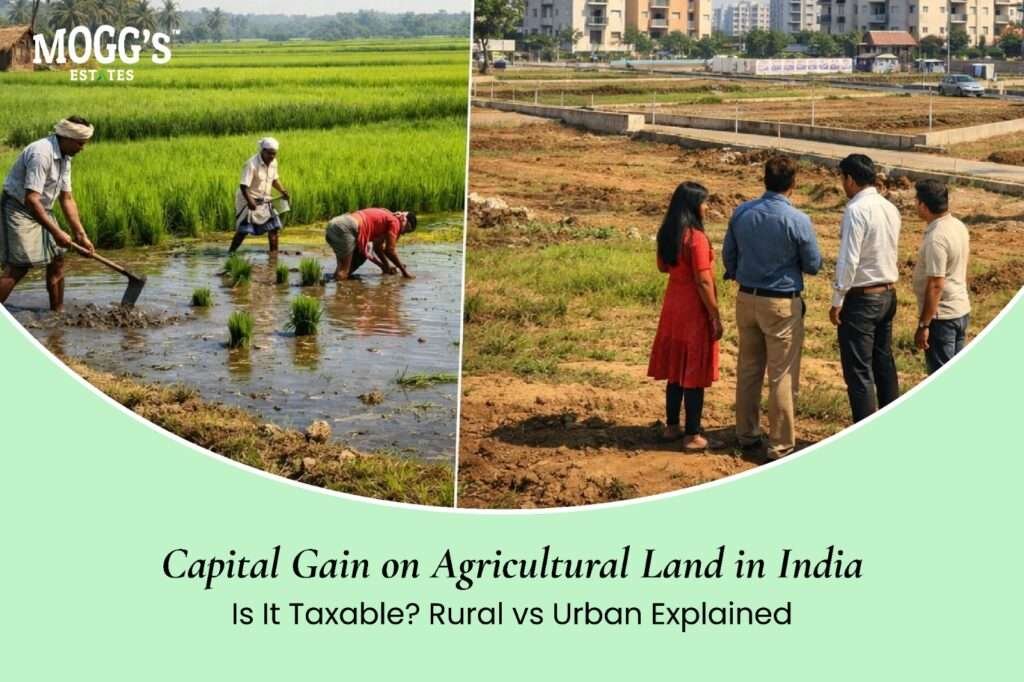
Quick answer: Capital gain on agricultural land depends on whether the land is rural or urban under the Income Tax Act. Under Indian income tax law, rural agricultural land is generally outside the definition of a capital asset, so gains from its sale are usually not taxed as capital gains. Agricultural land within the urban limits defined by the Act can be a capital asset, and gains from its sale can be taxable. Exemptions such as section 54B may apply in some cases, subject to strict conditions. Whether land is rural or urban depends on its location, distance from a municipal or notified area, and the population of that area. Confirm the position for each sale with a chartered accountant before you sign anything.
Selling farmland can produce a gain, and the tax treatment depends on whether the land is rural or urban under the law. Buyers ask the same question for a different reason. A seller’s tax position can affect the timing, the documents, and the price, so it is worth understanding before you negotiate. This guide explains the main rules, the tests that decide the classification, the exemptions most often discussed, and the questions to put to the seller and your adviser.
Why This Question Matters for Buyers and Sellers
Two parties are involved in every farmland sale, and each has a stake in the tax answer. A seller wants to know how much of the sale price is taxable, and whether an exemption applies. A buyer wants to know whether the seller’s tax position could delay registration, create a dispute later, or reveal a problem with the records.
Tax treatment also interacts with the deal’s paperwork. The sale deed must record the true consideration, and the stamp duty is calculated on the higher of the consideration or the guidance value. A deed that understates the price to reduce the seller’s tax creates a separate risk, and the two issues should be discussed together with your advisers. Understanding capital gain on agricultural land early helps both parties plan the deal
The Basic Rule: Capital Asset and Agricultural Land
Income tax applies to capital gains that arise from the transfer of a capital asset. The Income Tax Act defines a capital asset broadly, but it also excludes certain property. One of the main exclusions is rural agricultural land. Under the Act, agricultural land in India that is not situated within the specified urban limits is generally not treated as a capital asset.
The question of capital gain on agricultural land starts with whether the asset counts as a capital asset. This is why the rural and urban distinction matters so much. The same piece of farmland can receive different treatment depending on where it sits, and a difference of a few kilometres can change the answer.
What Makes Land Rural or Urban
The Act uses a combination of location and distance tests. Land may be treated as urban agricultural land if it lies within a specified distance of a municipality, cantonment board, or other notified area. The distance depends on the population of that area. Larger populations generally carry a larger distance band, and the population figures used are those fixed by the Act and the relevant census.
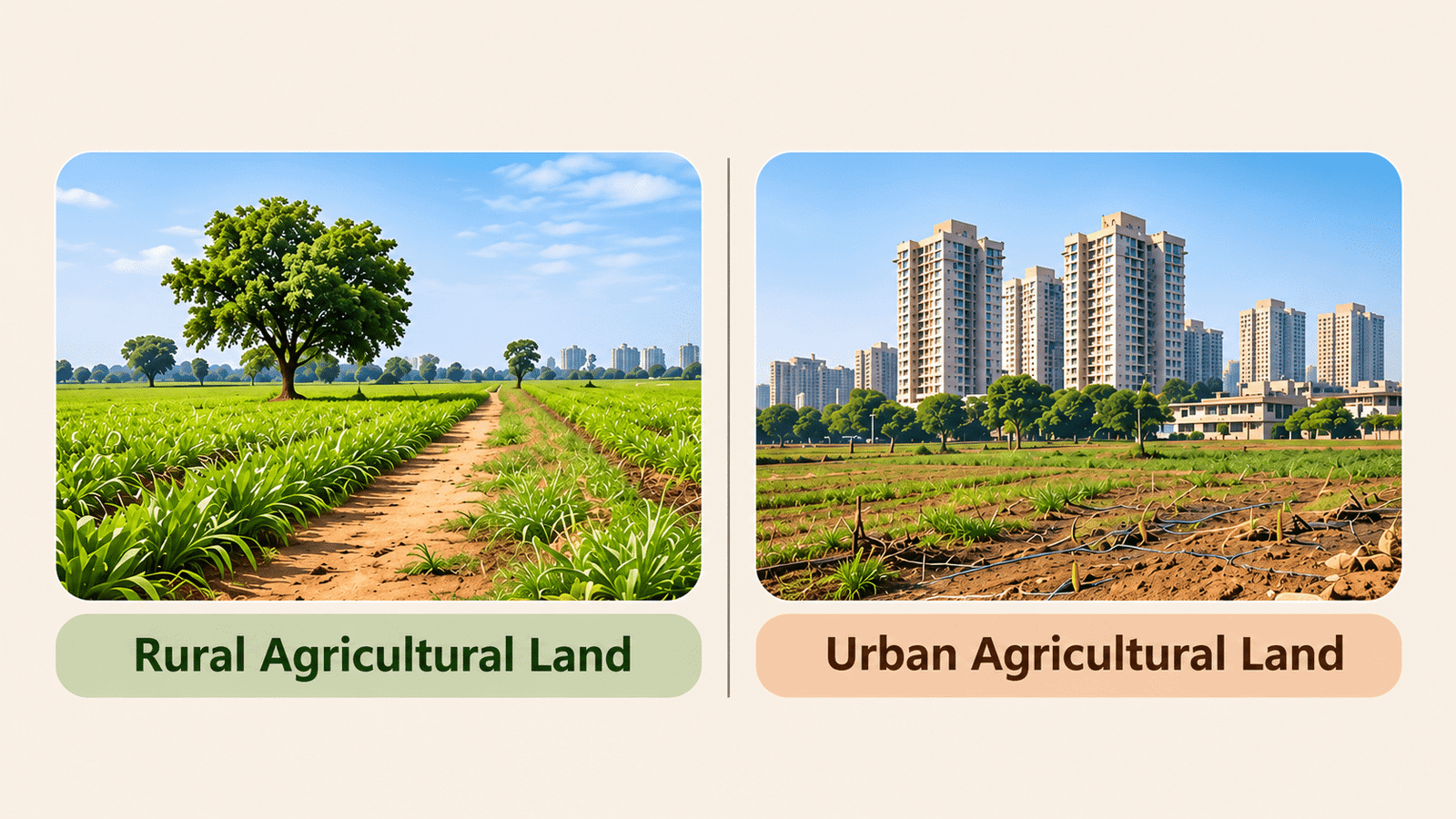
As commonly described, the bands work roughly as follows: a population of 10,000 or more but below one lakh brings land within about 2 kilometres of the limit into the urban category; a population of one lakh or more but below 10 lakh extends the distance to about 6 kilometres; and a population of 10 lakh or more extends it to about 8 kilometres. These distances are measured from the municipal or notified boundary. Confirm the exact text of the provision, the census basis, and any later notification before you rely on these figures.
Because the tests depend on official population data and the current boundaries of local bodies, a plot near a town may be classified differently from one a short distance further away. A map can suggest the answer, but it cannot confirm it. Ask a chartered accountant to verify the classification for the specific plot, using the official boundary and the relevant notifications.
Capital Gain on Rural Agricultural Land
If the land is rural agricultural land under the Act, gains from its sale are generally not taxed as capital gains. Most farmers and investors rely on this position when they sell land outside the urban limits. The exclusion applies only if the land meets the statutory definition, including its location and its agricultural character at the relevant time.
Even where the gain is not a capital gain, other tax questions can arise. The sale may affect the treatment of other income, the source of the funds used to buy the land, or any business activity linked to the land. Where the seller runs a farming business, the income from that business is assessed separately. Get specific advice for the facts of the sale rather than relying on a general rule.
Urban Agricultural Land: Taxable, With Possible Exemptions
When the land is urban agricultural land, capital gain on agricultural land may be taxable. If the land is urban agricultural land under the Act, it can be a capital asset. Gains may then be taxed as short-term or long-term capital gains, depending on the holding period and the rules in force on the date of transfer.
For land, the holding period is an important threshold. Land held for longer than the period the Act specifies is generally treated as a long-term capital asset. Rates, the availability of indexation, and the choice of computation method have changed in recent years, including for transfers made from a specified date in 2024. These changes are fact-specific, so a chartered accountant should confirm which rules apply to the year of sale and to the date the seller acquired the land.
Several exemptions can reduce or remove the tax in some cases. Section 54B is the provision most often discussed for agricultural land, and the next section explains it. Other provisions may apply to other types of reinvestment or to particular circumstances. Each exemption has its own conditions, timelines, and documentation requirements. Missing one requirement can make the exemption unavailable.
Section 54B: What It Covers and What It Requires
Section 54B is the provision relevant to the transfer of land used for agricultural purposes. In general terms, it allows an exemption on the capital gain when the seller reinvests the proceeds in other agricultural land within a specified period. The original land must have been used for agriculture by the seller, or by a parent in certain cases, during the period the Act requires before the transfer.
The conditions cover several points:
- Use of the original land. The land sold must have been used for agricultural purposes for the period the Act specifies before the sale.
- Who may claim. The provision has traditionally applied to individuals and Hindu undivided families. Confirm whether the seller’s status qualifies.
- Timing of the new purchase. The replacement agricultural land must generally be bought within a set period before or after the transfer, or constructed within a longer period. The dates are strict.
- Use of the new land. The replacement land must be used for agricultural purposes for the required period.
- Limit of the exemption. The exemption is generally restricted to the amount of the capital gain that is reinvested, and only up to the cost of the new asset.
Because the timelines and conditions are strict, a seller who plans to rely on section 54B should take advice before signing the sale. A reinvestment that is late, or that falls outside the conditions, can leave the gain taxable. The rules have been amended over time, so confirm the current text and any relevant notifications before you rely on the exemption.
This article describes the provision for information only. It does not recommend any reinvestment or tax planning step.
Capital Gains Basics for Land Sales
If a capital gain applies, the tax depends on the holding period, the cost of acquisition, the rules on indexation where they apply, and the rate in force at the time of sale. In outline:
- Holding period. The period for which the seller held the land decides whether the gain is short-term or long-term.
- Cost of acquisition. The purchase price and certain allowable costs reduce the gain. Records of the original purchase, such as the earlier sale deed, are therefore important.
- Indexation. Where it applies, indexation can adjust the cost for inflation. Its availability depends on the rules in force, including any transitional option for land acquired before a specified date.
- Rate. The applicable rate depends on whether the gain is short-term or long-term, and on the law at the time of transfer.
- Stamp duty value. Where the stamp duty value of the land exceeds the sale consideration, the Act can treat the stamp duty value as the consideration, subject to tolerance rules. A chartered accountant should confirm how this applies to the sale.
Do not use these points as a calculation method. Rules, rates, and indexation change, so confirm each figure with a current source before you rely on it.
Stamp Duty Valuation and Tax Risk

Tax authorities can compare the consideration in a sale deed with the stamp duty value or guidance value of the land. A large gap between the two can attract scrutiny, and the stamp duty value may be used in the tax calculation as described above.
Record the transaction accurately. Keep documents that explain the price, such as the sale agreement, the payment records, and any valuation. Do not misstate the consideration to reduce tax or stamp duty. Misstatement can lead to penalties, additional duty, a tax reassessment, and disputes between the parties. For how duty is calculated, read our guide to stamp duty for agricultural land in Karnataka.
Questions a Buyer Should Ask About the Seller’s Tax Position
Buyers do not normally pay the seller’s capital gains tax, but the seller’s position can affect the transaction. Before you sign, ask the following.
- Is the land rural or urban agricultural land under the Act? Ask for the evidence, including the distance and population tests, and check it against the official boundary.
- How long has the seller held the land, and how was it acquired? The answer determines the holding period and the cost of acquisition, and it may point to inheritance or partition records you should check.
- Does the seller plan to claim an exemption? If so, ask for the documents that support it, and the timeline for any reinvestment.
- Are any tax dues, notices, or disputes linked to the property? Ask for written confirmation, and check the records for pending notices.
- Has the sale been reflected accurately in the sale deed and the revenue records? The consideration in the deed should match the payments, and the mutation should follow the registration.
- Who will bear any tax on the sale? The sale agreement should say so in writing.
A buyer who understands these points can avoid disputes after registration. Tax-related defects can surface years later, when the property is sold again or when a loan is sought.
Tax Deduction at Source and Other Compliance Points
Some property purchases attract tax deduction at source, where the buyer deducts tax from the payment and deposits it with the government. The rules for this depend on the type of property, the value of the consideration, and the residence status of the seller. Rural agricultural land may fall outside these rules, but this depends on the definition used. Ask your chartered accountant to confirm whether any deduction applies to your transaction, and to explain the filing steps.
Non-resident sellers and buyers face additional rules. The tax treatment and the deduction rates can differ, and the foreign exchange rules on buying agricultural land also apply. For NRIs and foreign nationals, get written advice from a qualified adviser before you negotiate.
Common Mistakes Sellers and Buyers Make
These are the errors most often made with capital gain on agricultural land.
- Assuming all farmland is tax-free because it is agricultural: Classification depends on location and population, so an agricultural plot can still be urban for tax purposes.
- Treating land near a town as rural without checking the current limits: The distance is measured from a specified boundary, not from the town centre.
- Missing the conditions and timelines for a reinvestment exemption: A late purchase or a change of use can disqualify it.
- Relying on an old article for thresholds, rates, or section numbers: The rules have changed, and some older summaries describe repealed positions.
- Understating the sale price in the deed: This creates penalties, a tax reassessment, and a dispute risk.
- Confusing capital gains with other income: A sale can have effects beyond the capital gains computation, especially for active farming businesses.
- Ignoring the stamp duty value: The value recorded for stamp duty can influence the tax result.
Checklist for Farmland Sellers and Buyers
- Confirm whether the land is rural or urban agricultural land, with evidence.
- Confirm the holding period, and gather the acquisition documents.
- Ask a chartered accountant to calculate the gain using the rules in force at the time of transfer.
- Identify any exemption, and check its conditions and timelines in writing.
- Record the sale price accurately, and keep the supporting payment records.
- Confirm whether any tax deduction at source applies to the purchase.
- Keep receipts and tax filings for the period the law requires.
- Take written tax advice before you sign the sale agreement.
Key Takeaways
- Capital gain on agricultural land depends on the rural or urban classification of the plot.
- Classification depends on distance and population tests, so confirm it for each plot with evidence.
- Section 54B may provide an exemption, but it carries strict use, timing, and reinvestment conditions.
- Holding period, cost of acquisition, indexation, rates, and the stamp duty value all affect the result, and the rules have changed.
- Record the sale price accurately, because misstatement creates legal and financial risk.
- Buyers should ask about the seller’s tax position and documents before signing, and should confirm any deduction at source.
- Confirm the current rules with a qualified chartered accountant before any sale.
FAQs:
Is capital gain on agricultural land taxable in India?
Rural agricultural land is generally not treated as a capital asset, so its sale is usually outside capital gains tax. Urban agricultural land can be taxable, subject to exemptions and conditions.
What makes agricultural land rural or urban?
The classification depends on the distance from a specified municipal or notified area, and that distance depends on the population of the area. Confirm the current position for the specific plot with a chartered accountant.
What is section 54B?
It is a provision that may allow an exemption on capital gain from agricultural land if the seller reinvests the proceeds in other agricultural land within a set period, subject to strict conditions on use and timing.
Does a buyer pay the seller’s capital gains tax?
Usually not. However, the seller’s tax position can affect the transaction, so buyers should ask for the relevant details and documents before signing.
Can I reduce tax by understating the sale price?
No. Misstating the consideration creates legal and financial risk, including penalties, reassessment, and disputes. Record the transaction accurately.
Does the stamp duty value affect the tax?
It can. Where the stamp duty value exceeds the consideration, the Act may treat the stamp duty value as the consideration, subject to tolerance rules. A chartered accountant should confirm how this applies.
Do I need a chartered accountant for a farmland sale?
Yes, for any sale where tax may apply. The rules are technical, have changed in recent years, and depend on facts that a professional should review.