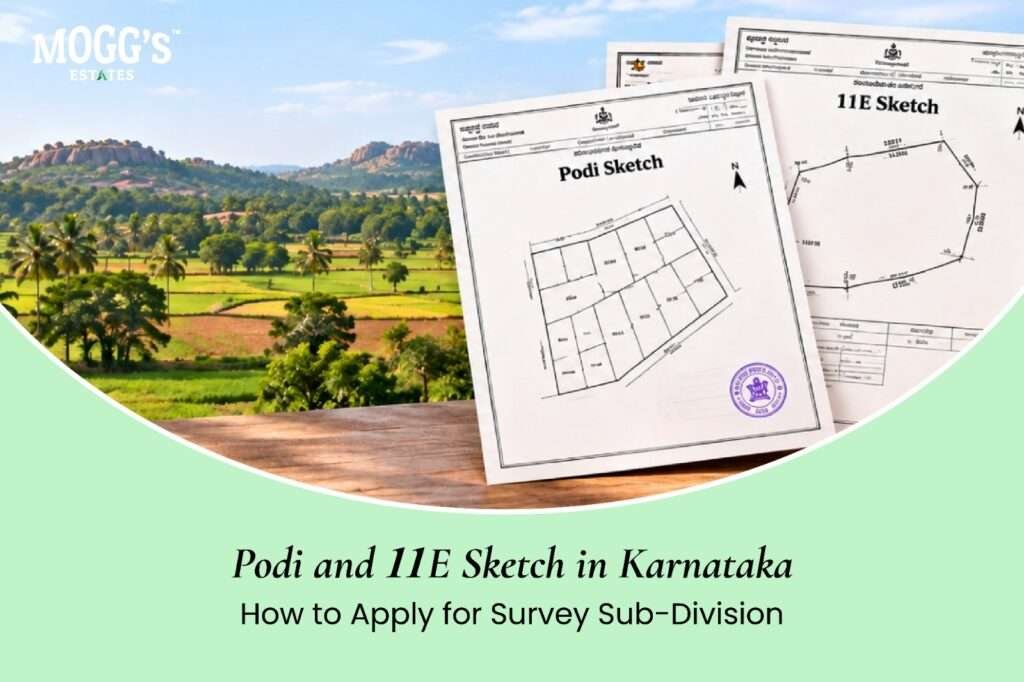
Quick answer: Podi Karnataka is the official sub-division of a survey number, and the 11E sketch marks the resulting boundaries. It creates separate hissas, each with its own boundary and owner. The 11E sketch is the survey map that marks those boundaries, and the Sub-Registrar generally needs it before a partial sale or partition can be registered. You can apply through the Mojini service on the Bhoomi portal or at the taluk survey office, and the process includes a site survey by a licensed surveyor and departmental verification.
If you are selling part of a survey number, splitting inherited land among heirs, or carving a plot out of a larger parcel, you cannot simply draw a line on paper. The survey number must be officially sub-divided, and the 11E sketch must be issued before the transfer can be registered. Skipping this step is one of the most common reasons a sale stalls at the registration counter. This guide explains what Podi is, when you need it, the documents involved, how to apply online or offline, and the issues that most often delay the process.
What Is Podi, or Survey Sub-Division?
In Karnataka, Podi is the process that splits a survey number into hissas, and you can read the full steps for Podi Karnataka below.”
Karnataka identifies land in three parts: the survey number, a surnoc (a division within the survey number), and a hissa, which is the smallest sub-division. Podi, also spelt phodi, officially splits a survey number into separate hissas. Each hissa holds its own boundary, area, and recorded owner.
For example, Survey No. 45 might be divided into 45/1, 45/2, and 45/3. Each of these is a distinct parcel on the record. The hissa numbers produced by a Podi application are what allow each part of the land to be bought, sold, or inherited on its own.
For a Mogg’s Estates buyer, this matters when a managed farmland project is built on a larger survey number and divided into individual plots. Each plot should map to a clear hissa and a clear boundary before you pay for it.
What Is the 11E Sketch and Why It Matters
The revenue and survey department issues the 11E sketch, an official survey map. It marks the exact boundaries of the sub-divided parcels. Karnataka law requires a valid 11E sketch before you can register a partial sale within a survey number. Without it, the Sub-Registrar cannot register the transfer of a portion of a survey number.
Treat the 11E as the gateway to registration. Any time only part of a survey number is being sold or partitioned, the 11E comes first. For buyers of individual farm plots, ask the seller or project team for the 11E sketch of your plot, and check that it matches the sale deed and the layout plan.
Mogg’s Estates provides 11E guidance on its blog, and the Aira Farms Phase 1 project page links to the same process for buyers who want to verify their plot boundaries.
When You Need a Podi or 11E Sketch
You will usually need Podi and an 11E sketch in these situations:
- Selling part of a survey number, such as carving one plot out of a larger holding
- Partition among heirs or co-owners, where jointly held land is split into individual shares
- After inheritance, when a deceased owner’s land is separated among legal heirs
- Layout or development, when land is divided into multiple farm plots
If the whole survey number is sold to one buyer as it stands, a Podi is generally not needed. It becomes necessary when the parcel is being split.
Who Can Apply
The registered owner or owners of the land, or an authorised representative, can apply. Where the land is jointly owned or being partitioned, the written consent of all co-owners is usually required. Get that consent before you start, because a single objection can stall the application.
Documents You Will Typically Need
Requirements vary by taluk and by case, so confirm the exact list with your taluk survey office. In most cases, prepare the following:
- RTC (pahani) for the survey number. Check it through the official Bhoomi portal. For background, read our guide on how to check the RTC pahani online on Bhoomi.
- Proof of ownership, such as the registered sale deed or title document
- Mutation extract showing the current owner
- Consent letters from co-owners, where the land is jointly held or being partitioned
- Identity proof of the applicant, such as Aadhaar
- Partition deed or court order, if the split follows one
Check each document against the others before you apply. A mismatch in the owner’s name or the extent is the most common reason for delay.
How to Apply Online Through Mojini
Most Podi Karnataka applications start on the Mojini service, which is managed by the Department of Survey, Settlement and Land Records (SSLR). Portal screens can change, so confirm each step on the official site.

Step 1: Open the Mojini services: Go to the Bhoomi portal and find the Mojini or survey (SSLR) services section.
Step 2: Select the location: Choose the district, taluk, hobli, and village.
Step 3: Choose the survey type: Select the sub-division or partition (phodi) service. Choosing the wrong service is a common cause of delay.
Step 4: Upload the documents: Attach the RTC, proof of ownership, and co-owner consent letters where needed.
Step 5: Pay the fee: Pay the survey fee online. The amount varies with the plot size and the type of survey.
Step 6: Save the application number: You will use it to track progress and, later, to download the 11E sketch.
How to Apply Offline
You can also apply at the taluk survey office, or through a Nadakacheri (Atalji Janasnehi Kendra). Submit the application with the same documents and pay the fee at the counter. Many applicants use this route when the record is not fully digitised, or when they need to raise an objection in person.
What Happens After You Apply
- A licensed surveyor is assigned and visits the site to take GPS-based measurements.
- The surveyor prepares a draft sketch and submits it to the Assistant Director of Land Records (ADLR) for verification.
- Once the ADLR verifies the sketch, the department issues the digitally prepared 11E sketch.
- The sub-division is reflected as new hissa numbers in the record, and mutation then updates the ownership of each new parcel. To track that side, read our guide on e-Pouthi Karnataka.
A site survey and departmental verification take time. Start well before any planned sale or registration date.
Fees for Podi and the 11E Sketch
The survey fee is not a flat amount. It depends on the plot size and the type of survey, and you pay it when you submit the application. Rates are revised from time to time, so check the current fee on the Mojini portal or at your taluk survey office rather than relying on an older figure. Budget for the fee, the surveyor’s charges, and any copy or document costs. For a fuller view of the purchase costs, see our guide on stamp duty and registration charges for agricultural land in Karnataka.
Common Issues and How to Avoid Them
Most delays in a Podi Karnataka application come from a few predictable problems:
Co-owner disputes: A partition stalls quickly if every co-owner has not consented. Get written consent before you apply.
Boundary mismatches: If the measured boundary does not match the neighbours’ records, the survey can be objected to. Keep the tippani and the neighbouring RTCs ready.
Old or unclear records: If the RTC, mutation entries, and sale deed disagree, resolve the differences first. The surveyor works from the record.
Trying to register a partial sale without an 11E sketch: The Sub-Registrar will refuse. Complete the Podi first.
Choosing the wrong survey type: Pick the sub-division or phodi service, or the application will be delayed.
Starting too late: Verification takes time, so plan the Podi before you set a registration date.
Practical Tips for Buyers and Owners
- Confirm that the RTC, mutation entries, and sale deed show the same owner before you start a Podi Karnataka application.
- Obtain co-owner consent in writing at the start.
- Save the application number, and track the status online.
- Ask the project team or seller for the 11E sketch of each plot you are considering, and compare it with the layout plan.
- Involve a property lawyer to review the sub-division and the draft deed before you pay the balance.
Podi, 11E, and Managed Farmland Plots
Buyers of managed farmland often purchase a single plot within a larger survey number. In that case, the plot should already be sub-divided, with its own hissa and an 11E sketch that matches the sale deed. If the plot is not yet sub-divided, the Podi process must be completed before the sale can be registered.
Before you pay for a plot, ask the Mogg’s Estates team for the following:
- The hissa number and the survey number for your plot
- The 11E sketch for the plot
- The RTC and mutation status for the plot
- The sub-division status, and the expected date for any pending step
Compare these documents with the sale deed. You can also explore individual project pages, such as Aira Farms Phase 1, Aira Farms Phase 2, Terrahill, and Nidhivanaa Farms, and confirm the plot details for each.
Key Takeaways
- Podi Karnataka is the official sub-division of a survey number into hissas, each with its own boundary and owner
- The 11E sketch marks those boundaries, and a partial sale or partition generally needs it before registration.
- You can apply through Mojini on the Bhoomi portal, or at the taluk survey office or Nadakacheri.
- The process includes a site survey by a licensed surveyor and verification by the ADLR.
- Mutation follows the sub-division and updates the ownership of each new parcel.
- For managed farmland, confirm the hissa, the 11E sketch, and the RTC status of your plot before you pay.
FAQs:
Is an 11E sketch mandatory to sell part of my land?
Yes. For a partial sale within a survey number, the Sub-Registrar generally requires a valid 11E sketch before registering the transfer.
What is the difference between Podi and mutation?
Podi sub-divides the survey number into new hissas and produces the 11E sketch. Mutation then updates the ownership record for each new parcel. Podi comes first, and mutation follows.
Can I complete the whole process online?
You can apply, pay, and track the application online through Mojini. A physical site survey by a licensed surveyor is still part of the process.
How long does Podi take?
The timing varies by taluk and by the complexity of the case, because it involves a site visit and departmental verification. Start early, well before any planned sale date.
Do all co-owners need to agree?
For a partition or a split of jointly held land, the consent of the co-owners is generally required.
Do I need Podi if I buy a whole survey number?
Generally no. A Podi is needed when the land is being split, not when the whole survey number is sold as it stands.