The way people think about property is changing.
For years, urban buyers in Bengaluru focused mainly on apartments, villas and conventional plots. But as the city expands, a different category of property is gaining attention: managed farmland near Bengaluru.
The appeal is easy to understand. Farmland offers something that urban property often cannot — open space, greenery, agricultural activity and a closer connection to nature. At the same time, professionally managed farmland can make ownership more convenient for people who do not have the time to manage agricultural land themselves.
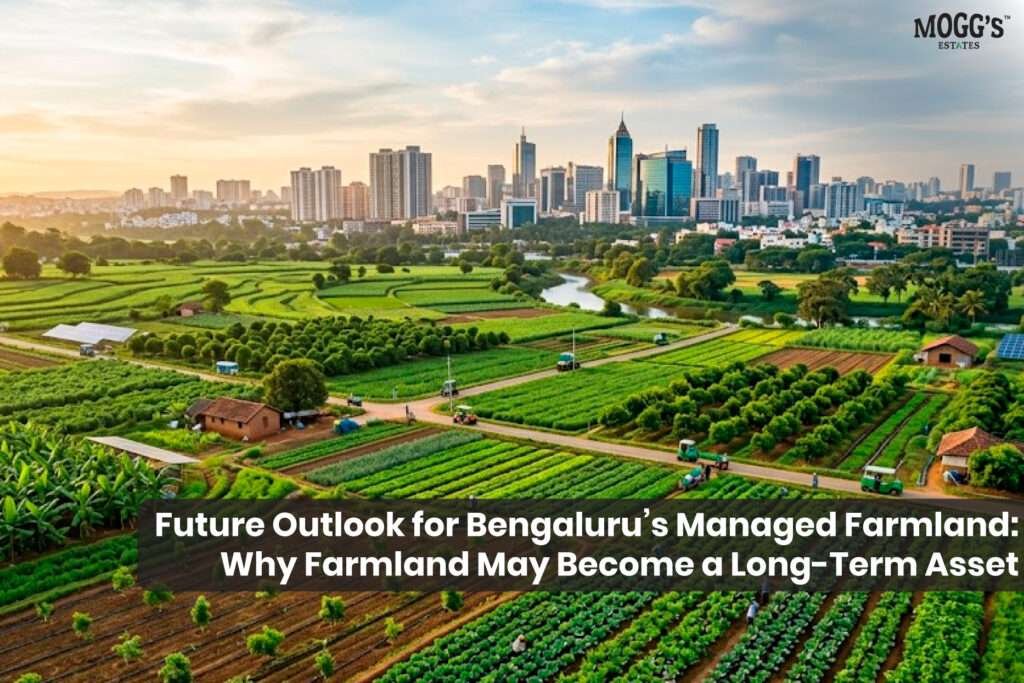
Bengaluru’s growth is also changing the relationship between the city and its surrounding rural areas. Research on Bengaluru’s peri-urban landscape has documented the pressure that urbanisation places on agricultural land, while current development plans continue to expand infrastructure and economic activity beyond the traditional city limits. (MDPI)
So, what could the future hold for farmland around Bengaluru?
Why Farmland Is Getting More Attention
Land has always been viewed as a long-term asset in India. However, today’s buyers are looking beyond simple ownership.
They want property that can offer a combination of:
- Long-term land ownership
- Green surroundings
- Weekend lifestyle opportunities
- Agricultural activity
- Potential appreciation
- Professional maintenance
- A peaceful escape from city life
This is where managed farmland near Bengaluru becomes particularly interesting.
Instead of purchasing a large agricultural parcel and handling everything independently, managed farmland communities can provide organised infrastructure and ongoing maintenance.
For busy professionals, entrepreneurs and families, this model can make rural property ownership much easier.
You can explore options such as managed farmland near Bengaluru while comparing factors such as location, accessibility, land title, infrastructure and management services.
Bengaluru’s Expansion Could Influence the Future of Farmland
Bengaluru is no longer growing only within its traditional urban boundaries.
Infrastructure, employment centres, industrial developments and residential expansion are steadily influencing areas around the city. The proposed Greater Bidadi Integrated Township, for example, illustrates the scale of development being considered along the Bengaluru–Mysuru corridor. (The New Indian Express)
This expansion can create a complicated situation for agricultural land.
On one hand, urbanisation can put pressure on farmland. On the other, it can increase interest in land located within reasonable driving distance of major urban centres.
That makes location one of the most important factors when evaluating farmland near Bengaluru.
A parcel that is too remote may offer plenty of space but limited accessibility. A parcel that is strategically located near established roads and developing corridors may offer a different long-term proposition.
However, buyers should never assume that infrastructure development automatically guarantees appreciation. Land investment always requires proper legal, location and market due diligence.
The Rise of Managed Farmland
Traditional farmland ownership can involve several responsibilities.
The owner may need to think about irrigation, plantation, fencing, security, maintenance, labour and regular visits.
For someone living in Bengaluru and working a full-time job, managing all of this can be difficult.
Managed farmland addresses this challenge by combining land ownership with professional farm management.
Depending on the project, management may include plantation care, common-area maintenance, security, irrigation management and upkeep of the property.
This creates an interesting middle ground.
You can own a piece of agricultural land without necessarily having to become a full-time farmer.
That is one reason Bengaluru’s managed farmland segment could become more relevant in the years ahead.
Agriculture Could Become More Technology-Driven
The future of farming will not look exactly like farming of the past.
Technology is increasingly influencing agriculture through:
- Smart irrigation
- Weather monitoring
- Soil testing
- Crop monitoring
- Farm management software
- Precision agriculture
- Sustainable cultivation practices
Bengaluru also has an established horticultural ecosystem. Karnataka’s horticulture sector includes fruits, vegetables, flowers and plantation crops, while floriculture has a particularly strong presence in the peri-urban areas around Bengaluru. (Bengaluru Urban)
This creates opportunities for managed agricultural communities to adopt better farming practices.
The future of farmland may therefore be less about simply owning an empty piece of land and more about creating productive, well-maintained agricultural ecosystems.
Sustainability Will Become More Important
The future of farmland cannot be discussed without talking about sustainability.
Water availability, soil health, climate variability and biodiversity will increasingly influence agricultural decisions.
Recent research on Bengaluru has highlighted regenerative agriculture as a potential nature-based solution for improving environmental health in urban and peri-urban areas. (DOI)
This is important for the future of managed farms.
A well-planned farm can incorporate practices such as:
- Organic inputs
- Water-efficient irrigation
- Soil improvement
- Native plantations
- Composting
- Rainwater management
- Biodiversity-friendly landscaping
Such practices can make farmland more resilient while creating a healthier environment for owners and visitors.
For buyers exploring farmland for sale, sustainability should therefore be considered alongside price and location.
Farmland Could Become More Than an Investment
One of the biggest changes in the farmland market is that buyers are not always looking at land purely from a financial perspective.
They are also looking for experiences.
Imagine spending a weekend away from traffic, surrounded by trees and agricultural fields. Children can learn where food comes from. Families can spend time outdoors. Professionals can disconnect from screens.
This is why the idea of a farmhouse near Bengaluru or a professionally managed farm has become attractive to urban families.
The land becomes part investment, part lifestyle and part long-term family asset.
For many buyers, that combination can be more meaningful than purchasing another property inside the city.
The Growing Importance of Accessibility
Future farmland demand will likely be influenced heavily by connectivity.
People may be willing to travel farther for a holiday destination. But when they are buying property for regular weekend use, convenience becomes important.
Good road connectivity can make a significant difference.
Areas surrounding Bengaluru that connect to major highways and established growth corridors may therefore continue to attract attention.
For buyers researching farms for sale near Bengaluru, it is worth looking beyond the advertised distance from the city.
Consider the actual travel time.
Also examine:
- Road quality
- Highway connectivity
- Nearby towns
- Existing infrastructure
- Future development
- Accessibility during monsoon
- Distance from major employment hubs
These factors can influence both usability and long-term demand.
What Buyers Should Look For in the Future
The future may be promising, but farmland should never be purchased purely because someone predicts that prices will rise.
Due diligence remains essential.
Before purchasing, buyers should carefully evaluate:
1. Legal Documentation
Verify ownership records, title history, survey details, encumbrances and applicable land-use regulations.
2. Location
Study the surrounding area instead of focusing only on the project’s internal development.
3. Water Availability
Agriculture depends heavily on reliable water management. Ask how water is sourced, stored and managed.
4. Farm Management
Understand exactly what the management company provides and what the owner is responsible for.
5. Accessibility
Check the actual travel time from Bengaluru rather than relying only on a distance mentioned in marketing material.
6. Long-Term Purpose
Decide whether you are buying for lifestyle, agriculture, family use, diversification or a combination of these goals.
You can also compare different managed farmland opportunities before making a decision.
What Could the Next Decade Look Like?
The future of farmland around Bengaluru is likely to be shaped by three major forces: urbanisation, agriculture and lifestyle demand.
Urbanisation will continue influencing the city’s outskirts.
Agriculture will become increasingly technology-driven and sustainability-focused.
At the same time, urban residents may continue looking for ways to reconnect with nature without giving up the conveniences of city life.
This combination could strengthen the appeal of professionally managed agricultural communities.
But the future will not be identical for every location.
Some areas may experience rapid infrastructure growth. Others may remain predominantly agricultural. Some farms may develop strong lifestyle appeal, while others may remain focused mainly on cultivation.
Therefore, the quality of the land, management, location and legal structure will matter more than simply owning “farmland.”
The Future of Farmland Is About Ownership With Purpose
The next generation of farmland buyers may think differently from traditional land investors.
They may not simply ask, “How much will this land be worth?”
They may also ask:
“What can this land become for my family?”
It could become a weekend retreat.
It could become a place where children understand agriculture.
It could become a space for growing food.
It could become a long-term family asset.
Or it could simply become a quiet place to escape the pace of Bengaluru.
That is where the future of Bengaluru’s managed farmland becomes interesting.
As the city grows, open land becomes increasingly valuable not only because of its location, but because of the experiences and possibilities it can offer.
For buyers exploring farmland near Bengaluru, the opportunity is therefore about more than buying land today. It is about understanding how agriculture, infrastructure, sustainability and lifestyle could shape the value of land tomorrow.
And perhaps that is the real future of farmland — owning a piece of nature while becoming part of a more sustainable way of living.