When it comes to farmland investment, one question comes up almost immediately: How much land should I actually buy?
There is no single answer. A quarter-acre, half-acre, or one-acre parcel can all make sense depending on your budget, purpose, location, and how much involvement you want in managing the property.
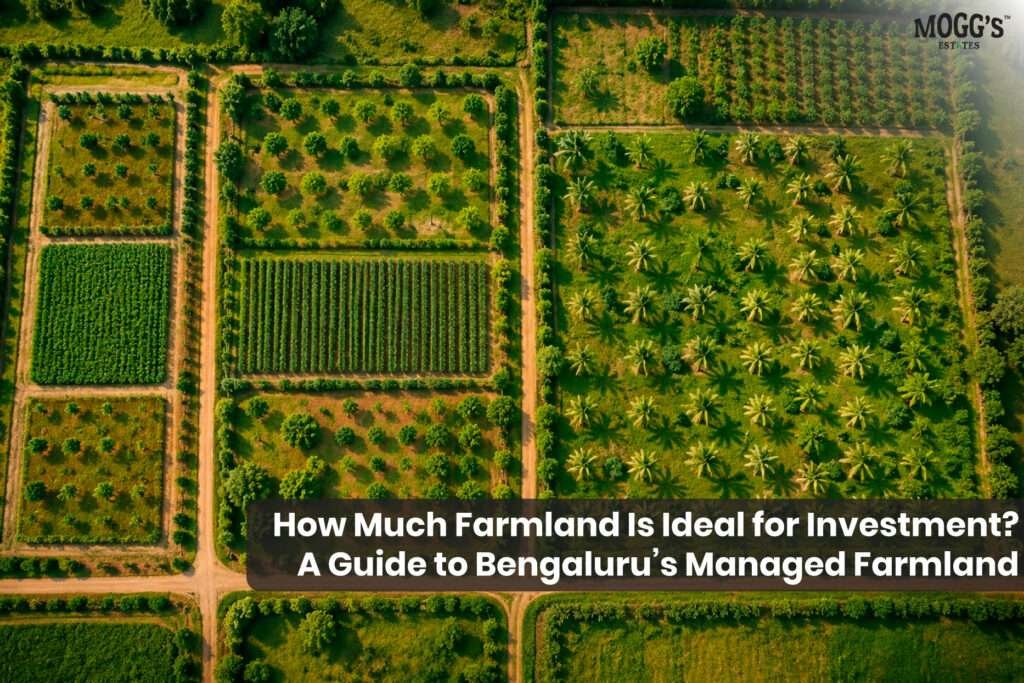
For investors exploring managed farmland near Bengaluru, the decision becomes even more important. A managed farm can combine land ownership with professional cultivation and maintenance, making it easier for urban buyers to own farmland without handling every aspect of farming themselves.
The ideal size, therefore, is not simply about owning more land. It is about finding the right balance between investment, usability, maintenance, and long-term value.
Why Farmland Size Matters
Land is one of the few assets where size can directly influence both the experience of ownership and the investment commitment.
A smaller parcel generally requires less capital and can be easier to manage. A larger parcel gives you more space for cultivation, recreation, landscaping, or a future farmhouse, but it also comes with a higher purchase price and potentially greater maintenance requirements.
This is why buyers should not begin with the question, “What is the biggest plot I can afford?”
Instead, ask:
“What size of farmland best fits the way I want to invest?”
That simple change in perspective can make the buying decision much clearer.
Is 0.25 Acre Enough for a Farmland Investment?
For someone entering the market for the first time, a quarter-acre parcel can be an attractive starting point.
It provides actual land ownership without requiring the same capital commitment as a larger holding. It can also suit buyers who primarily want a green retreat, a small orchard, or a place to spend weekends with family.
A quarter-acre can work particularly well when the project is professionally managed. Instead of worrying about everyday irrigation, plantation care, landscaping, and maintenance, the owner can enjoy the land while a management team handles the operational side.
However, buyers should carefully examine what the project includes. A smaller plot may be ideal for lifestyle ownership, but it may not provide enough space for every type of agricultural activity.
So, if your priority is affordable entry and personal use, a smaller managed farmland plot can make sense.
Why Half an Acre Is Often a Comfortable Middle Ground
For many investors, half an acre offers an attractive balance.
It is large enough to feel like a genuine piece of countryside while remaining more accessible than a full-acre investment. It can provide enough space for plantations, landscaping, recreation, and other farm-related activities, depending on the property’s design and applicable regulations.
This size can appeal to professionals and families who want more than just an investment certificate. They want a place they can actually visit, walk around, spend time in, and gradually make part of their lifestyle.
For buyers considering farmland near Bengaluru, half-acre properties can therefore sit comfortably between affordability and usability.
It is also important to remember that land value is not determined by size alone. Connectivity, soil quality, water availability, title clarity, surrounding development, road access, and the quality of farm management can have a significant influence on the overall attractiveness of a property.
Is One Acre Better for Long-Term Investors?
If the budget allows and the objective is long-term land ownership, one acre can offer greater flexibility.
A larger holding provides more room for agricultural activities and can accommodate a broader plantation plan. It can also offer greater privacy and flexibility for buyers who eventually want to create a more substantial countryside retreat, subject to applicable land-use and construction regulations.
However, buying one acre simply because “more land is better” is not always the right investment strategy.
A well-located, professionally managed smaller parcel can be more practical than a poorly located larger parcel.
The principle is simple:
Quality of land and location should come before quantity of land.
Managed Farmland Changes the Equation
Traditional farmland ownership often requires considerable involvement.
The owner may have to arrange irrigation, labour, fencing, plantation maintenance, security, and regular visits. For someone living in Bengaluru and working a full-time job, this can become difficult.
That is where managed farmland becomes relevant.
A managed farmland model typically combines land ownership with professional maintenance and agricultural management. Depending on the project, services can include plantation care, irrigation management, landscaping, security, infrastructure maintenance, and other farm operations.
This model is particularly relevant for urban investors who want to own agricultural land but do not want farming to become another full-time responsibility.
When comparing managed farmland near Bengaluru, buyers should therefore look beyond the plot size. Ask what happens after you purchase the land.
Who maintains it?
Who manages the plantation?
How is water managed?
What infrastructure is provided?
What are the ongoing maintenance costs?
The answers can be just as important as the number of square feet you are buying.
What Size Is Right for Different Buyers?
There is no universal ideal size, but a simple framework can help.
For first-time investors:
A smaller parcel can provide a relatively accessible entry into farmland ownership.
For families:
A medium-sized plot can offer a better balance between investment and lifestyle use.
For long-term investors:
A larger holding may provide greater flexibility, provided the location and land quality justify the additional investment.
For buyers interested in a farmhouse:
The required size should be evaluated carefully based on the property’s legal status, permitted land use, project regulations, and construction approvals. Buying farmland with the assumption that a farmhouse can automatically be built can lead to problems later.
This is why searches such as farmhouse for sale, farmhouse near Bengaluru, and farmland for sale should always be followed by proper due diligence rather than focusing only on photographs or amenities.
Location Can Matter More Than Plot Size
Imagine two properties.
One offers a full acre but is far from Bengaluru, has poor road access, limited water availability, and little surrounding development.
The other offers a smaller managed farmland parcel closer to the city, with better connectivity, professional maintenance, reliable infrastructure, and a well-planned agricultural environment.
Which is the better investment?
The answer may not be the larger property.
For farmland investors, location, accessibility, land quality, documentation, and long-term demand can matter as much as the size of the parcel.
This is particularly important around Bengaluru, where growth is extending into several peripheral corridors. Buyers should evaluate not only today’s distance from the city but also the area’s connectivity, infrastructure and future development potential.
Don’t Buy More Land Than You Can Use
One of the most common mistakes investors make is assuming that a larger property automatically means a better investment.
But unused land still requires ownership costs, management, and attention.
If your primary goal is to create a weekend escape, you may not need an acre.
If you want a productive plantation and greater privacy, a larger parcel could make more sense.
If your goal is purely long-term land ownership, the decision may depend more heavily on location, legal clarity, acquisition cost, and future demand.
The best investment is therefore not necessarily the biggest one.
It is the one that fits your financial plan and intended lifestyle.
What Should You Check Before Buying Farmland?
Before purchasing any agricultural property, size should be only one part of your evaluation.
Look at:
- Clear and verifiable land title
- Survey and boundary details
- Legal status and land-use restrictions
- Water availability
- Soil quality
- Road connectivity
- Access to the property
- Development and maintenance commitments
- Management charges
- Plantation or farming plan
- Exit and resale considerations
- Rules relating to construction or farmhouse development
If you are comparing options for farmland for sale, do not make your decision purely on price per square foot.
A cheaper property can become expensive if it has poor access, unclear documentation, inadequate water, or significant maintenance challenges.
The Ideal Farmland Size Is the One That Fits Your Investment
So, what is the ideal farmland size for investment?
The honest answer is: it depends.
A smaller plot can provide an easier entry point. Half an acre can offer a balanced combination of investment and lifestyle. One acre or more can provide greater flexibility for buyers with a larger budget and a long-term agricultural vision.
But size should never be considered in isolation.
For buyers exploring farmland near Bengaluru, the smarter approach is to evaluate the entire proposition: location + land quality + legal clarity + connectivity + management + purpose.
That is what turns farmland from simply a piece of land into a thoughtfully chosen asset.
In the end, successful farmland investing is not about owning the most land.
It is about owning the right land, in the right location, at the right size — and giving it the right amount of time to grow in value.