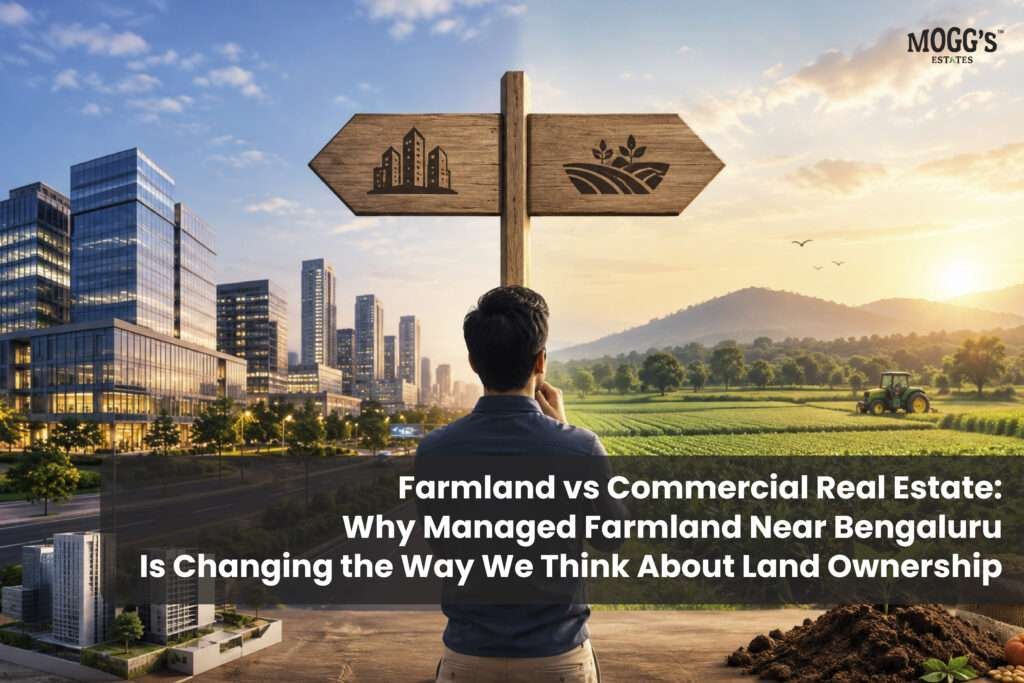
When people think about real estate investment, commercial buildings, office spaces and retail properties often come to mind. These assets are associated with rental income, business activity and urban development. But there is another category of land ownership that brings together agriculture, nature and long-term asset planning: managed farmland.
The comparison between farmland and commercial real estate is not simply about choosing one property over another. It is about understanding how each asset works, what responsibilities it involves and how it fits into an individual’s long-term goals.
With Bengaluru’s continued connection to business, infrastructure and expanding urban areas, interest in different forms of land ownership has created room for conversations around farmland and commercial property. However, both options have distinct characteristics, and their suitability depends on factors such as location, budget, management, intended use and risk tolerance.
So, farmland vs commercial real estate: what should you understand before choosing a property? Let’s explore the differences and the role of professional management in making land ownership more practical.
1. Understanding the Difference Between Farmland and Commercial Real Estate
Farmland is land primarily associated with agriculture, including cultivation, plantations and farming activities. Depending on the property, it may generate agricultural output, support environmental goals or serve as a long-term landholding.
Commercial real estate, on the other hand, includes properties designed for business-related activities. Examples include office buildings, retail spaces, warehouses and commercial complexes.
The primary distinction lies in the purpose of the asset.
Commercial real estate is often planned around business occupancy, rental arrangements or commercial operations. Farmland is connected to land use, agricultural activities and the management of natural resources.
Neither category follows the same ownership model. Understanding the differences helps prospective buyers assess an opportunity based on its actual characteristics rather than assumptions about returns.
2. Managed Farmland: More Than Owning Agricultural Land
Owning agricultural land can involve responsibilities such as crop selection, irrigation, maintenance, labour coordination and monitoring farm conditions. For people who live in cities or have demanding professional schedules, handling these activities independently may be difficult.
This is where [Managed Farmland] becomes relevant.
Managed farmland refers to agricultural land supported by professional management services. Depending on the provider and project, these services may include plantation maintenance, crop planning, irrigation management, site upkeep and regular updates.
Instead of leaving every operational decision to the landowner, a managed model establishes a system for maintaining and developing the farm.
For example, a landowner who lives in Bengaluru may not be able to visit a farm regularly. A professional management team can help coordinate essential activities while keeping the owner informed about the property’s progress.
However, the exact services differ between providers. Buyers should review the management agreement, agricultural plans and responsibilities before making a decision.
3. Commercial Real Estate and the Importance of Location
Commercial real estate is closely connected to business activity. A property’s location, accessibility, surrounding infrastructure, tenant demand and permitted use can influence its commercial prospects.
An office space near a business district may serve a different purpose from a warehouse located near a logistics corridor. Similarly, a retail property depends on factors such as customer access and the surrounding market.
For commercial property owners, management responsibilities may include maintenance, tenant coordination, lease administration and building-related expenses.
The ownership experience therefore depends not only on the building itself but also on how the property is operated.
Farmland has its own location-related considerations. Soil conditions, water availability, access roads, climate and agricultural suitability can be important. This means that location should be evaluated according to the intended use of the property.
4. Farmland Investment vs Commercial Property: How the Objectives Differ
The purpose of buying a property can influence the type of asset a person considers.
Commercial real estate may be purchased for business use, rental income or long-term ownership. The financial outcome can depend on occupancy, rent, operating expenses, financing costs and changes in market conditions.
Farmland investment may involve land ownership, agricultural activity, plantation development and the possibility of income from farm operations, depending on the project.
It is important to distinguish between land ownership and guaranteed returns. Farmland does not automatically generate a fixed income, and commercial property does not guarantee continuous occupancy or rental growth.
Before choosing an asset, prospective buyers should ask:
-
What is the primary purpose of the property?
-
How will the property be managed?
-
What costs will the owner be responsible for?
-
Are there documented income arrangements?
-
What legal and land-use requirements apply?
These questions help create a more realistic understanding of the investment.
5. Why Professional Farm Management Matters
Agriculture requires ongoing attention. Plant health, soil conditions, water availability and seasonal changes can influence farming operations.
For landowners who want to own agricultural property without handling every task personally, [Professional Farm Management] can provide an organised approach to maintenance and operations.
A management team may support activities such as:
-
Crop and plantation planning
-
Irrigation coordination
-
Farm maintenance
-
Monitoring agricultural progress
-
Managing farm-related labour
-
Providing updates to landowners
The scope of services depends on the project. A buyer should confirm whether the management covers agricultural operations, infrastructure maintenance, harvesting and other responsibilities.
This approach can be particularly relevant for people who want a connection to agriculture while maintaining their primary professional or personal commitments in Bengaluru.
6. Managed Farmland Near Bengaluru: Connecting Land and Lifestyle
Bengaluru’s surrounding regions include agricultural areas, plantations and developing infrastructure corridors. This creates different opportunities for people exploring land ownership outside the city.
However, proximity to Bengaluru alone does not establish the value or suitability of a farmland project. Buyers should evaluate accessibility, the surrounding environment, land documentation, agricultural plans and the services provided.
A [Managed Farmland Near Bangalore] project may appeal to someone looking for a combination of land ownership and access to nature. The experience can include visiting plantations, spending time outdoors and observing agricultural activities.
For some owners, this connection with the land may be part of a broader lifestyle preference. For others, agricultural productivity and land management may be the main focus.
The important point is that the property should be evaluated according to its actual features rather than relying solely on location-based expectations.
7. Agricultural Land Investment Requires Due Diligence
Before purchasing farmland, buyers should understand the legal status and permitted use of the land.
[Agricultural Land Investment] requires careful consideration of ownership documents, land classification, access, applicable restrictions and any development permissions relevant to the property.
Depending on the location and project structure, buyers may need to review documents such as the title records, encumbrance certificate and revenue records with qualified professionals.
The availability of amenities or farm infrastructure should also be assessed separately from the legal status of the land. Infrastructure claims, development plans and management commitments should be verified through appropriate documentation.
These steps are important for anyone considering land ownership, whether the property is marketed as a managed farm or as an agricultural holding.
8. Farmland and Commercial Real Estate Have Different Cost Structures
The total cost of ownership is an important part of property comparison.
For commercial real estate, expenses may include property taxes, maintenance, insurance, loan costs, vacancy periods and tenant-related expenses. The exact costs depend on the property and ownership arrangement.
Farmland can involve expenses associated with plantation development, irrigation, farm maintenance, labour, security and infrastructure. A managed project may include specific service charges or other contractual costs.
The purchase price alone does not explain the full financial commitment.
Before selecting a [Managed Farm], prospective owners should understand the initial purchase cost, recurring management charges and any additional expenses that may arise.
Similarly, buyers considering commercial property should assess operating costs and possible periods without rental income.
A clear cost assessment helps owners make decisions based on their actual financial capacity.
9. Comparing Farmland ROI With Commercial Property Returns
The phrase [Farmland ROI] is often used when discussing the potential financial performance of agricultural land. However, calculating returns requires more than looking at the property’s purchase price.
Possible farmland-related income may depend on agricultural output, crop prices, operational expenses and the terms of any management arrangement. These factors can vary from season to season.
Commercial real estate returns may depend on rental income, occupancy, operating expenses, property appreciation and financing costs.
The two asset categories should therefore be assessed using comparable financial information. A projected return is not the same as a guaranteed result.
Buyers should request documented assumptions, understand the risks and avoid making decisions based only on promotional estimates.
10. Choosing Between Farmland and Commercial Real Estate
The comparison between farmland and commercial real estate does not have a universal answer. Each asset category serves different purposes and involves different responsibilities.
Someone seeking a commercial space for business operations may focus on location, permitted use and tenant demand. Someone interested in agricultural land may prioritise soil conditions, farm management, land documentation and the agricultural plan.
For individuals exploring [Farmland Near Bangalore], it is useful to consider whether the property aligns with their intended use, time commitment and ownership expectations.
Likewise, people considering commercial property should understand the financial and operational responsibilities associated with the asset.
The decision should be based on documented information, personal circumstances and an understanding of the risks involved.
11. A More Informed Approach to Land Ownership
The discussion around farmland and commercial real estate reflects the variety of ways people can approach property ownership.
Farmland can connect owners with agriculture, plantation development and the natural environment. Commercial real estate can support business activities and property-based operations.
The value of professional management lies in the services and systems it provides. For farmland owners, effective management may help coordinate agricultural activities and maintain the property. The results depend on the quality of operations, project conditions and the agreed scope of services.
At Mogg’s Estates, the managed farmland model is positioned around agricultural land management and farm development. Prospective buyers should evaluate each project individually, including its land records, management commitments and financial considerations.
Land ownership is not only about acquiring a property. It is also about understanding how that property is used, maintained and managed over time.