
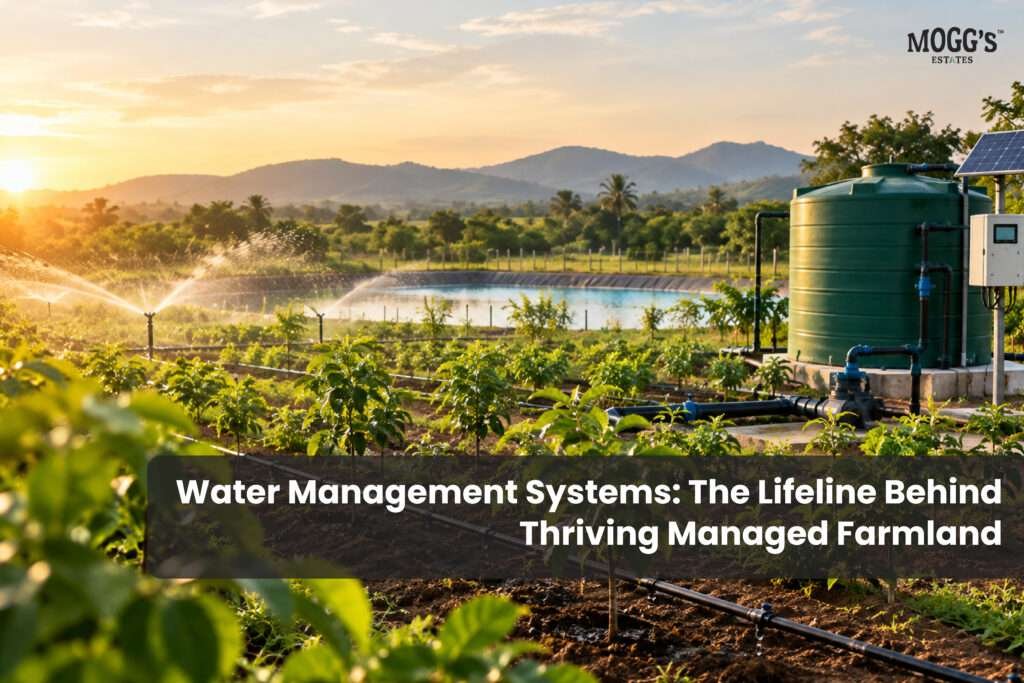
Water is one of the most important resources on any farm. It supports plant growth, keeps soil healthy, and plays a major role in maintaining productive agricultural land. But good farming is not simply about having enough water. It is about managing water efficiently.
For Managed Farmland, a well-planned water management system can make a significant difference. From irrigation and water storage to drainage and seasonal planning, every part of the system helps ensure that the farm receives the water it needs without unnecessary wastage.
As interest in farmland around Bengaluru continues to grow, understanding how water is managed can help buyers look beyond the land itself and understand what goes into caring for it.
Why Water Management Matters on a Farm
A farm depends on water throughout the year. However, the requirement is not always the same.
Young plants may need regular watering as they establish their roots. Mature trees may have different requirements. During the rainy season, drainage becomes important, while dry periods can increase the need for irrigation.
This makes water management an ongoing responsibility.
For people considering Farmland Investment, understanding the farm’s water infrastructure can be just as important as looking at its location, plantations, and surrounding environment.
A good system aims to:
- Deliver water where it is needed
- Reduce unnecessary water loss
- Maintain suitable soil moisture
- Support healthy plant growth
- Manage excess rainwater
- Improve the efficiency of farm operations
In short, effective water management helps the farm work with its natural environment rather than against it.
What Is a Water Management System?
A water management system is a combination of infrastructure, technology, and farming practices used to collect, store, distribute, monitor, and conserve water on agricultural land.
Depending on the farm, the system may include:
- Irrigation systems
- Water storage tanks
- Drip irrigation
- Sprinklers
- Rainwater harvesting
- Drainage systems
- Water pumps
- Pipelines
- Soil moisture monitoring
The right combination depends on factors such as the size of the property, soil type, crops or trees being grown, water availability, and local climate.
In a Managed Farm, these systems can form part of the larger agricultural management process, where water requirements are monitored along with plantation and soil health.
Drip Irrigation: Delivering Water Where It Matters
Drip irrigation is one of the commonly used methods for efficient agricultural watering.
Instead of distributing large amounts of water across an entire area, the system delivers water gradually near the root zone of plants.
This can help reduce unnecessary water loss and provide plants with a more controlled supply.
For plantations, orchards, and other agricultural crops, targeted irrigation can be especially useful because different plants may have different water requirements.
However, the effectiveness of any irrigation system depends on proper installation, maintenance, and monitoring.
Sprinkler Systems for Wider Coverage
Sprinkler irrigation distributes water through a network of pipes and sprinklers, creating a rainfall-like pattern over the agricultural area.
This can be useful where wider coverage is required.
Sprinklers can be used for certain crops, lawns, nurseries, and other areas depending on the farm’s requirements.
The choice between drip irrigation, sprinklers, or another irrigation method should be based on the type of plantation and the characteristics of the land.
Good Professional Farm Management considers these factors rather than applying the same irrigation method to every farm.
Water Storage: Preparing for Changing Conditions
Water availability can change with the seasons.
During periods of rainfall, farms may have opportunities to collect and store water for later use. During drier periods, stored water can support irrigation requirements, depending on the property’s water sources and infrastructure.
Water storage systems may include tanks, reservoirs, ponds, or other suitable structures.
Rainwater harvesting can also contribute to water conservation by capturing rainfall and directing it toward storage or groundwater recharge systems, where appropriate.
For Managed Farmland Near Bangalore, having a planned approach to water storage can be particularly valuable because agricultural requirements continue throughout changing weather conditions.
Rainwater Harvesting and Water Conservation
Rain does not have to be treated only as something that falls on the farm and flows away.
With suitable planning, rainwater can become a useful resource.
Rainwater harvesting systems can collect and direct rainfall for storage, recharge, or other appropriate uses.
The design depends on the land, rainfall pattern, soil, slope, and existing infrastructure.
Water conservation can also involve simpler practices such as reducing leaks, maintaining irrigation lines, avoiding unnecessary watering, and monitoring soil moisture.
The goal is to use available water responsibly while supporting the needs of the farm.
Soil and Water Work Together
Water management cannot be separated from soil management.
Healthy soil can influence how water moves through the land. Soil structure, organic matter, drainage, and moisture retention can all affect plant growth.
If soil becomes excessively dry, plants may experience water stress. If water remains stagnant for too long, roots may also be affected.
This is why Agricultural Land Investment should be viewed from more than a location or ownership perspective. Understanding how the land is cared for can provide a better picture of its long-term agricultural environment.
Drainage Is Just as Important as Irrigation
When talking about farm water systems, irrigation often receives the most attention.
But drainage is equally important.
During heavy rainfall, excess water needs to move away from areas where it could damage plants, soil, pathways, or infrastructure.
A suitable drainage system can help manage surface water and reduce waterlogging in areas where it may become a problem.
This highlights an important principle of farm management:
Good water management is about controlling both water supply and excess water.
Water Management Around Bengaluru
The agricultural areas surrounding Bengaluru have different landscapes and farming conditions.
Places such as Kanakapura, Hoskote, Maddur, and Kunigal have their own local characteristics, including differences in soil, rainfall, vegetation, and agricultural activity.
Because of this, water management should be planned according to the specific property.
A system that works well for one farm may not necessarily be suitable for another.
For anyone looking at Farmland Near Bangalore, understanding the property’s water sources, irrigation system, drainage, and maintenance approach can provide useful insight into how the farm is managed.
How Professional Farm Management Supports Water Management
A water system is only useful when it is properly maintained.
Pipes can develop leaks. Pumps can require servicing. Irrigation equipment can become blocked. Storage systems need inspection. Seasonal conditions can change water requirements.
This is where Professional Farm Management becomes important.
A professional team can monitor the farm, identify maintenance requirements, coordinate agricultural activities, and adjust routine practices according to the needs of the land.
For owners who may not be able to visit their farmland regularly, this can make ongoing management more organised.
Technology Can Make Water Management Smarter
Modern agriculture can use technology to understand water requirements more effectively.
Depending on the farm, tools such as soil moisture sensors, automated irrigation systems, weather monitoring, and water-level monitoring can support better decision-making.
These technologies do not replace agricultural knowledge. Instead, they can provide useful information that helps management teams make more informed decisions.
The objective is simple:
Use the right amount of water, at the right time, in the right place.
What Should You Check Before Buying Managed Farmland?
If you are considering Farmland Investment Near Bangalore, water management is one area worth discussing before making a decision.
Ask questions such as:
- What is the primary water source?
- Is irrigation available across the property?
- What type of irrigation system is used?
- Is there water storage?
- How is rainwater managed?
- How is excess water drained?
- Who maintains the irrigation infrastructure?
- How are seasonal water requirements handled?
- Is water usage monitored?
These questions can help you understand the practical side of owning agricultural land.
Water Management and Long-Term Farm Care
A successful farm is built through consistent care.
Water management supports plant health. Soil management supports root development. Regular plantation care helps trees grow. Infrastructure maintenance keeps the property functional.
All these activities work together.
For a Managed Farm, water management is therefore not an isolated service. It is one part of a larger system of agricultural care.
When irrigation, soil, plantations, drainage, and maintenance are managed together, the farm can be cared for in a more structured way.
The Real Value of Managing Every Drop
Water may seem like a basic part of farming, but how it is managed can influence almost every aspect of agricultural activity.
A farm needs enough water to support its plants, but it also needs systems that prevent unnecessary loss and manage excess rainfall.
For people exploring Farm Land Investment, understanding these systems offers a different perspective on farmland ownership.
The value of agricultural land is not only about where it is located. It is also about how the land is cared for over time.
With the right systems and consistent management, every drop of water can play a meaningful role in supporting a healthier farm.
And that is what effective water management is really about:
Not simply using water, but managing it wisely so the land can continue to thrive.