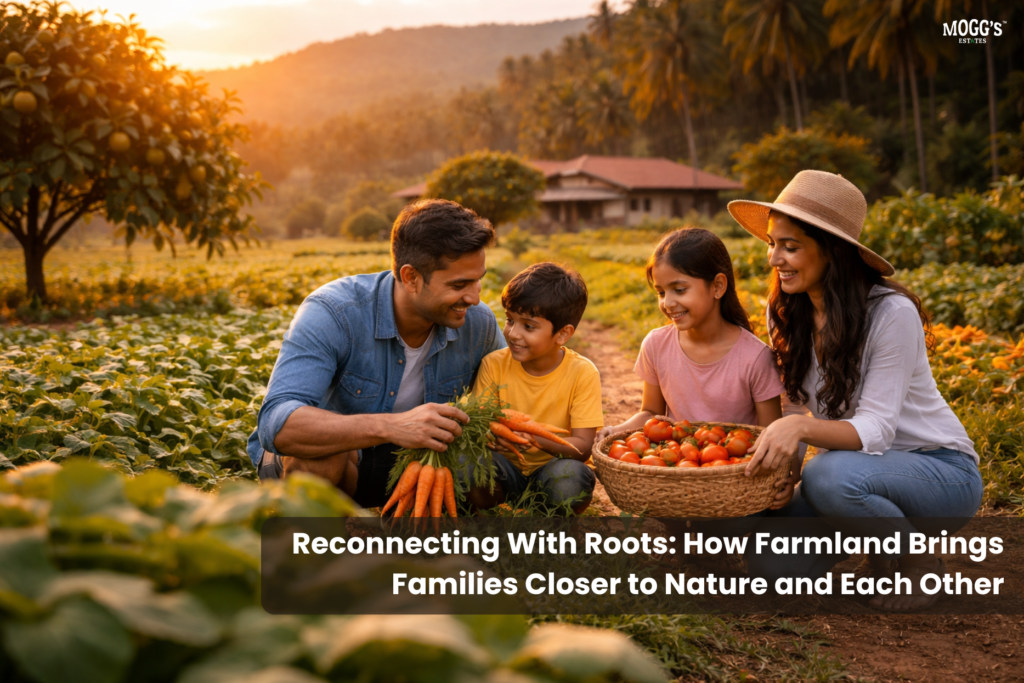
On a quiet Sunday morning, far away from the rush of Bangalore’s traffic and the constant buzz of notifications, the Sharma family stood barefoot on a patch of soft soil. The air felt different, cool, fresh, and calm. There were no honking cars, no screens demanding attention, no rush to be anywhere. Just open land, gentle breeze, and the sound of birds echoing across rows of young trees.
For them, this wasn’t just a weekend getaway.
It was the beginning of a reconnection.
Like many urban families, the Sharmas had spent years building a life in the city. Their weekdays were structured around work, school schedules, and endless responsibilities. Conversations often happened in between tasks, and family time felt limited to short dinners or occasional outings.
Somewhere along the way, they realized something important: while they were growing financially, they were drifting emotionally.
That realization led them to explore something unexpected: farmland near Bangalore.
At first, it was simply about investment. They wanted to diversify beyond apartments and traditional financial options. But when they discovered the concept of managed farmland, it opened up a completely new perspective.
Managed farmland enabled them to own agricultural land without worrying about the complexities of farming. Professional teams would handle everything, from planting and irrigation to maintenance and harvesting. Companies like Mogg’s Estates were creating structured farmland projects designed specifically for urban investors.
But what truly drew them in wasn’t just the convenience.
It was the experience.
The first time they visited a premium managed farmland near Bangalore, something shifted. Their children, Aarav and Meera, who were used to screens and indoor activities, suddenly found themselves excited about running through open spaces. They picked up soil, asked questions about trees, and watched insects with curiosity.
For the parents, it was a rare moment.
A moment where time slowed down.
A moment where conversations felt natural.
A moment where family felt… present.
That is the quiet power of farmland.
In today’s fast-paced world, nature often becomes distant. Urban life, while convenient, can create a disconnect from the environment, from simple living, and sometimes even from each other. Farmland offers a way back.
It offers space.
It offers stillness.
It offers connection.
As the Sharma family continued visiting their land, weekends began to change. Instead of malls or crowded restaurants, they chose mornings at the farm. They walked along pathways between growing trees, watched irrigation systems gently water the soil, and spent time together.
There was no agenda.
No rush.
Just presence.
This is one of the most underrated benefits of managed farmland; it is not just an investment in land, but an investment in lifestyle.
At projects developed by Mogg’s Estates, farmland is thoughtfully designed to support both agricultural productivity and human experience. While the farms are professionally managed to ensure growth and yield, they are also accessible for families to visit, explore, and enjoy.
This dual purpose creates a unique balance.
On one side, there is financial growth through land appreciation and crop cycles.
On the other hand, there is emotional growth through experiences and memories.
Over time, the Sharmas began to notice bigger changes.
Their children became more curious about nature. They started asking where fruits come from, how trees grow, and why seasons change. Simple visits to the farm turned into learning experiences. Without realizing it, they were developing an understanding of the natural world that no textbook could fully teach.
For the parents, farmland became a place to pause.
A place to reflect.
A place to reconnect, not just with nature, but with themselves.
This is why many families today are exploring the best farmland near Bangalore. It is not just about owning land; it is about creating a space where relationships can grow alongside trees.
Because in a farmland, growth is visible.
You plant a sapling today, and over time, you watch it become a tree.
You nurture the soil, and it begins to give back.
You spend time with your family, and the bond deepens naturally.
This parallel between nature and relationships is what makes farmland so meaningful.
And yet, many people hesitate.
They assume farmland requires constant effort, knowledge of agriculture, or long-term involvement. This is where premium managed farmland changes the narrative.
With expert teams handling operations, investors can enjoy the benefits without the burden. The land is professionally maintained, crops are planned strategically, and resources such as water and soil are managed sustainably.
For families like the Sharmas, this meant freedom.
Freedom to experience farmland without worrying about its management.
Freedom to visit when they wanted.
Freedom to let the land grow, just like their memories.
Another important aspect of farmland is its role in sustainability.
In a time when environmental concerns are growing, owning farmland is not just a personal decision; it is a responsible one. Trees planted on farmland contribute to better air quality, improved biodiversity, and healthier ecosystems.
Every visit to the farm reminded the Sharmas that they were part of something larger.
They were not just consuming resources; they were contributing to them.
This sense of responsibility added a deeper layer of meaning to their investment.
It was no longer just about returns.
It was about impact.
Over the years, their one-acre plot transformed. What started as open land slowly became a green space filled with growing trees. The soil became richer. The farm became more vibrant.
And their connection to it grew stronger.
Family gatherings started happening there. Celebrations felt more meaningful in open spaces than in closed halls. Even quiet afternoons, spent doing nothing, felt valuable.
Because sometimes, doing nothing in the right place is everything.
This is the beauty of farmland near Bangalore: an escape without being too far. It allows families to step out of the city without disconnecting completely. It creates a bridge between urban life and a natural way of living.
For many investors, this balance is exactly what they are looking for.
And with trusted developers like Mogg’s Estates, accessing such opportunities has become easier and more structured.
Their projects focus on creating farmland that is not just productive, but also sustainable and accessible. By combining modern agricultural practices with thoughtful planning, they ensure that investors receive both value and experience.
For the Sharma family, this journey has been transformative.
What began as an investment decision turned into a lifestyle change.
What started as curiosity became commitment.
What felt like land became home.
Today, when they stand on their farmland, they no longer see just trees or crops.
They see memories.
They see conversations.
They see laughter carried by the wind.
They see a space where they truly belong.
In a world that is constantly moving forward, farmland offers a chance to look back, to reconnect with roots, values, and relationships that matter most.
It reminds us that growth is not only about financial success.
It is about connection.
Connection to nature.
Family connection.
Connection to life itself.
And sometimes, all it takes to rediscover that connection… is a single acre of land.