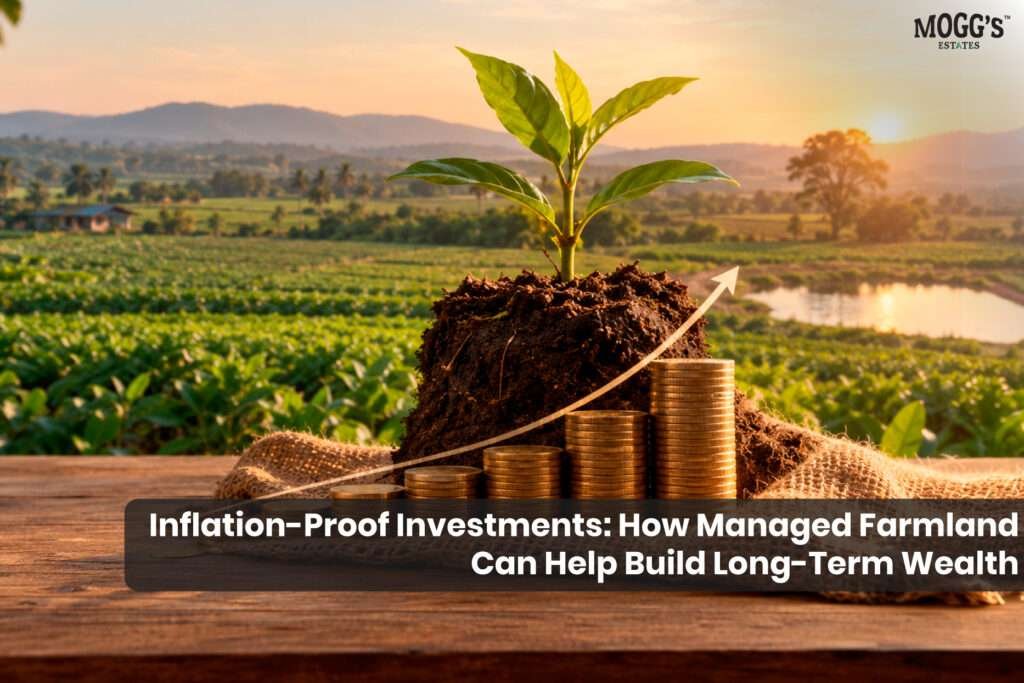
Inflation changes the value of money over time. As the cost of goods, services, housing, and everyday essentials increases, the purchasing power of money can gradually decline. This is why many people look beyond traditional savings and explore assets that may support long-term wealth creation.
Among different real assets, land continues to attract attention because it is tangible, limited, and capable of supporting productive activities. Agricultural land, in particular, combines land ownership with farming potential.
For investors exploring Farmland investment, managed farmland offers an organised approach to owning agricultural land while professional teams take care of farming and maintenance activities. However, no investment is completely protected from inflation or market risk. The right approach is to understand how the asset works, what influences its value, and whether it fits your long-term financial goals.
What Are Inflation-Proof Investments?
Inflation-proof investments are generally understood as investments that may help preserve purchasing power when prices increase. It is important to remember that no investment can guarantee protection against inflation.
When inflation rises, simply keeping money in a low-growth asset may reduce its purchasing power over time. Investors therefore often consider a mix of assets, including equities, real estate, commodities, and productive land.
Agricultural land can be part of this broader conversation because it is a physical asset connected to an essential economic activity: agriculture. Food demand continues to create a fundamental need for productive agricultural resources.
However, the performance of farmland depends on several factors, including location, soil quality, water availability, agricultural productivity, infrastructure, market demand, and management.
Why Consider Farmland as an Investment?
Land is different from many financial assets because it is a physical resource with a defined location. It can be used for agriculture, plantations, and other permitted activities depending on its classification and applicable regulations.
For individuals considering Agricultural land investment, the appeal can come from the combination of tangible ownership and productive use.
Farmland can potentially generate value in two ways. The first is through agricultural activity, where crops or plantations may produce income. The second is through possible appreciation in the value of the underlying land over a longer period.
These possibilities should not be viewed as guaranteed returns. Agricultural income can change because of weather, crop prices, input costs, water availability, and other operating conditions. Similarly, land appreciation depends on local demand, infrastructure, development, and market conditions.
This makes research particularly important when evaluating Farmland investment opportunities.
How Managed Farmland Changes the Ownership Experience
Owning agricultural land can involve much more than purchasing a piece of property. Farming requires regular attention to irrigation, plantation maintenance, soil health, crop planning, labour, infrastructure, and security.
For people who want farmland ownership without handling every agricultural activity themselves, managed farmland provides an alternative model.
A professionally managed farmland project may include services such as plantation management, irrigation support, farm maintenance, infrastructure upkeep, security, and regular monitoring.
This approach can make Farm investment more structured for owners who may not have the time or agricultural expertise required to manage a property independently.
At Mogg’s Estates, the managed farmland model focuses on professionally managing agricultural land so that landowners can participate in farmland ownership while the farming and maintenance activities are handled through an organised management system.
Before purchasing, however, investors should understand exactly what the management agreement covers, what costs apply, and what responsibilities remain with the landowner.
Can Farmland Help During Inflation?
The relationship between farmland and inflation is not straightforward. Land values can respond to economic conditions, while agricultural products are influenced by food demand, production costs, and market prices.
This is one reason some investors consider Farm land investment when building a diversified long-term portfolio.
Agricultural land is a real asset, but its performance can vary significantly from one property to another. A well-located property with suitable soil, reliable water, good accessibility, and professional management may have different prospects from land without these advantages.
Therefore, investors should avoid treating farmland as a guaranteed inflation hedge. Instead, it can be evaluated as one component of a diversified strategy.
Understanding Farmland Investment Returns
Returns from farmland can come from different sources. Depending on the project structure, these may include agricultural income, potential appreciation in land value, or both.
Investors researching Farmland investment returns should look at the complete financial picture rather than focusing only on an estimated future value.
Purchase price, registration expenses, management fees, agricultural expenses, taxes, maintenance costs, and potential selling costs can all affect the actual outcome.
Understanding Farmland ROI therefore requires more than looking at a percentage mentioned in a project presentation. Investors should understand how the figure was calculated, what assumptions were used, and whether the return is projected or contractually defined.
Similarly, Agricultural land ROI can vary depending on crop performance, land appreciation, operating expenses, and the investment period.
A simple ROI calculation is:
ROI = (Net Gain ÷ Total Investment Cost) × 100
For example, if an investment produces a net gain of ₹5 lakh on a total investment of ₹25 lakh, the simple ROI would be 20%. This is only an illustration and should not be interpreted as an expected return from farmland.
Is Farmland a Good Investment?
The answer to Is farmland a good investment depends on the property, the investment structure, and the investor’s objectives.
Farmland may suit investors who are comfortable with a longer holding period and value tangible asset ownership. It can also provide an opportunity to participate in agriculture without necessarily managing a farm independently, when a professional management structure is in place.
Some potential Benefits of farmland investment include tangible ownership, diversification, agricultural productivity, and the possibility of long-term appreciation.
At the same time, farmland has limitations. It can be less liquid than some financial investments, and selling land may take time. Agricultural operations can also face weather risks, changing crop prices, water challenges, and rising input costs.
Understanding both the opportunities and limitations is essential before considering Investing in farmland.
Investing in Agricultural Land for the Long Term
A long-term approach can be particularly relevant when considering land because property value and agricultural development may take time.
Investing in agricultural land requires careful due diligence. Investors should examine ownership records, land classification, access roads, water availability, surrounding development, soil conditions, and applicable approvals.
The management structure should also be clearly understood. Investors should know who handles agricultural operations and how maintenance is carried out.
For people considering Long-term farmland investment, the objective should be to understand the asset rather than make decisions based solely on short-term market expectations.
A long-term holding period may also provide more time for agricultural activities and infrastructure development to contribute to the property’s overall potential, although future outcomes cannot be guaranteed.
Exploring Passive Farmland Investment
One of the challenges of owning agricultural property independently is the time required for regular management.
Passive farmland investment can appeal to individuals who want exposure to farmland ownership while relying on professional teams for day-to-day agricultural activities.
The level of involvement depends on the project and management agreement. Investors should therefore ask clear questions about what is included.
For example, does the management team handle plantation maintenance? Who manages irrigation? How often are updates provided? What happens if crops underperform? Are management charges included in the initial cost?
These questions are important for anyone considering Income generating farmland.
Agricultural income should never be assumed simply because a property is classified as farmland. Actual income depends on agricultural performance, operating costs, market conditions, and the terms of the project.
Evaluating Farm Investment Returns Carefully
When evaluating Farm investment returns, investors should separate projected figures from guaranteed income.
A farmland project may present an estimated return based on assumptions about crop productivity or land appreciation. Those assumptions should be examined carefully.
The Return on farmland investment can also depend on the holding period. A particular percentage return over ten years is very different from the same percentage earned over two years.
Investors should therefore consider annualised returns, total costs, potential income, and liquidity before comparing farmland with other asset classes.
What Makes Farmland Worth Considering?
For many investors, the appeal of farmland goes beyond financial calculations.
Land connects ownership with something tangible. Agriculture connects that land with food production, nature, and long-term resource management.
For individuals searching for Farmland for investment, the focus should be on finding a property with sound fundamentals rather than simply chasing projected returns.
Location, accessibility, documentation, water resources, soil quality, management, infrastructure, and long-term demand all deserve attention.
A professionally managed model can further simplify ownership by bringing agricultural expertise and regular farm maintenance into the ownership experience.
Building a Thoughtful Farmland Investment Strategy
Inflation is one reason investors think carefully about where they place their money. While no asset can completely eliminate inflation risk, tangible assets such as agricultural land can form part of a diversified long-term strategy.
Investing in farmland should always begin with research. Understand the property, verify the documentation, study the management structure, evaluate the costs, and consider the investment horizon.
Managed farmland brings together land ownership and professional agricultural management, offering an organised approach for people who want to participate in farmland ownership without taking on every day-to-day farming responsibility themselves.
Ultimately, Farmland as an investment should be considered based on its individual fundamentals, the investor’s financial objectives, and the risks involved.
For those exploring Agricultural investment, farmland can be a meaningful asset to research as part of a broader portfolio. The key is not simply to look for an asset that promises protection from inflation, but to understand how the asset creates value over time.
A thoughtful approach to farmland begins with one simple principle: understand the land, understand the management, understand the numbers, and then make an informed long-term decision.